Sub-Synchronous Control Interaction (SSCI) in IBR-Dominated Grids
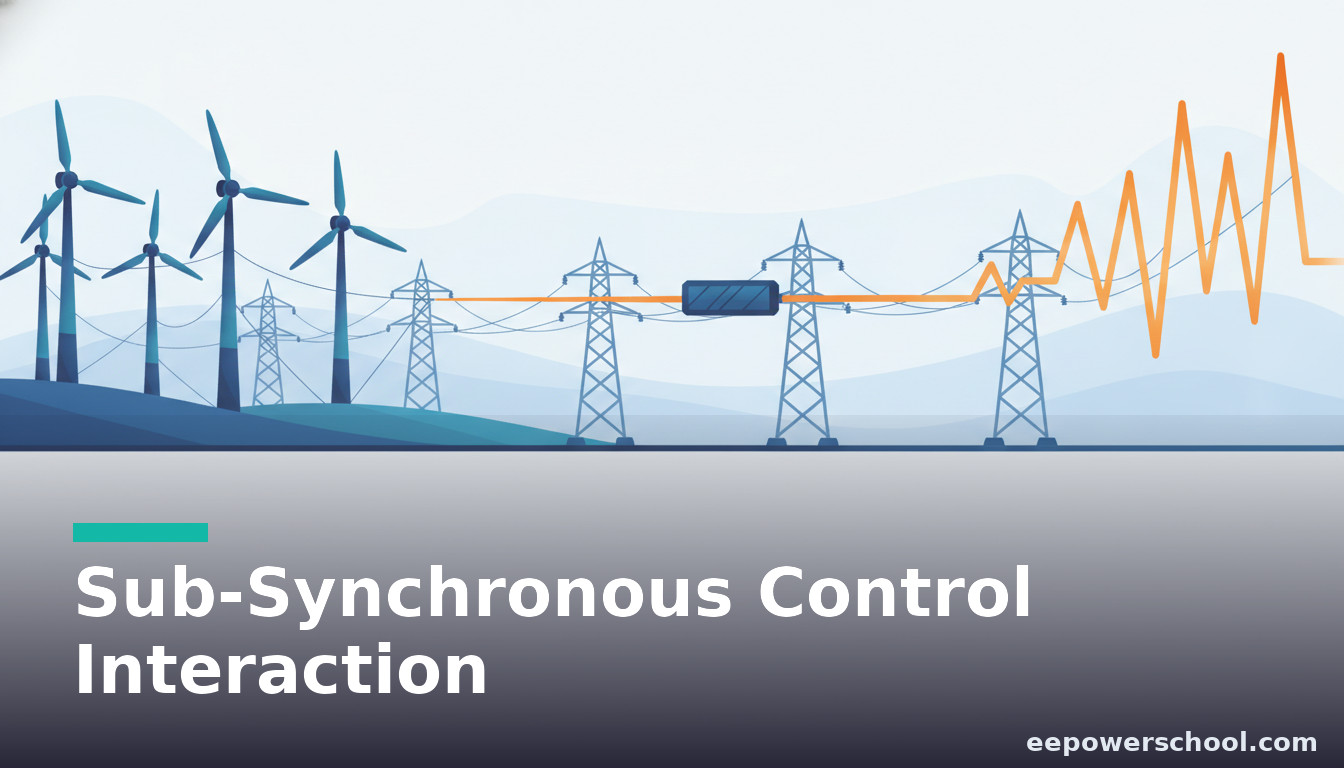
Some of the most expensive surprises in modern grids are oscillations nobody designed for. A wind farm and a transmission line, each perfectly healthy on its own, can connect and within milliseconds build a violent, growing oscillation that damages converters and capacitors. That phenomenon is sub-synchronous control interaction, or SSCI, and it is one of the signature failure modes of the inverter age.
This article explains what sub-synchronous control interaction is, how it differs from the classic sub-synchronous resonance engineers have known for decades, the real event that put it on the map, and why it can only be caught with the right kind of simulation. We finish with how it is screened for and mitigated.
What Sub-Synchronous Control Interaction Is
Sub-synchronous control interaction is an unstable electrical oscillation, at a frequency below the system fundamental, that arises from the interaction between the fast controls of an inverter-based resource and a resonant element in the network, typically a series-compensated line.
The word that matters is control. Unlike older sub-synchronous problems rooted in mechanical shafts, sub-synchronous control interaction is driven by the converter’s control loops exchanging energy with the network’s electrical resonance. There is no rotating mass in the loop at all, which is precisely why it is fast, and why it took the industry by surprise.
The Family: SSR, SSTI, and SSCI
Sub-synchronous phenomena form a small family, and keeping them straight avoids confusion:
- SSR (sub-synchronous resonance): the classic problem, where a series-compensated line resonance interacts with a turbine-generator’s torsional shaft modes.
- SSTI (sub-synchronous torsional interaction): torsional shaft modes excited by fast controls such as HVDC or FACTS.
- SSCI (sub-synchronous control interaction): purely electrical, between inverter controls and a series-compensated line, with no torsional mass required.
SSCI is the newest and, in inverter-heavy grids, the most relevant, because it needs only power electronics and series compensation to occur.
The Mechanism: Control Meets Resonance
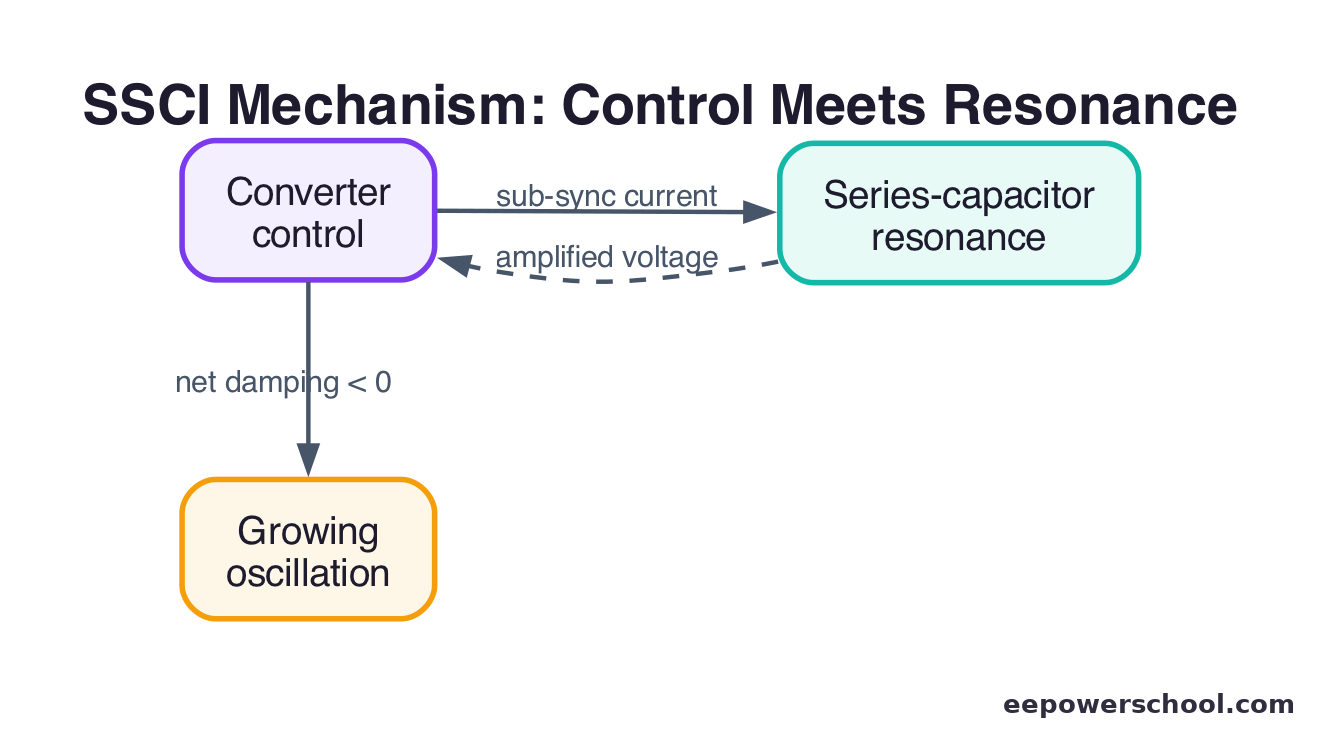
A series-compensated line has an electrical resonance at a sub-synchronous frequency set by the line inductance and the series capacitor. If a nearby converter’s control loops respond to disturbances at that frequency in a way that reinforces rather than opposes them, the combined system has net negative damping: any small oscillation at the resonant frequency grows instead of decaying.
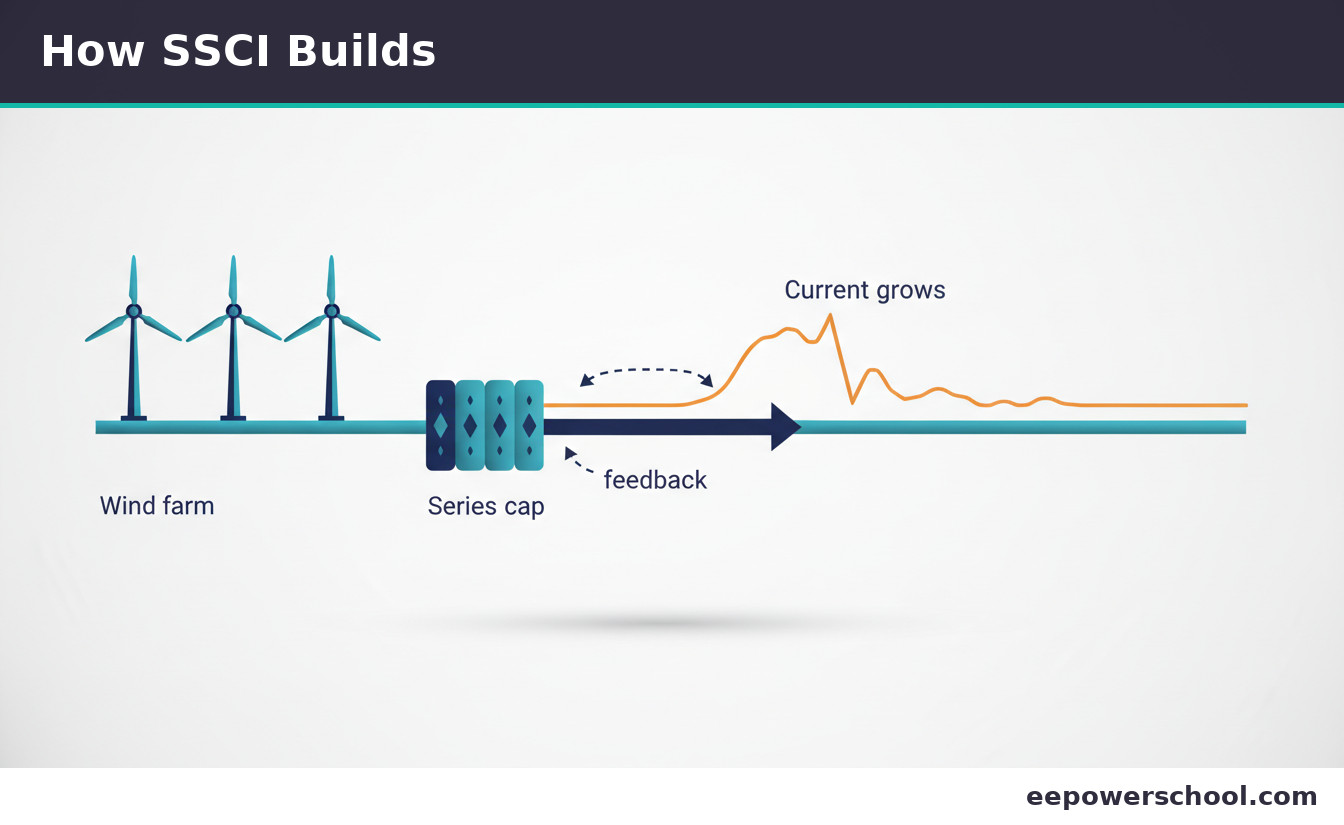
The converter injects current at the sub-synchronous frequency, the resonant network amplifies it into a voltage that feeds back to the converter, and the control loop responds in phase to push it harder. The loop closes on itself, and the oscillation builds rapidly, as the diagram below illustrates.
The Event That Put SSCI on the Map
The defining case occurred in the ERCOT system in Texas in 2009. After a fault tripped a 345 kV line, a wind plant of doubly-fed induction generators was left radially connected to the grid through a 50% series-compensated line. The interaction between the wind turbines’ converter controls and the series-capacitor resonance excited a fast, undamped sub-synchronous oscillation that damaged turbine converter equipment and series-capacitor components.
Crucially, the wind farm and the line were each individually compliant; the instability emerged only from their interaction in that radial configuration. That event made sub-synchronous control interaction a mandatory screening item near series compensation, not a theoretical curiosity.
Why SSCI Differs from Classic SSR
Classic SSR has a fixed set of frequencies, the torsional natural modes of the machine shaft. Sub-synchronous control interaction does not. Because its frequency is set by the interaction of control parameters and network resonance, it shifts with operating conditions: wind speed, the number of turbines online, the control settings, and the level of series compensation.
That moving target makes SSCI harder to anticipate with classical fixed-frequency methods, and it means a mitigation tuned for one operating point may not protect another. The oscillation can also build extremely fast, leaving little time for slow protection to act, so prevention by design matters more than detection after the fact.
Why It Needs EMT, Not RMS
Phasor (RMS) stability tools assume balanced, fundamental-frequency behaviour and cannot represent the fast, sub-synchronous control dynamics that drive SSCI. Studying it requires electromagnetic-transient (EMT) simulation, which resolves the actual waveforms and the converter control loops in detail.
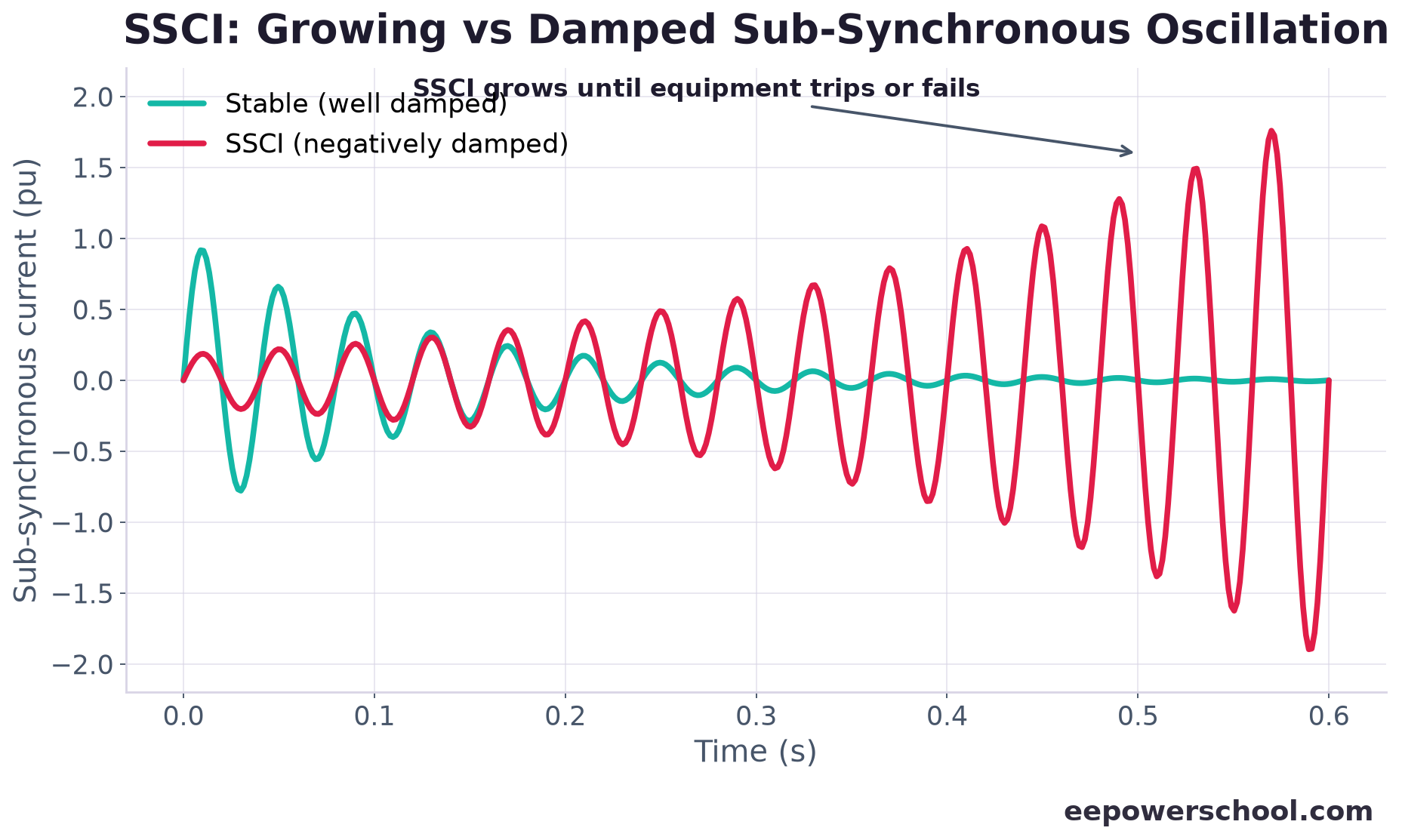
This is a textbook example of why the modelling choice matters: an RMS study of the same wind farm and line would show nothing wrong, while an EMT study reveals the growing oscillation. The chart below contrasts a well-damped response with the negatively damped one that defines SSCI.
Screening and Mitigation
Managing sub-synchronous control interaction combines analysis and engineering:
- Impedance-based screening scans the converter and network impedances for frequencies where their interaction implies negative damping.
- Control retuning reshapes the converter’s response so it adds, rather than removes, damping at the resonant frequency.
- Sub-synchronous damping controllers (SSDC) add a supplementary control loop that actively damps the oscillation.
- Network measures such as bypassing or relocating series capacitors, or using FACTS devices, change or remove the resonance.
Increasingly, vendors must supply accurate EMT converter models so the interaction can be studied before connection, rather than discovered in service.
Designing SSCI Out
The durable answer is to design sub-synchronous control interaction out at the planning stage. Where inverter-based resources connect near series compensation, EMT studies with validated manufacturer models are now standard, and grid codes increasingly require demonstrating stable behaviour across the full range of operating conditions, not just one.
Done well, the control is retuned or a damping controller is added before energization, and the plant rides through the configurations that would otherwise trigger an oscillation. SSCI is a solved problem in principle; the discipline is in studying it thoroughly enough, with the right tools, before the breaker closes.
Frequently Asked Questions
What is sub-synchronous control interaction (SSCI)?
It is an unstable electrical oscillation below the system fundamental frequency, caused by the interaction between an inverter-based resource's fast control loops and a network resonance, usually a series-compensated line. Unlike classic sub-synchronous resonance, it involves no mechanical shaft, so it is purely electrical and fast.
How is SSCI different from sub-synchronous resonance (SSR)?
Classic SSR involves the torsional modes of a machine shaft at fixed frequencies. SSCI is purely a control-versus-network electrical interaction with no torsional mass, and its frequency shifts with operating conditions such as wind speed, number of turbines, control settings, and series-compensation level.
What causes SSCI to grow?
Net negative damping at the line's sub-synchronous resonant frequency. The converter injects current at that frequency, the series-compensated line amplifies it into a voltage, and the control loop responds in phase, reinforcing the oscillation so it builds instead of decaying.
Why can't RMS simulation detect SSCI?
Phasor (RMS) tools assume balanced, fundamental-frequency behaviour and cannot represent the fast sub-synchronous control dynamics that drive SSCI. It must be studied with electromagnetic-transient (EMT) simulation, which resolves the actual waveforms and the converter control loops.
How is SSCI mitigated?
Through impedance-based screening, retuning the converter controls to add damping, adding sub-synchronous damping controllers, and network measures such as bypassing or relocating series capacitors or using FACTS devices. Validated EMT models let engineers design it out before connection.
Related reading
- Inverter-based resources: the future of renewable energy
- Inverter basics: classification and applications
- Grid inertia 101: frequency dynamics and the modern grid
- Electrical Engineering Formula Cheat Sheet (power systems quick reference)
References
- ERCOT experience with sub-synchronous control interaction and proposed remediation (IEEE)
- Analysis of subsynchronous control interactions in DFIG-based wind farms: ERCOT case study (IEEE)
- Hatziargyriou et al. (2021), Definition and Classification of Power System Stability – Revisited & Extended (IEEE)