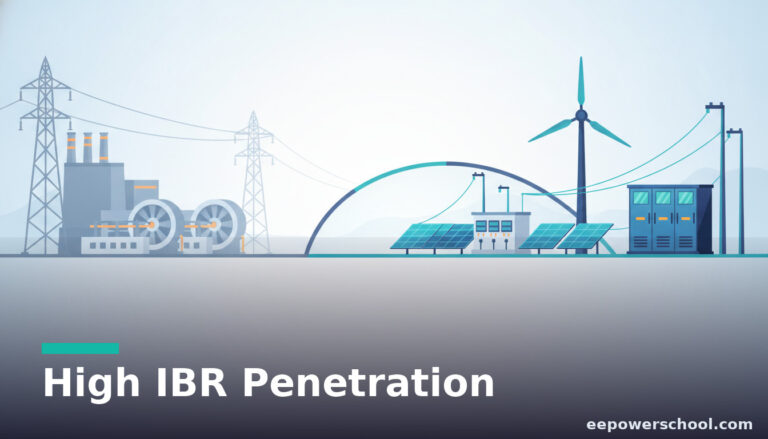
What Is Grid Strength? Short-Circuit Ratio and Weak Grids, Explained
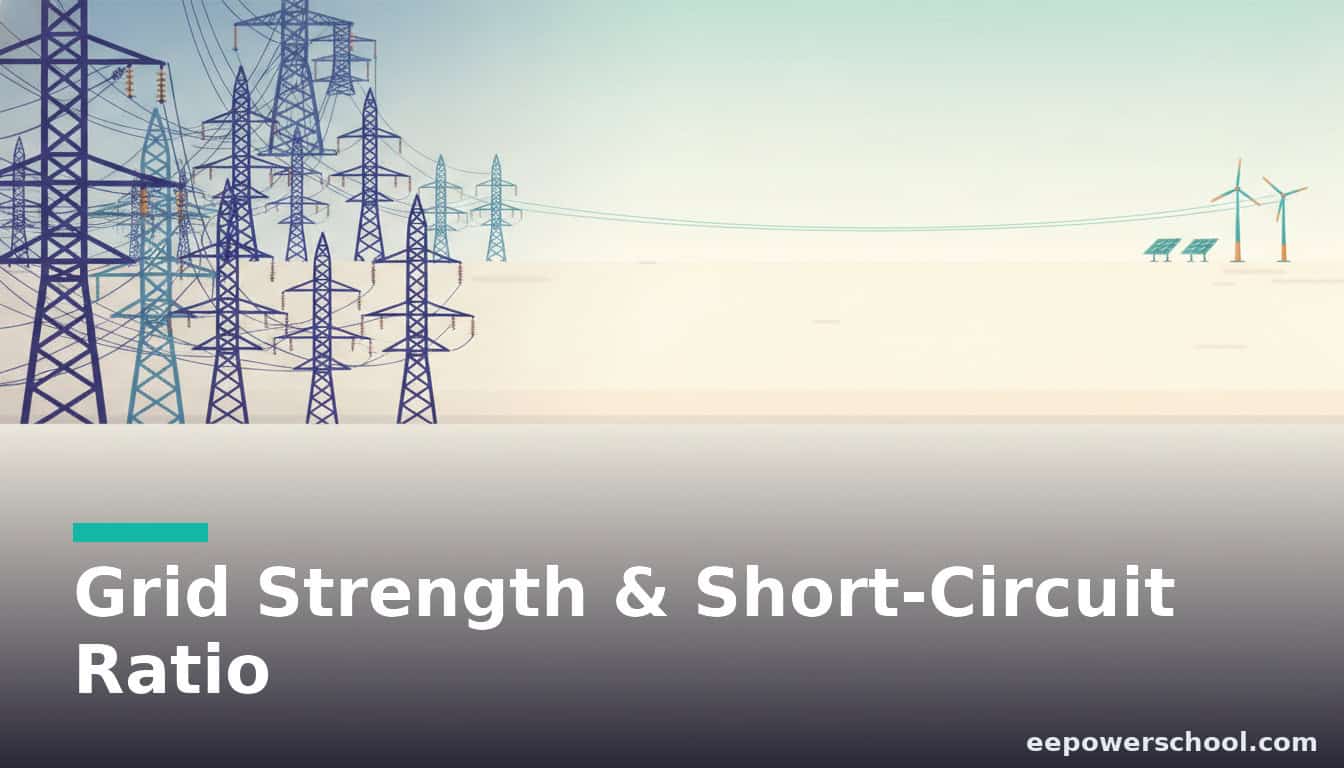
Ask two power engineers what limits how much solar or wind a region can connect, and inertia usually comes up first. But there is a second limit that bites earlier and is far less understood: grid strength. It is the reason a perfectly healthy inverter can pass every factory test and still oscillate, trip, or refuse to ride through a fault once it is plugged into a real network.
This article explains what grid strength actually is, how the short-circuit ratio (SCR) puts a number on it, why a “weak” grid destabilises inverter-based resources, and how operators measure and fix it. We will keep the physics intuitive and finish with a worked SCR calculation you can reuse.
What Grid Strength Actually Means
Grid strength is, loosely, how stiff the voltage is at a given point in the network. A strong point holds its voltage magnitude and angle almost unchanged when you inject or withdraw current; a weak point lets the voltage swing around in response to the same disturbance.
The Australian operator AEMO defines system strength as the ability of the power system to maintain and control the voltage waveform at any given location, both in steady state and following a disturbance. That phrase “control the voltage waveform” is the key: a strong grid imposes a clean, stable reference that connected equipment can lock onto, while a weak grid does not. Crucially, grid strength is a local property: the same network can be strong near a large conventional power station and weak at the far end of a long radial line.
Short-Circuit Ratio: Putting a Number on Grid Strength
The most common metric for grid strength is the short-circuit ratio (SCR). For a single connecting plant it is simply:
SCR = (three-phase fault level at the connection point, in MVA) ÷ (rated power of the plant, in MW)
The numerator, the fault level (or available fault current), is how much current the surrounding network would dump into a bolted three-phase fault at that bus. A big, well-meshed network with lots of nearby synchronous machines has a high fault level; a remote connection point fed by a long line has a low one.
As a rough industry heuristic, an SCR above about 3 is comfortable, between 2 and 3 is marginal, and below 2 is genuinely weak and usually needs remediation. These are not hard physical constants, they are rules of thumb, and the real threshold depends on the specific inverter controls involved.
Why a Weak Grid Is 'Weak': The Thevenin View
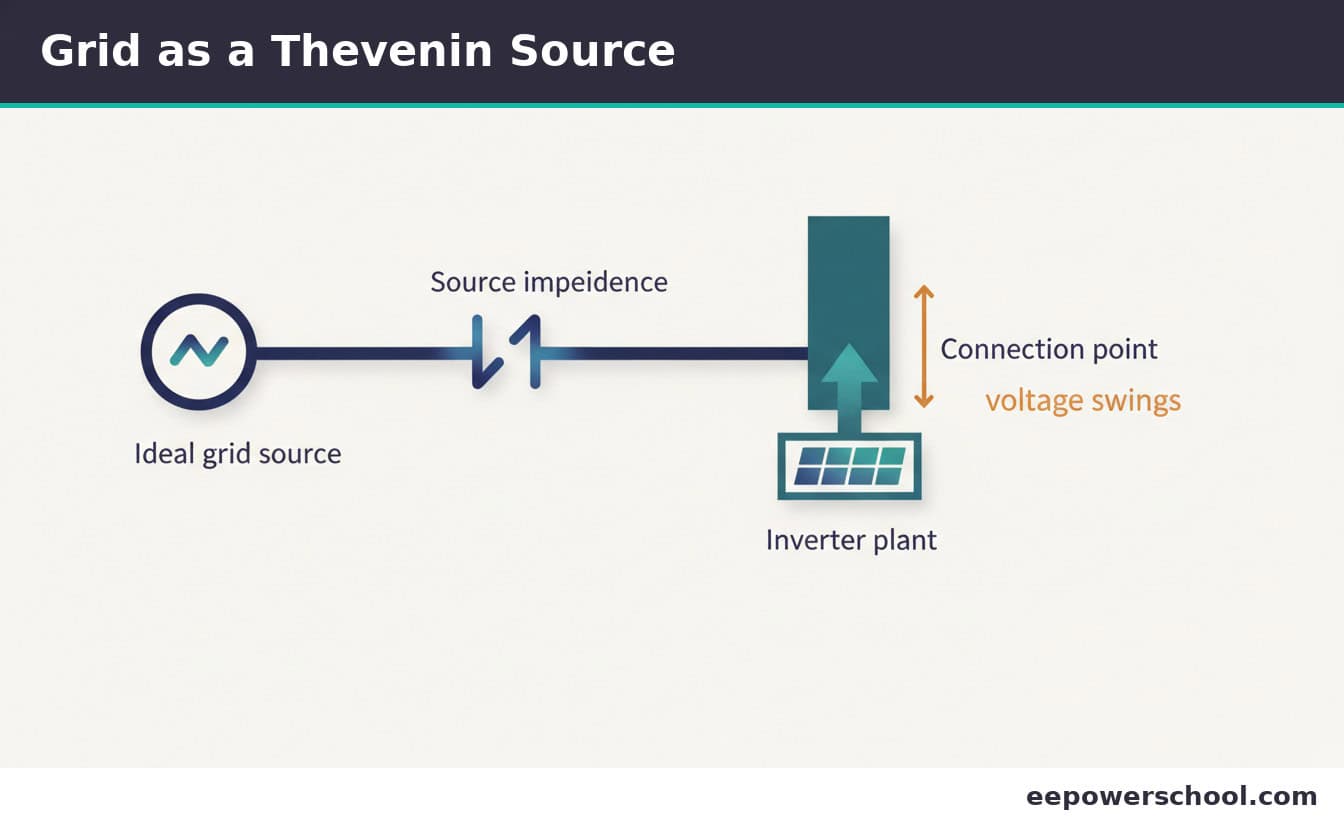
The cleanest way to see grid strength is to replace everything behind the connection point with its Thevenin equivalent: an ideal voltage source behind a single series impedance, Zth. The fault level is set almost entirely by that impedance, fault level ≈ V² / Zth, so a high impedance means a low fault level and a weak grid.
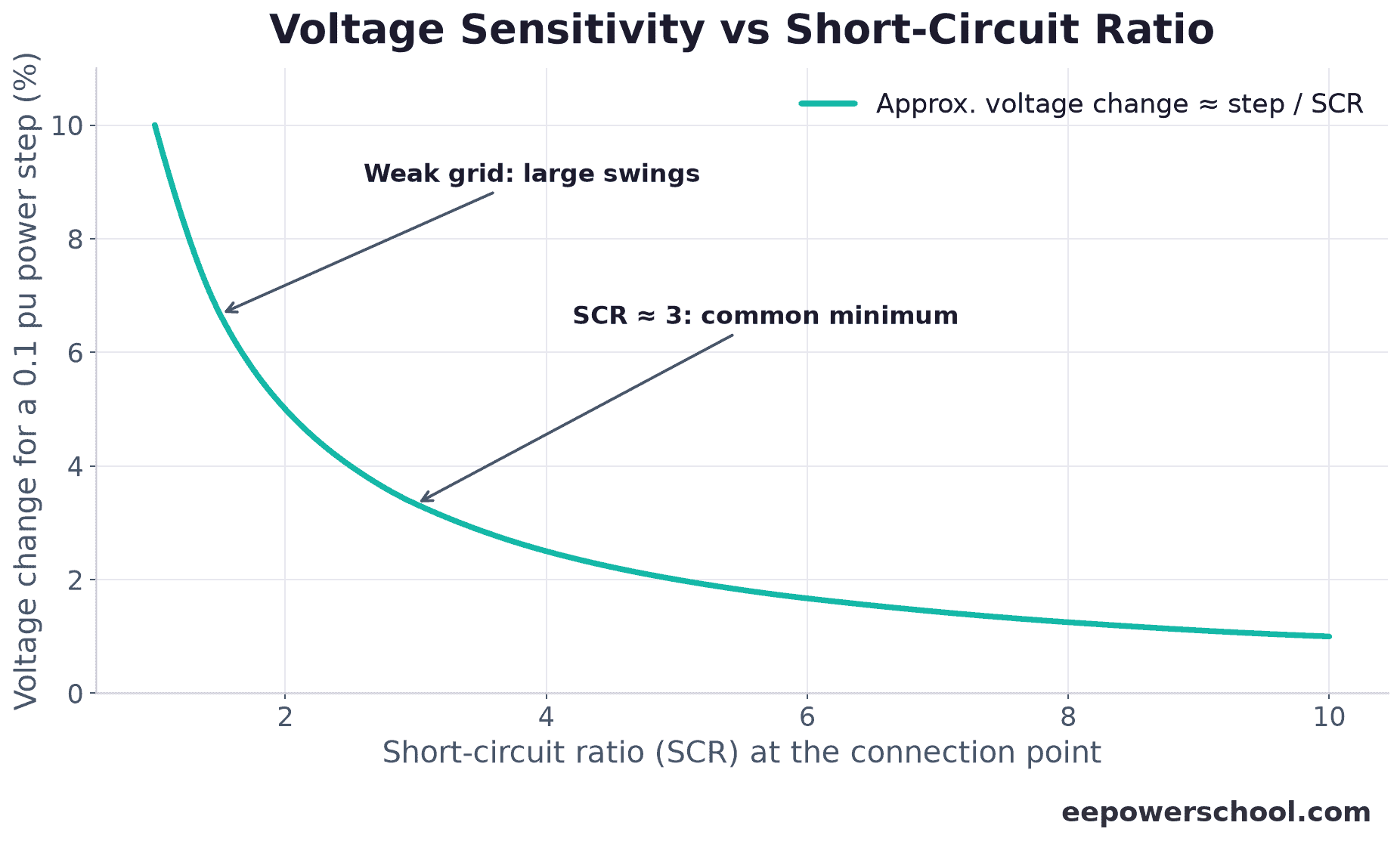
Now inject current from an inverter. The voltage seen at the connection point is the source voltage plus the drop across Zth. On a strong grid (small Zth) that drop is tiny and the voltage barely moves. On a weak grid (large Zth) every change in injected current produces a large voltage swing. A useful approximation is that the per-unit voltage change for a power step is roughly the size of that step divided by the SCR, so halving the SCR doubles the voltage wobble for the same action. That single fact, large voltage sensitivity to current, is the root cause of almost every weak-grid problem. If you want to revisit how fault levels are computed in the first place, see our guide to faults in power systems.
Beyond Simple SCR: WSCR, CSCR and the Multi-Infeed Problem
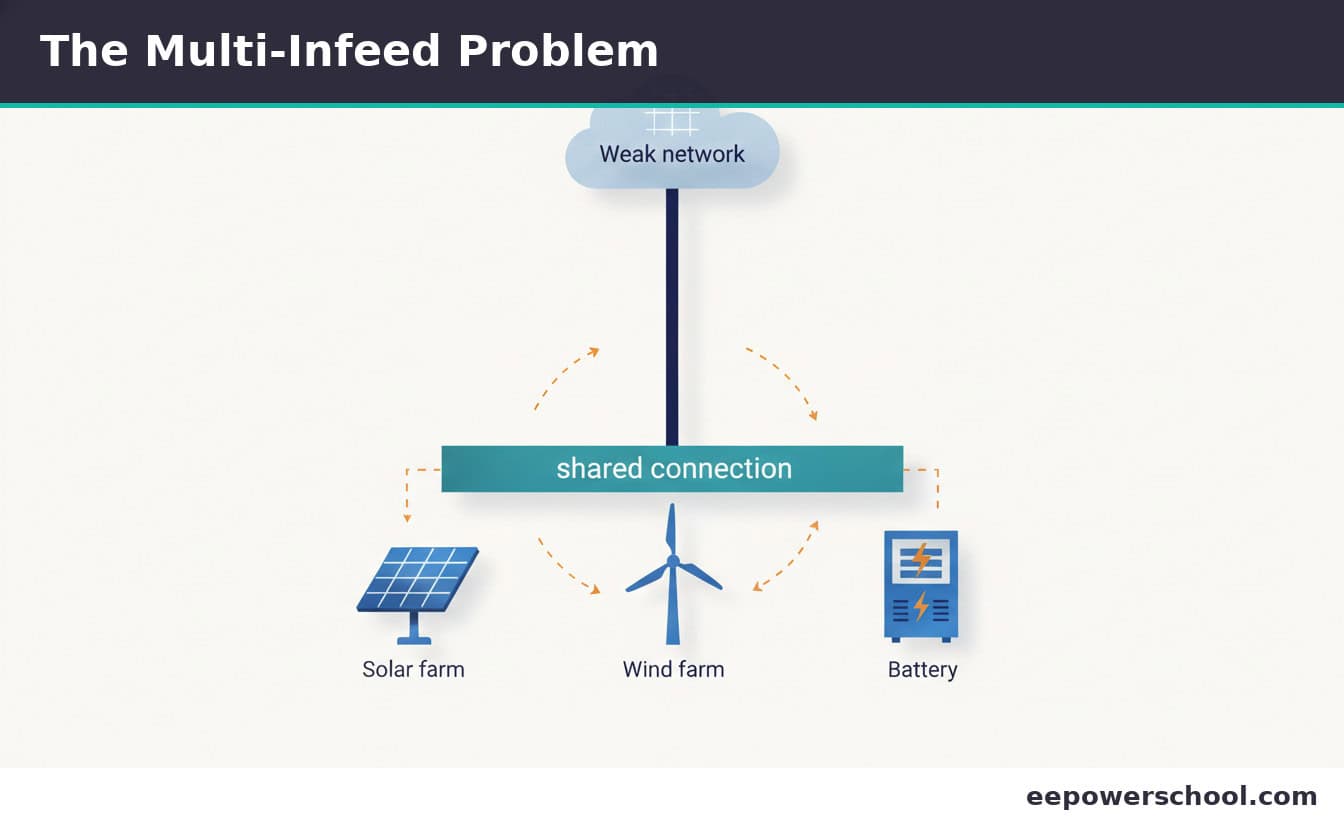
The single-plant SCR quietly assumes your inverter is the only non-synchronous device in the neighbourhood. In reality, wind and solar farms cluster where the resource is good, and they all lean on the same weak corner of the network. When several inverter-based resources share a region, they interact, and the effective strength each one sees is lower than its standalone SCR suggests.
That is why operators use composite or weighted measures instead:
- Weighted SCR (WSCR) aggregates the fault level across a group of nearby plants, weighting by their ratings, to capture their shared dependence on the same network.
- Composite SCR (CSCR) similarly lumps a tightly coupled cluster behind a common interconnection point.
- Equivalent SCR (ESCR) adjusts for local reactive plant such as capacitor banks and filters.
The practical takeaway: a project can show an acceptable SCR on its own and still fail once the neighbouring farms are switched in. Multi-infeed interaction is a system-level question, not a single-connection one.
Why Grid-Following Inverters Struggle in Weak Grids
Conventional grid-following inverters work by measuring the grid voltage with a phase-locked loop (PLL) and then injecting current in step with it. That control loop quietly assumes the voltage it is measuring is a stable reference it cannot itself disturb. On a weak grid that assumption breaks: the inverter’s own current changes the voltage it is trying to track, the PLL chases its own tail, and the result can be poorly damped or unstable oscillations.
This is not just theory. NERC’s analysis of the 2021–2022 disturbances in Texas documented inverter-based resources tripping or reducing output during grid faults, with weak-grid control interaction among the contributing factors. As fault level falls, the margin that grid-following controls rely on shrinks, and behaviour that was fine in a stiff network becomes fragile. The chart below shows why: voltage sensitivity climbs sharply once the SCR drops below about 3.
How Strong Is Strong Enough? Thresholds and Standards
There is no single universal number, but the standards are converging. AEMO, operating one of the world’s most inverter-heavy grids, requires new connecting plant to remain stable down to defined minimum short-circuit levels and tests a plant’s ability to “withstand” low-SCR conditions, in its framework down to an SCR of around 1.2. In the United States, IEEE Std 2800-2022 sets interconnection performance requirements for inverter-based resources, including stable operation across a range of system strengths rather than assuming a stiff grid.
The honest engineering answer is that the threshold is plant-specific. A modern inverter with well-tuned controls, or a grid-forming one, can be stable at an SCR where an older grid-following unit would oscillate. That is exactly why the question is shifting from “what is the SCR?” to “what controls are connecting, and how do they behave at this SCR?”
How to Strengthen a Weak Grid
If grid strength is too low for what you want to connect, there are four broad levers, often used in combination:
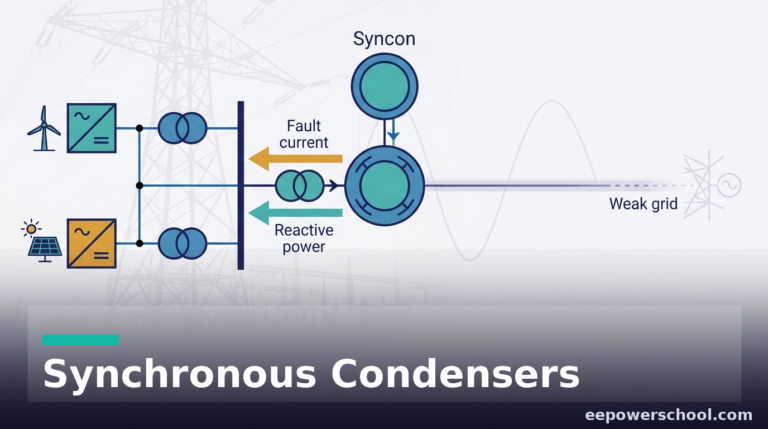
- Synchronous condensers — free-spinning synchronous machines that add fault current (and a little inertia) exactly where it is needed. They have become a popular retrofit precisely because they raise the local fault level directly.
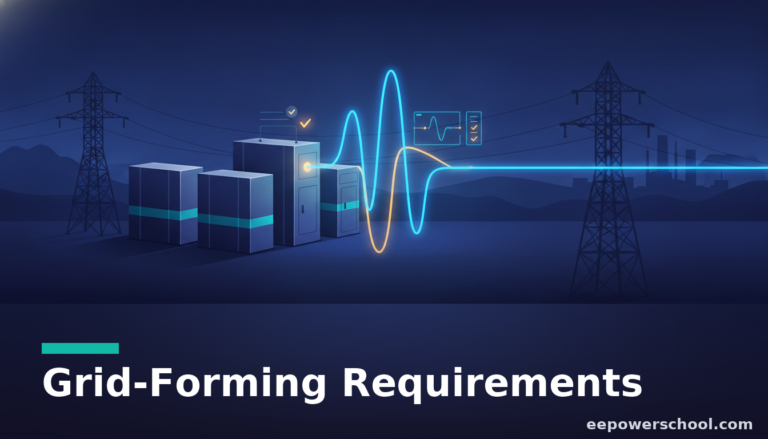
- Grid-forming inverters — converters that impose a voltage reference instead of following one, and so behave well in, and contribute to, weak grids. Standards bodies increasingly call for grid-forming capability on new storage.
- STATCOMs and SVCs — fast dynamic reactive support that stabilises voltage, though they add less to the raw fault level than a rotating machine.
- Network reinforcement — new lines or transformers that lower the Thevenin impedance, the most direct but slowest and most expensive fix.
Increasingly the cheapest “fix” is in the control software: requiring better-damped or grid-forming behaviour so the equipment tolerates the strength the network actually has.
Worked Example: Calculating SCR at a Connection Point
Suppose a developer wants to connect a 250 MW solar farm at a substation where the network study reports a three-phase fault level of 600 MVA. The standalone short-circuit ratio is:
SCR = 600 MVA ÷ 250 MW = 2.4
That is below the common comfort threshold of 3, so the connection is marginal-to-weak and the operator will likely require a remediation study, especially once neighbouring farms are included in a weighted SCR. One option is a synchronous condenser: adding one that raises the local fault level to, say, 850 MVA lifts the ratio to 850 ÷ 250 = 3.4, comfortably back above the threshold. The alternative, increasingly chosen, is to specify grid-forming inverters that are contractually required to stay stable at the lower SCR, avoiding the extra hardware entirely. Either way, the SCR calculation is the first screening number every renewable connection now has to clear.
Frequently Asked Questions
What is a weak grid in simple terms?
A weak grid is a connection point with a low fault level (high source impedance), so its voltage swings significantly when current is injected or withdrawn. Strong grids hold their voltage almost constant; weak grids do not, which makes stable inverter control much harder.
What short-circuit ratio is considered weak?
As a rule of thumb, an SCR above about 3 is comfortable, 2 to 3 is marginal, and below 2 is weak and usually needs remediation. The exact threshold depends on the specific inverter controls connecting, so it is a screening guide rather than a hard limit.
What is the difference between grid strength and system strength?
They are used almost interchangeably. 'Grid strength' is the everyday term for voltage stiffness at a location, while 'system strength' is the formal term operators like AEMO use, defined as the ability to maintain and control the voltage waveform during steady state and disturbances.
Do grid-forming inverters increase system strength?
They improve how a connection behaves at low strength by imposing a voltage reference, and they contribute to system strength during disturbances. However, a rotating machine such as a synchronous condenser still adds more raw steady-state fault current, so the two are often used together.
How is fault level calculated at a connection point?
Fault level is the apparent power the network would deliver into a bolted three-phase fault at that bus, approximately the square of the voltage divided by the Thevenin source impedance. It is found from a short-circuit study of the surrounding network and is the numerator in the SCR.
Related reading
- Inverter-based resources: the future of renewable energy
- Faults in power systems: types, causes and arcing
- Inverter basics: classification and applications
- Electrical Engineering Formula Cheat Sheet (power systems quick reference)