Fast Frequency Response (FFR) from Inverter-Based Resources
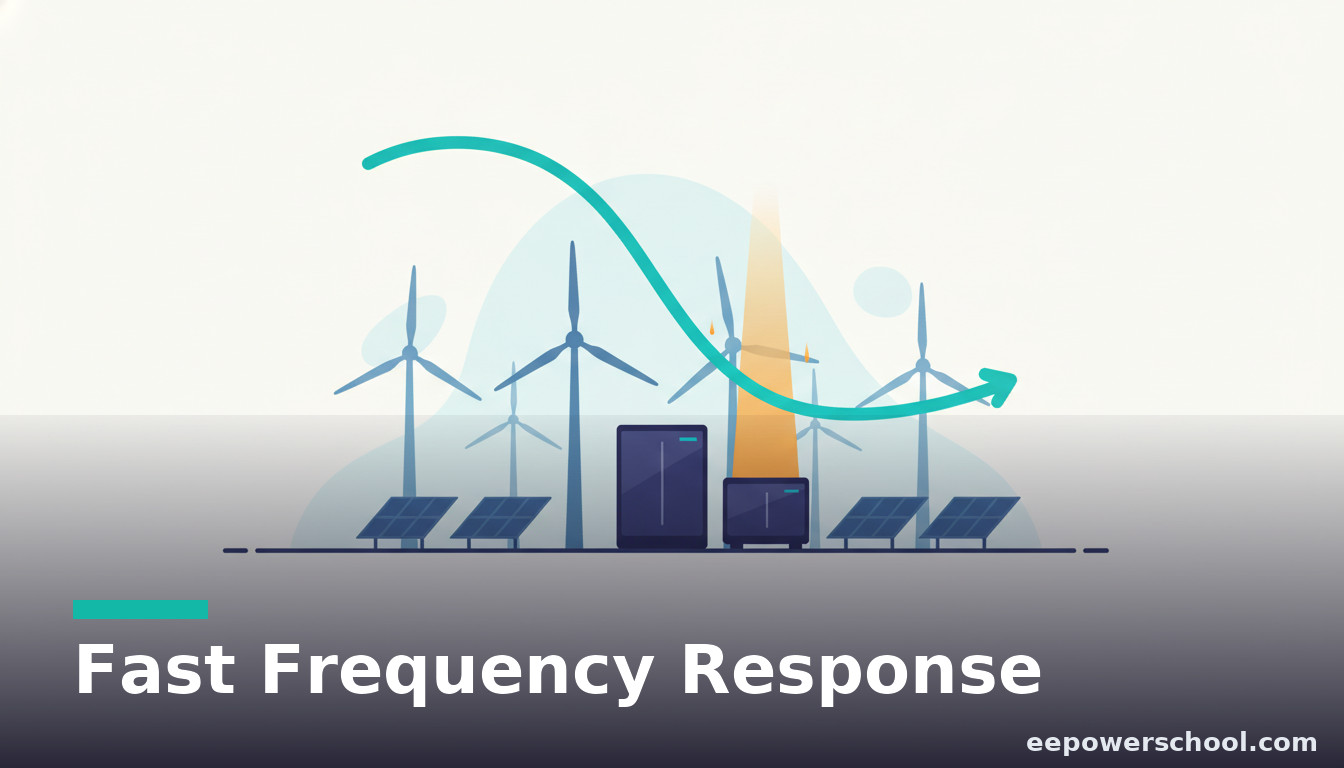
When a large generator or interconnector trips, the grid loses a block of supply in an instant and the frequency starts to fall. For a century, the spinning mass of synchronous machines slowed that fall for free, buying time for slower reserves to react. As that inertia disappears, the fall gets faster, and the grid increasingly relies on something new to catch it: fast frequency response.
This article walks through the anatomy of a frequency event, explains where fast frequency response sits among the other reserves, why batteries and inverters are so well suited to it, and how it is actually configured and procured. We finish with a worked estimate of how much FFR lifts the frequency nadir.
Why Frequency Falls: The Anatomy of an Event
System frequency is a real-time balance gauge. When generation exactly matches demand it sits at nominal (50 Hz or 60 Hz); when supply is suddenly lost, the deficit is met from stored energy and the frequency drops. The shape of that drop has a few distinct phases.
In the first instant, the only thing resisting the fall is inertia, the kinetic energy in spinning machines, which sets the initial rate of change of frequency (RoCoF). Frequency keeps falling, more slowly, until injected reserves overtake the deficit; the lowest point is the nadir. After that, response services push the frequency back up toward nominal. If the nadir falls far enough to reach under-frequency load-shedding thresholds, the grid starts disconnecting customers to survive. For the underlying mechanism, see our explainer on grid inertia and frequency dynamics.
Inertia vs Fast Frequency Response vs Primary Response
These terms are often blurred, but they are distinct layers acting on different timescales:
- Inertial response is instantaneous and automatic, a physical reaction of spinning mass (or an emulation of it). It does not stop the fall, it just slows the rate.
- Fast frequency response (FFR) is active power delivered very quickly, within roughly a second or two, specifically to arrest the decline before the nadir.
- Primary response is the governor-style response of conventional plant over the following seconds to tens of seconds.
The key point is that as inertia shrinks, the window between the event and the nadir gets shorter, so the value shifts toward whatever can act fastest. That is exactly the niche fast frequency response fills.

What 'Fast' Actually Means
Definitions vary by market, but they all emphasise speed. Ireland’s pioneering DS3 programme, for example, defines FFR as additional power delivered within two seconds of an event and sustained for several seconds afterward. Great Britain and other systems have introduced sub-second products with similar intent.
What matters is the comparison: a conventional steam plant might take tens of seconds to ramp meaningfully, while a fast frequency response asset is expected to act before the nadir, which in a low-inertia system can arrive in just a few seconds. Speed, not size, is the defining specification.
Why Batteries and Inverters Are Ideal for FFR
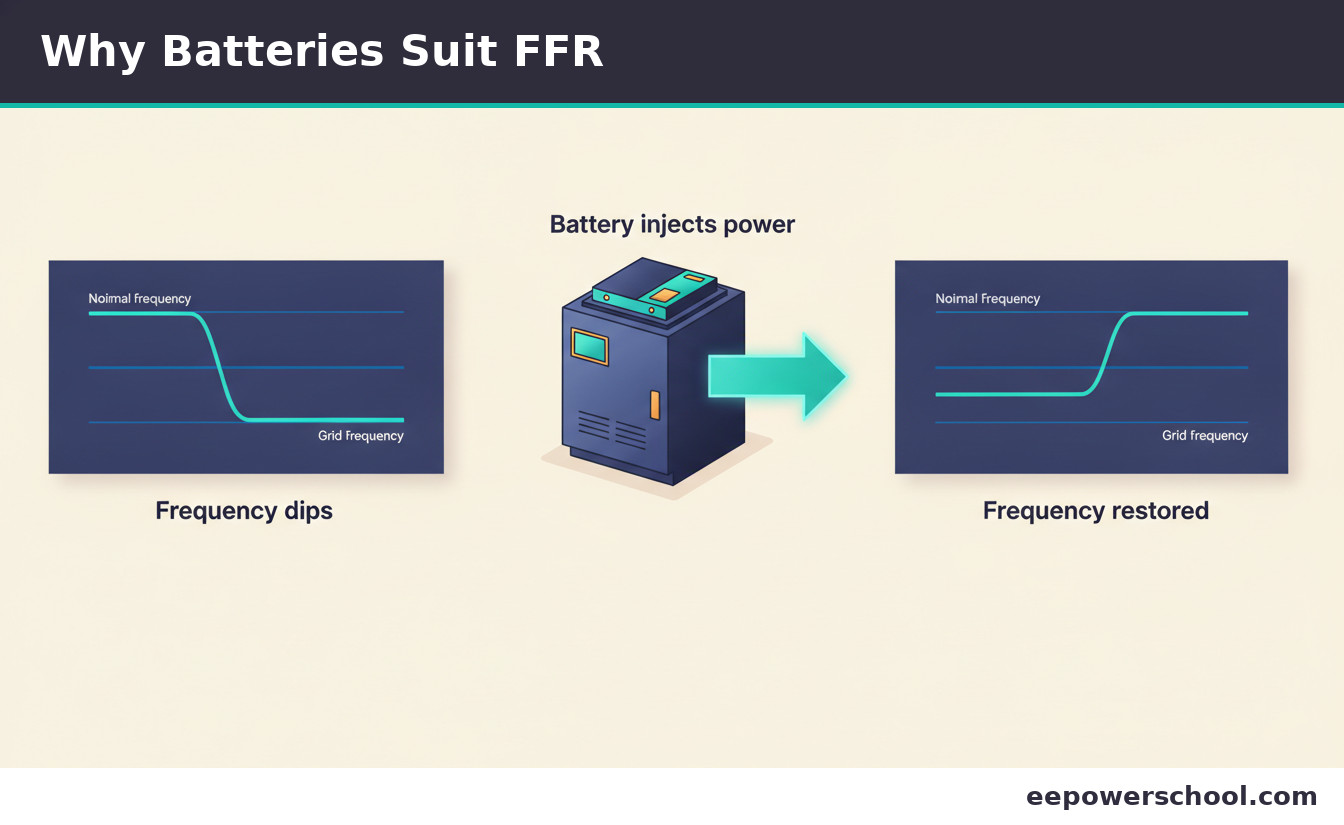
Battery energy storage paired with inverters is almost purpose-built for this role. An inverter can change its output essentially within a cycle, far faster than any mechanical governor, and a battery has energy ready to deliver in either direction, so it can both inject power during a low-frequency event and absorb it during a high-frequency one.
Inverters are also precise: their response can be tuned exactly, with a defined deadband, slope, and delivery time, rather than relying on the physical characteristics of a turbine. The trade-off is duration. A battery’s energy is finite, so FFR is about delivering a sharp, accurate burst to arrest the nadir and bridge to slower reserves, not about supplying energy for long periods.
How FFR Is Configured: Droop, Deadband, and Delivery Time
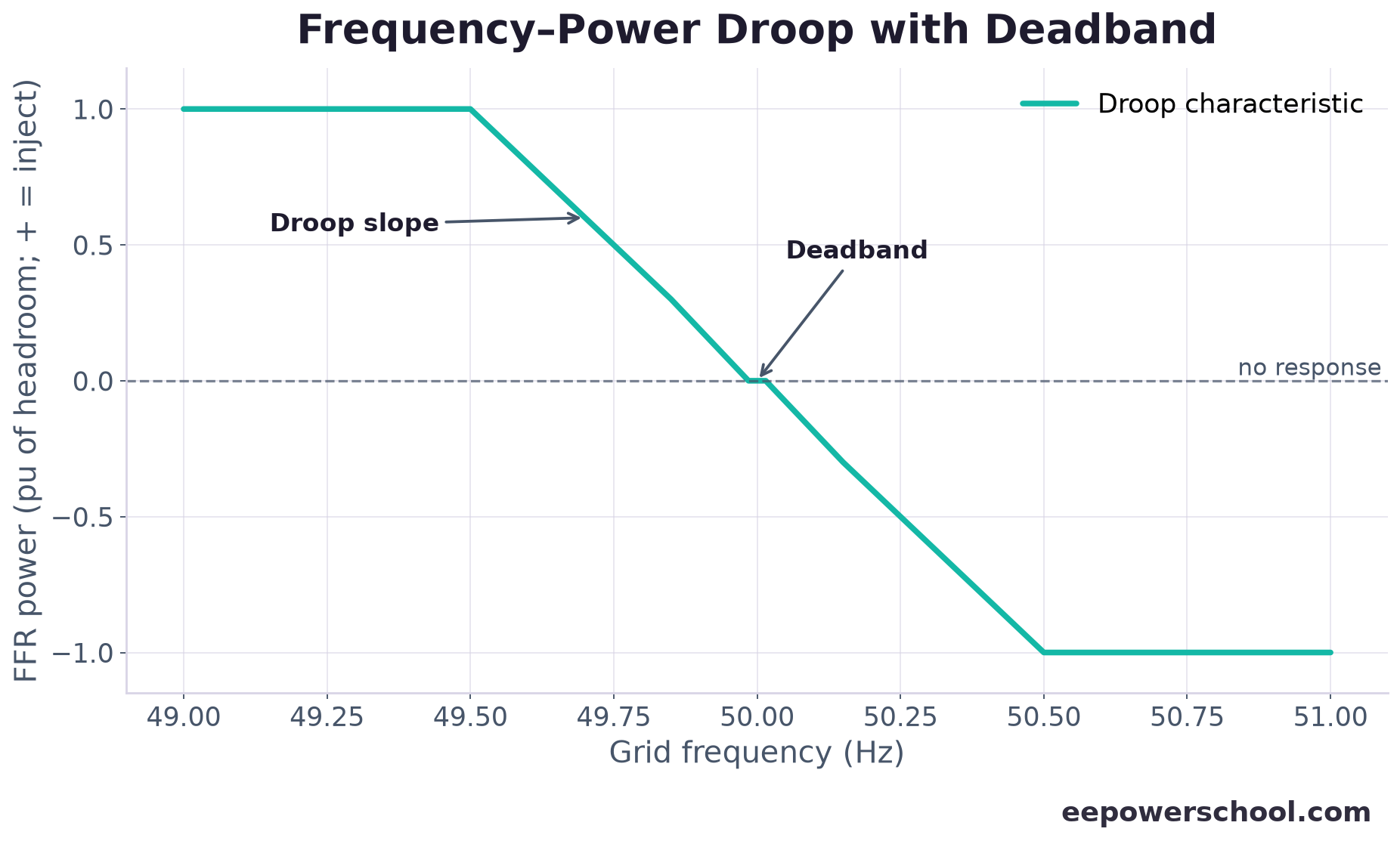
An FFR asset is governed by a frequency-power characteristic. A deadband around nominal frequency keeps it idle during normal small fluctuations. Outside the deadband, a droop setting determines how much power it delivers per unit of frequency deviation, a steeper response giving more power for a given dip. A delivery time specifies how quickly the full response must be reached.
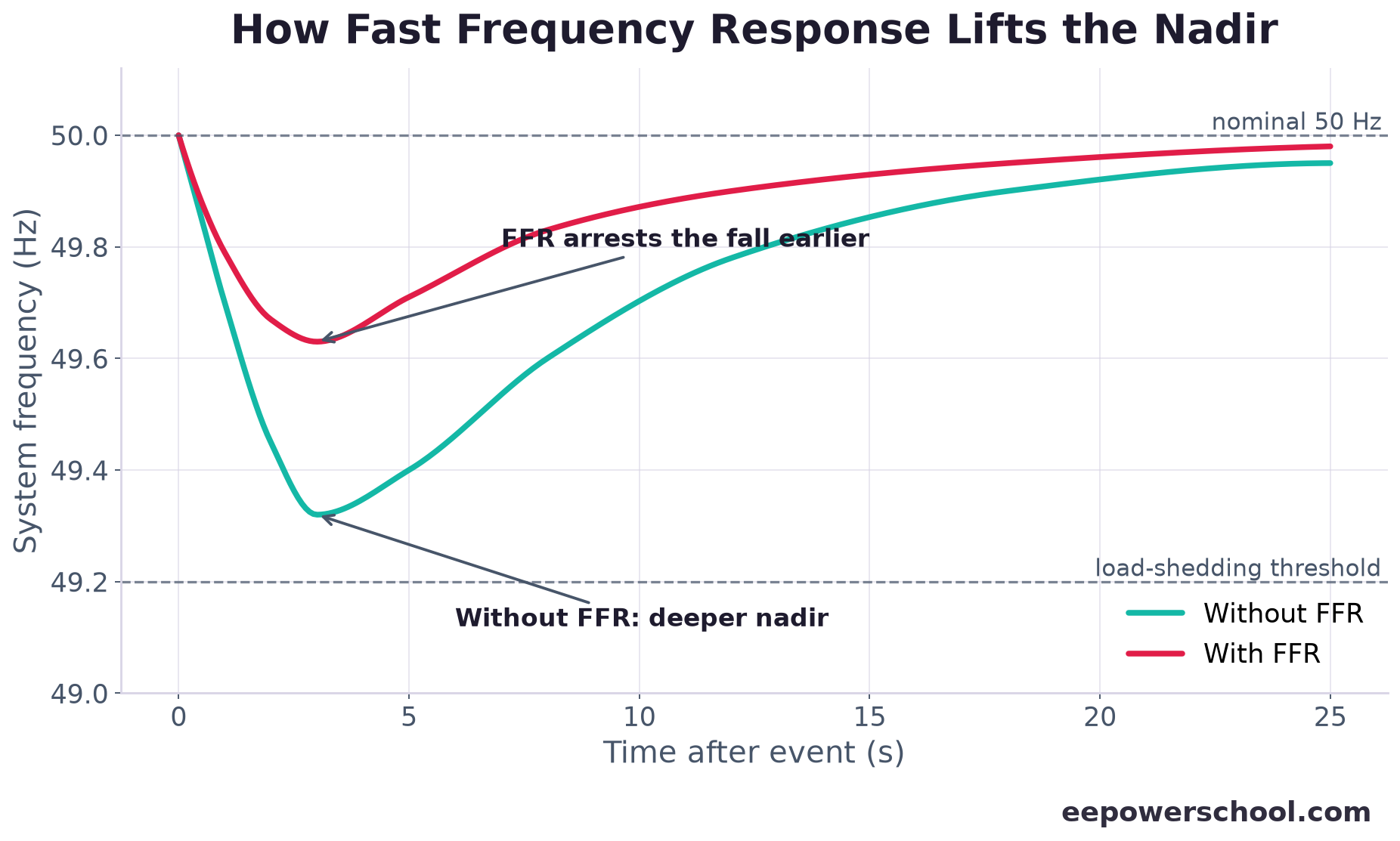
Tuning these is a balancing act. Too sluggish and the response misses the nadir; too aggressive and many fast units can over-correct and cause the frequency to overshoot or oscillate. The chart below shows the practical payoff of getting it right: the same event with and without fast frequency response, and the droop characteristic that shapes the response.
Synthetic Inertia and the Grid-Forming Connection
Two related ideas often appear alongside FFR. Synthetic (or virtual) inertia is a control mode that measures RoCoF and injects power proportional to it, deliberately mimicking the inertial response of a machine. It targets the rate of fall, whereas classic FFR targets the nadir; the distinction matters when writing specifications.
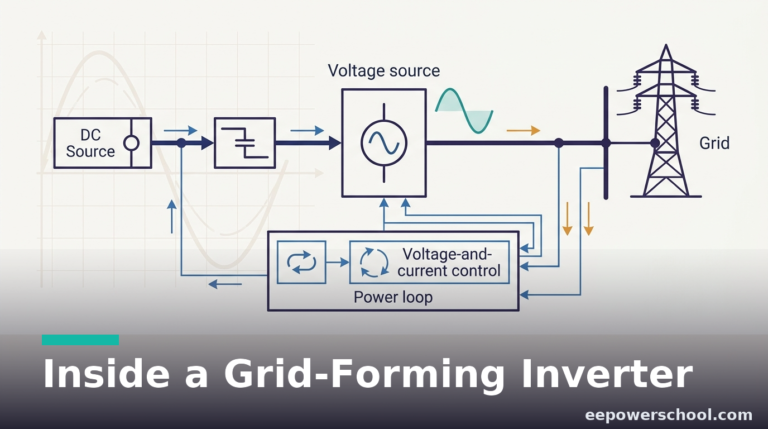
Grid-forming inverters take this further. Because they impose a voltage reference rather than following one, they provide an inherent, near-instant power response to disturbances, blurring the line between inertia and fast response. This is a major reason grid codes increasingly favour grid-forming capability on storage, and it is covered in depth in our grid-forming explainer.
FFR in the Real World: Markets and Standards
Fast frequency response has moved from research to routine procurement. Ireland’s DS3 programme created explicit markets for fast services and synchronous inertial response; Great Britain introduced sub-second frequency products; and operators in Australia, Texas, and elsewhere have followed with their own fast services as inverter share has risen.
Standards are catching up too. IEEE Std 2800-2022 sets frequency ride-through and frequency-response expectations for bulk-system inverter-based resources, and NERC has been tightening requirements after disturbances in which inverter-based resources did not respond as assumed. The direction is unmistakable: fast, well-specified electronic response is becoming a baseline grid service rather than a premium add-on.
Worked Example: Estimating the Nadir Improvement
Consider a 50 Hz system that suddenly loses 1000 MW. Suppose the inertia alone would let the frequency fall to a nadir of 49.3 Hz before slower reserves arrive, dangerously close to first-stage load shedding, often around 49.0 to 49.2 Hz.
Now add a fleet of batteries contracted to deliver, say, 300 MW of fast frequency response within one second. By injecting power early, while the frequency is still falling, they reduce the net deficit during the most critical window and arrest the decline sooner. In studies of systems like this, a fast response of that scale can lift the nadir by a few tenths of a hertz, enough to move from 49.3 Hz up to roughly 49.6 Hz and clear the load-shedding threshold with margin. The exact figure depends on inertia, delivery speed, and droop, which is precisely why operators model these events in detail, but the mechanism is simple: act early, and a modest amount of power buys a large amount of frequency security.
Frequently Asked Questions
What is the difference between fast frequency response and inertia?
Inertia is the instantaneous physical resistance to frequency change from spinning mass, which slows the rate of fall. Fast frequency response is active power deliberately injected within a second or two to arrest the fall before the nadir. Inertia limits how fast frequency drops; FFR limits how far.
How fast is fast frequency response?
It depends on the market, but FFR is typically delivered within about one to two seconds of an event, with some products responding in well under a second. The defining requirement is acting before the frequency nadir, which in a low-inertia grid can occur within just a few seconds.
Why are batteries good at providing FFR?
Inverter-coupled batteries can change output within a cycle, far faster than mechanical governors, and can both inject and absorb power. Their response is also precisely tunable. The main limitation is duration, so FFR is a sharp, accurate burst to bridge to slower reserves rather than sustained energy.
Is synthetic inertia the same as fast frequency response?
No. Synthetic inertia measures the rate of change of frequency and injects power proportional to it, targeting how fast frequency falls. Classic FFR targets the nadir, the lowest point. They are complementary, and grid-forming inverters can provide an inherent response that resembles both.
What standards cover frequency response from inverter-based resources?
IEEE Std 2800-2022 sets frequency ride-through and frequency-response requirements for bulk-system inverter-based resources. Market frameworks such as Ireland's DS3 define and procure fast services explicitly, and NERC is developing mandatory reliability standards for IBR performance.
Related reading
- Grid inertia 101: frequency dynamics and the modern grid
- Inverter-based resources: the future of renewable energy
- Inverter basics: classification and applications
- Electrical Engineering Formula Cheat Sheet (power systems quick reference)