Grid-Forming vs Grid-Following Inverters: What Every Power Engineer Should Know
For a century the grid ran on spinning machines. Now solar, wind, and batteries connect through power electronics instead, and the question of grid-forming vs grid-following inverters has moved from a research curiosity to a front-line engineering decision. The two control philosophies look similar on a one-line diagram, but they behave like completely different devices the moment the grid is disturbed.
This guide explains the real difference in plain terms, shows why it matters more every year as system inertia falls, and walks through what it means for the protection schemes you already know.
Grid-Forming vs Grid-Following Inverters: The Core Difference
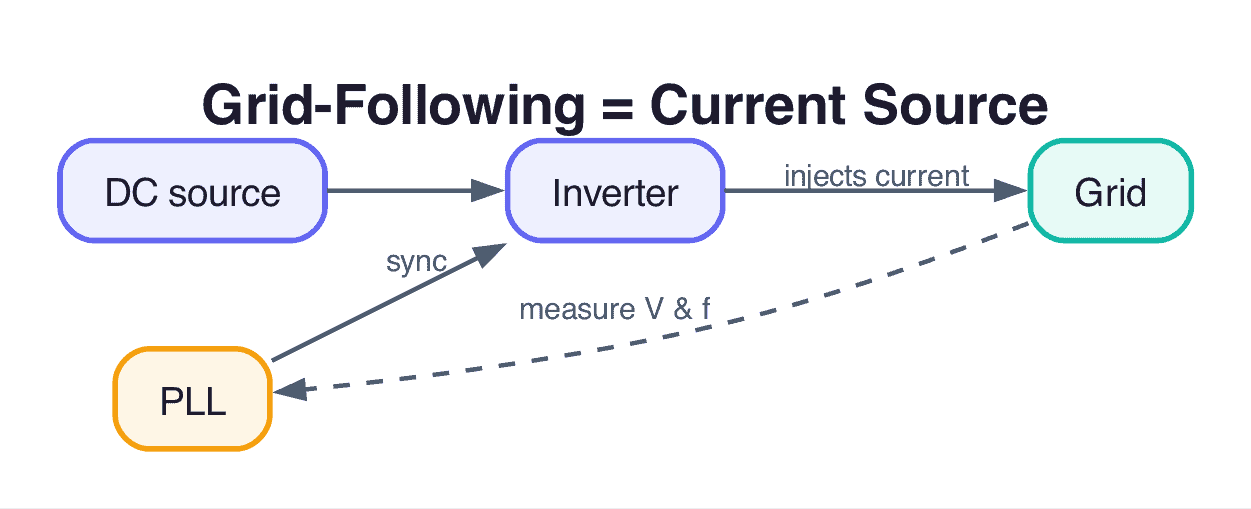
Here is the whole idea before the detail: a grid-following inverter behaves like a controlled current source that pushes power into a voltage that already exists, while a grid-forming inverter behaves like a controlled voltage source that creates the voltage and frequency reference itself.
That single distinction, current source versus voltage source, drives everything else: whether the unit can run during a blackout, whether it supports grid stability, and how it behaves during a fault. Keep it in mind as we go.
How Grid-Following Inverters Work
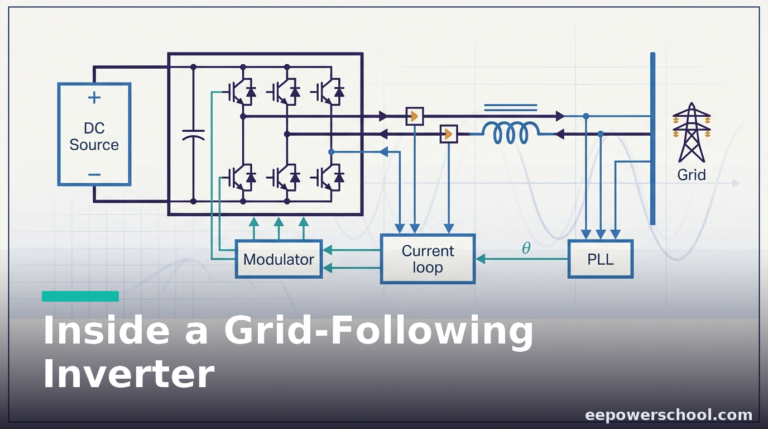
Grid-following inverters are the workhorses of today’s solar and wind fleet. They use a phase-locked loop (PLL) to continuously measure the grid’s voltage angle and frequency, then inject current precisely in step with that measured reference.
Because they need to lock onto an existing voltage, a grid-following inverter cannot stand on its own:
- It needs a stable external grid (or another forming source) to synchronize to.
- It cannot black start, and a single grid-following unit cannot energize an island by itself.
- It delivers active and reactive power on command, but it does not set the system’s voltage or frequency.
On a strong grid this is perfectly fine, and it keeps the control simple and robust. The trouble starts as the grid gets weaker and there are fewer machines left to follow.
How Grid-Forming Inverters Work
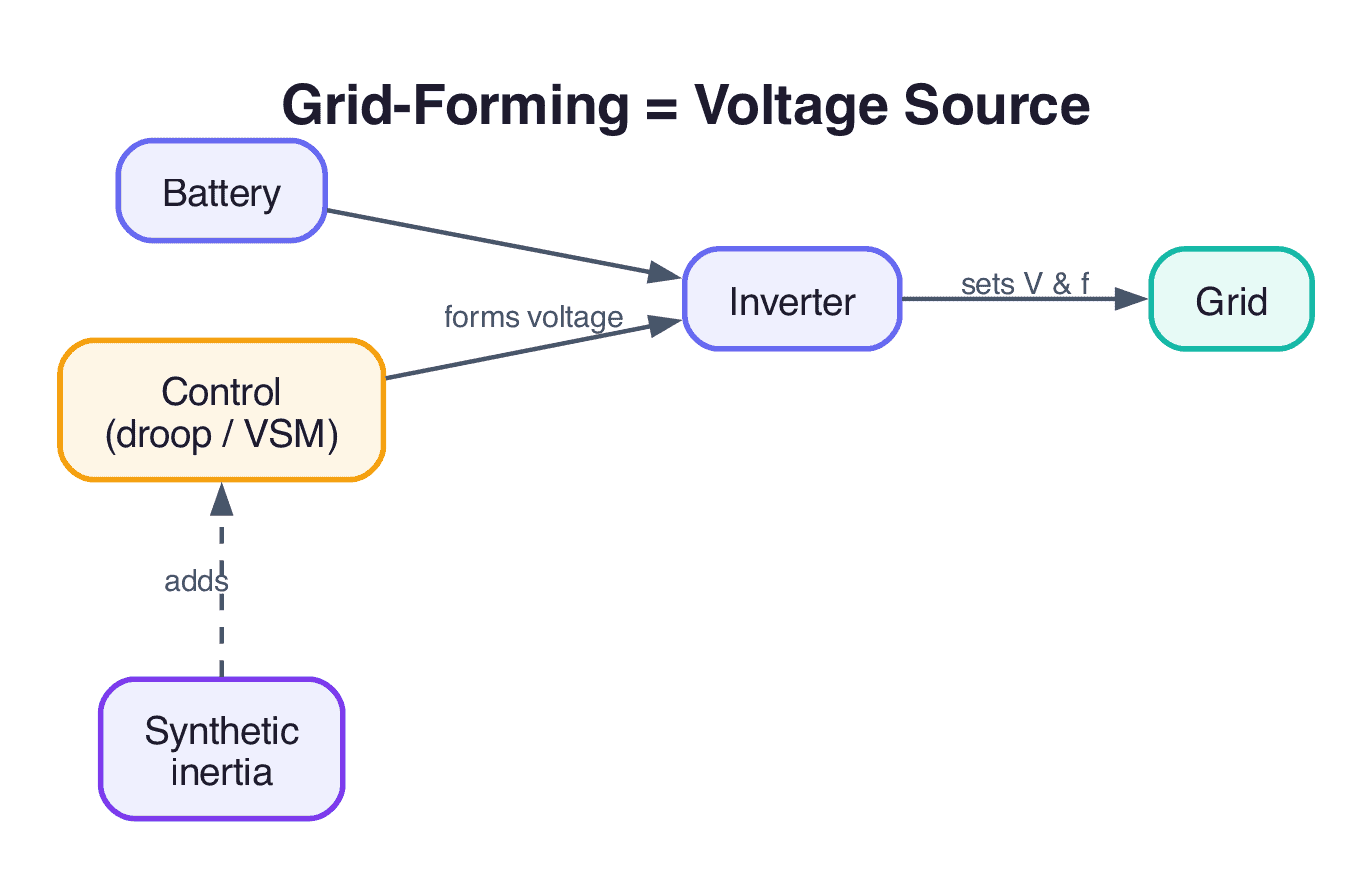
A grid-forming inverter flips the relationship. Instead of chasing the grid, it imposes its own voltage waveform with a defined magnitude and frequency, then lets power flow naturally based on the angle difference with the rest of the system, exactly the way a synchronous generator does.
Several control strategies achieve this behavior:
- Droop control adjusts frequency and voltage with load, allowing multiple units to share power without communication.
- Virtual synchronous machine (VSM) control emulates the inertia and damping of a real generator.
Because it forms the reference, a grid-forming inverter can energize a dead network (black start), run an island on its own, and hold up a weak grid. It is the closest a power-electronic device gets to acting like the rotating machines it is replacing.
Side-by-Side Comparison
When you put grid-forming vs grid-following inverters side by side, the table below sums up the practical differences engineers care about:
| Characteristic | Grid-Following (GFL) | Grid-Forming (GFM) |
|---|---|---|
| Electrical behavior | Current source | Voltage source |
| Needs an existing grid? | Yes (uses a PLL to sync) | No (creates the reference) |
| Sets voltage and frequency | No | Yes |
| Black start | Not possible alone | Capable |
| Provides inertia | None | Synthetic / virtual |
| Performance on weak grids | Can become unstable | Strong, stabilizing |
| Typical use today | Most utility solar and wind | Batteries, microgrids, islands |
Note that the difference is in the control software and reference, not in the power stage. The same hardware can often be either, given the right firmware and an energy buffer to back it up.
Why This Matters Now: Falling Grid Inertia
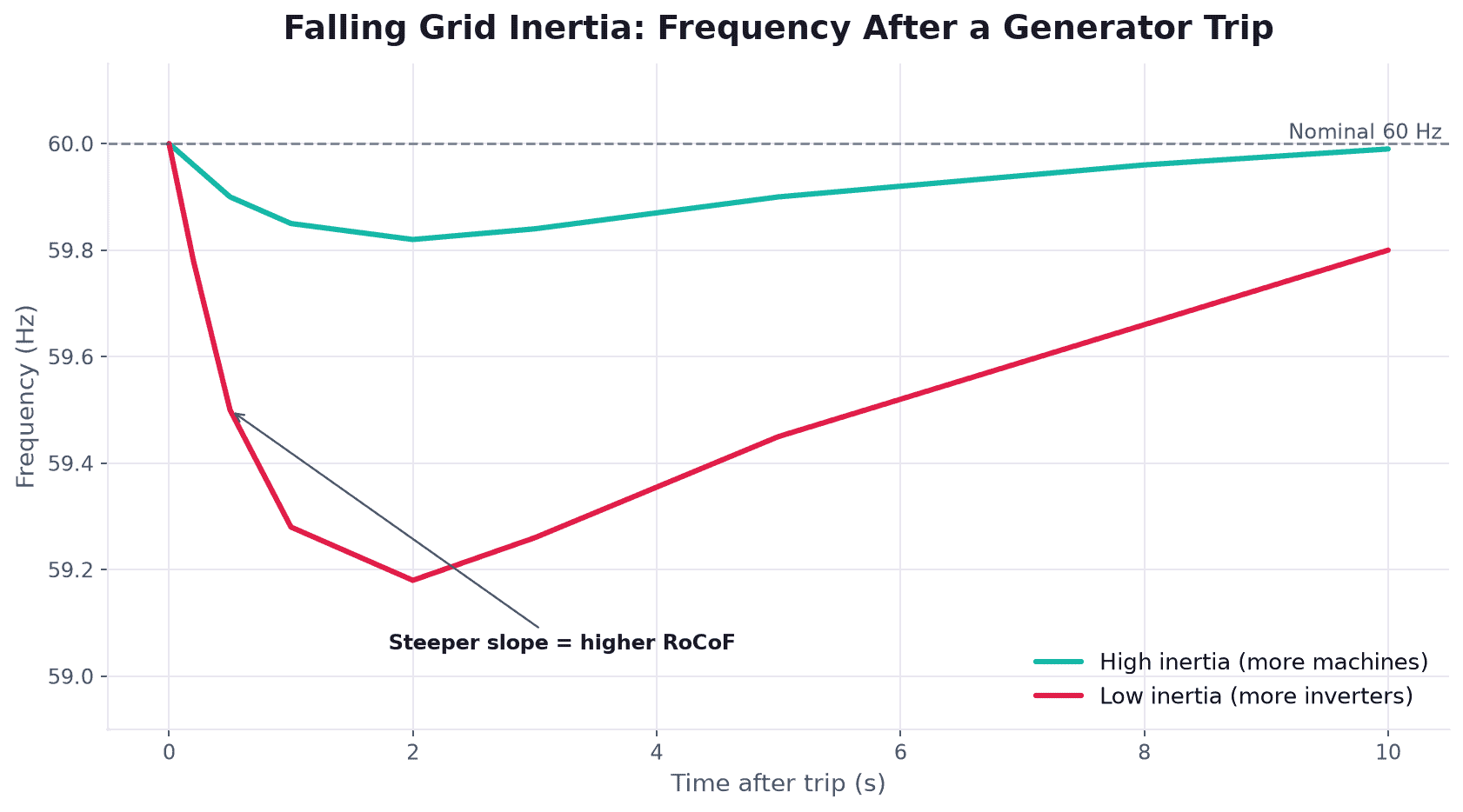
Synchronous generators store energy in their spinning mass. That rotational inertia resists sudden frequency change and buys protection and control systems precious time after a disturbance. Every coal or gas plant that retires takes its inertia with it.
As inverter-based resources take over, the grid gets lighter and faster to move. The rate of change of frequency (RoCoF) after a large trip rises, and weak corners of the network lose the system strength that grid-following units quietly rely on. Push grid-following penetration high enough and the PLLs that keep them in step can start fighting each other.
Grid-forming inverters are the fix: they supply synthetic inertia and a firm voltage reference, which is why grid codes and standards such as IEEE 2800 increasingly call for grid-forming capability, especially on battery storage.
What It Means for Protection and Fault Current
This is where it gets personal for protection engineers. A synchronous generator slams 5 to 7 times its rated current into a nearby fault. An inverter, forming or following, is limited by its semiconductors to roughly 1.1 to 1.5 times rated current, and only for a controlled window.
That low, tightly controlled fault contribution breaks assumptions baked into traditional schemes:
- Overcurrent (50/51) elements may not see enough current to pick up or coordinate the way they do on a conventional source.
- Distance (21) elements can misjudge reach because the inverter’s fault behavior is set by control, not by physics.
- Negative-sequence and directional logic can respond differently depending on the manufacturer’s control strategy.
Grid-forming units help by presenting a more machine-like voltage source during the sub-transient instant, but the core lesson stands: as the grid fills with inverters, fault levels drop and protection has to be re-studied, not copied forward. If you want a refresher on the underlying behavior, start with our guide to faults in power systems.
Where Each Is Used Today
In practice, choosing between grid-forming vs grid-following inverters is about role, not maturity, and both technologies are in service right now:
- Grid-following still dominates large utility-scale solar and wind on strong transmission grids, where a firm reference is already present and the control simplicity pays off.
- Grid-forming is becoming the default for battery energy storage, microgrids, remote and island systems, and any project connecting to a weak grid, increasingly because the grid code requires it.
The direction of travel is clear. As IBR penetration climbs toward and past 100 percent in some regions, grid-forming moves from a premium feature to a baseline requirement.
Key Takeaways
- Grid-following = current source that needs an existing grid; grid-forming = voltage source that creates the reference.
- Only grid-forming units can black start, run an island alone, and provide synthetic inertia.
- Falling system inertia is the reason grid-forming is moving from optional to mandatory, especially for storage.
- All inverters contribute very little fault current, so protection must be re-studied as IBR penetration grows.
If you work anywhere near renewables or storage, the grid-forming vs grid-following inverters distinction is one worth knowing cold. It changes how a plant behaves on its best day and, more importantly, on its worst.
Frequently Asked Questions
Can a grid-following inverter work during a blackout?
No. A grid-following inverter needs an existing voltage reference to synchronize to, so a single unit cannot black start or energize an island on its own. You need a grid-forming source for that.
Do grid-forming inverters provide real inertia?
Not rotational inertia. They provide synthetic or virtual inertia by using control and a stored energy buffer to emulate how a spinning machine resists frequency change. The effect is similar even though there is no rotating mass.
Why do inverters contribute so little fault current?
Their output is limited by the current rating of the semiconductor switches, typically about 1.1 to 1.5 times rated current. A synchronous generator, by contrast, can deliver 5 to 7 times its rating into a nearby fault.
Is grid-forming capability required by code?
Increasingly, yes. Grid codes and interconnection standards such as IEEE 2800 are moving toward requiring grid-forming behavior, particularly for battery energy storage on weak or low-inertia grids.
Can a grid-following inverter be converted to grid-forming?
Often it is mainly a control and firmware change, since the power stage can be similar. The catch is that grid-forming needs a real energy buffer to back the voltage it forms, so a retrofit is easiest on battery systems rather than plain solar.
Related reading
- Inverter-based resources: the future of renewable energy
- Grid inertia 101: frequency dynamics and the modern grid
- Faults in power systems: types, causes and arcing
- Inverter basics: classification and applications
- Electrical Engineering Formula Cheat Sheet (power systems quick reference)