Voltage Stability in Power Systems with High IBR Penetration
Frequency gets most of the attention in the renewable-energy transition, but it is not the only way a grid can lose control. A power system can sit at a perfectly healthy 50 or 60 Hz and still slide into a slow, local voltage stability problem that ends in collapse. As synchronous machines retire and inverter-based resources take their place, this failure mode is becoming more common and harder to ignore.
This article explains what voltage stability is, why reactive power sits at the heart of it, how the classic P-V and Q-V curves describe the limits, and why high IBR penetration stresses voltage stability in particular. We finish with the practical toolbox engineers use to keep voltage firmly under control.
What Voltage Stability Is
Voltage stability is the ability of a power system to maintain steady, acceptable voltages at every bus, both in normal operation and after a disturbance. It is distinct from frequency stability and from rotor-angle stability; the 2021 IEEE/CIGRE classification lists it as its own category for good reason, because the physics and the cures are different.
The classic failure is voltage collapse: a progressive, often slow decline in voltage across part of a network that, once it passes a critical point, runs away and cannot be recovered without shedding load. It is usually driven by the system being unable to supply enough reactive power to meet demand at acceptable voltage, a balance that high IBR penetration quietly disturbs.
Reactive Power: The Currency of Voltage
You cannot understand voltage stability without reactive power. While active power (watts) does the useful work, reactive power (vars) is what sustains the voltage magnitude needed to move that active power around. Transmission lines and transformers consume reactive power as loading increases, and that consumption rises steeply near the limit.
The crucial subtlety is that reactive power does not travel well; it has to be supplied locally. A region can be awash with active power yet still suffer low voltage because there is not enough nearby reactive support. This local nature is exactly why retiring local synchronous machines, each a fast reactive source, has such an outsized effect on voltage stability.
The P-V Curve and the Nose Point
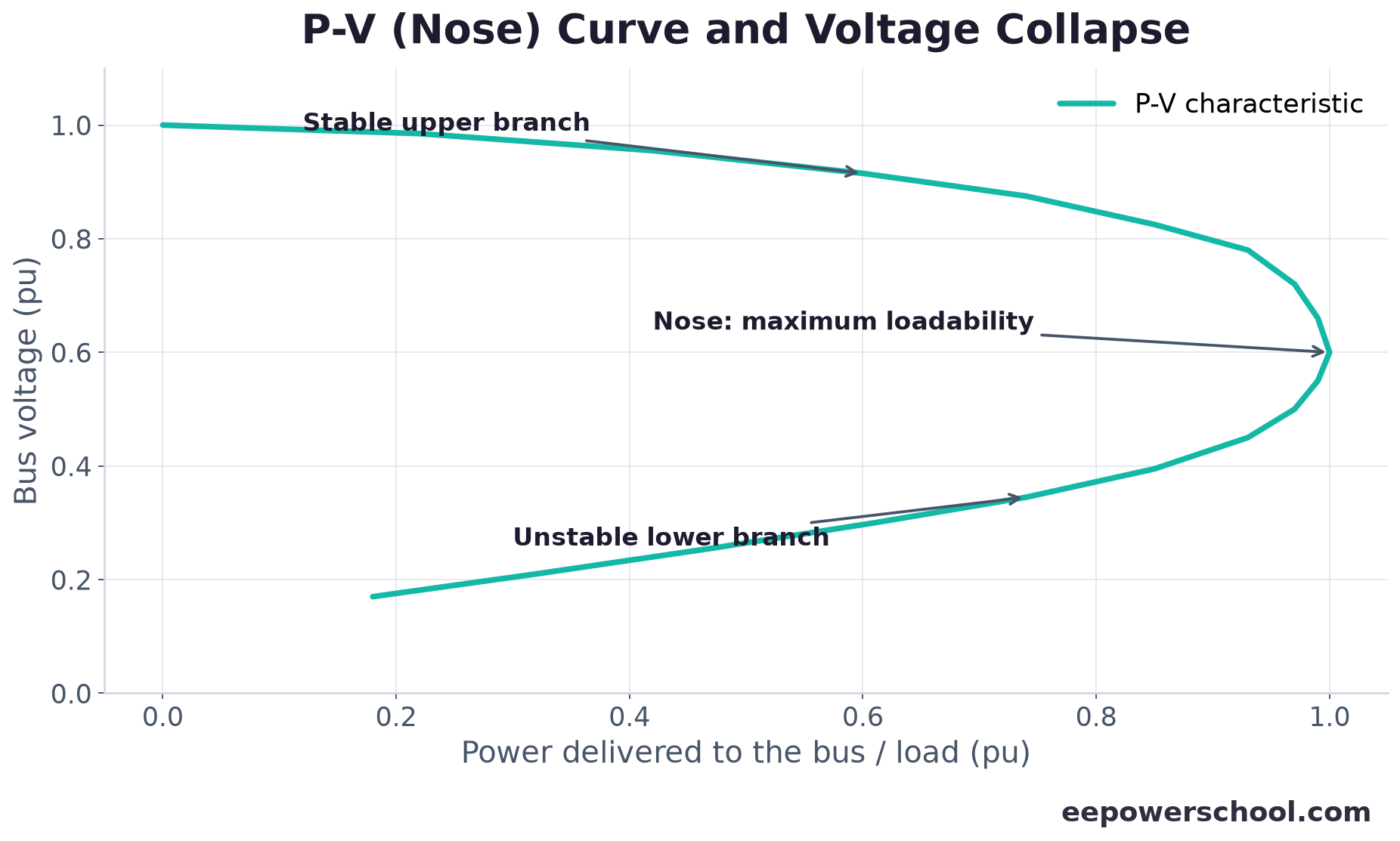
The single most useful picture in voltage stability is the P-V curve. It plots how the voltage at a bus changes as the power delivered through it increases. As load grows, voltage sags gently at first, then ever more steeply, until it reaches the nose point, the maximum power the network can deliver to that point.
Beyond the nose, there is no stable operating solution: pushing for more power actually delivers less at a collapsing voltage. The horizontal distance from the present operating point to the nose is the loadability margin, and keeping a healthy margin is a core planning objective. The chart below shows the characteristic nose shape and the unstable region past it.
The Q-V Curve and Reactive Margin
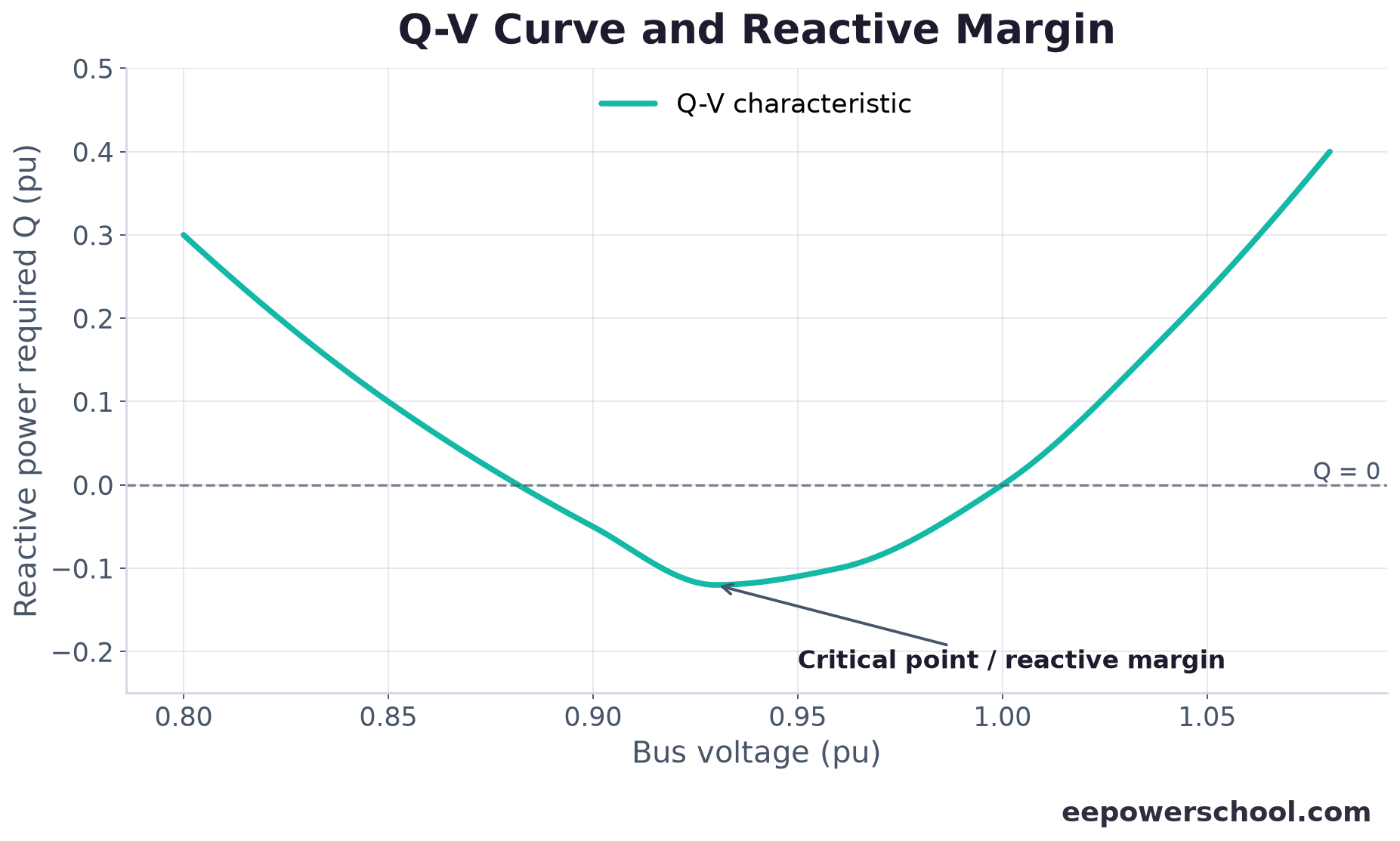
Where the P-V curve shows loadability, the Q-V curve shows reactive headroom. It plots the reactive power that must be injected at a bus to hold it at a given voltage. The bottom of the curve is the critical point: the lowest voltage the bus can sustain, and the reactive margin is how much extra reactive support is available before reaching it.
Operators use Q-V curves to quantify exactly how many additional vars a weak bus needs to stay safe. A shrinking reactive margin is an early warning that a bus is drifting toward instability, well before any obvious symptom appears. The second chart shows a typical Q-V curve and its margin.
Why High IBR Penetration Stresses Voltage Stability
Several effects combine as inverters displace machines. Retiring synchronous generators removes fast, robust local reactive sources and their large short-term overload capability. The grid gets electrically weaker, so the same power transfer produces larger voltage swings. And during faults, the limited current of inverters provides less of the reactive punch a machine would have delivered.
The net effect is a smaller, slower reactive reserve precisely where a weaker network needs more of it. This is why voltage stability, alongside system strength, is often the binding constraint on connecting more renewables in a region, a point explored further in our overview of inverter-based resources.
Static vs Dynamic Voltage Support
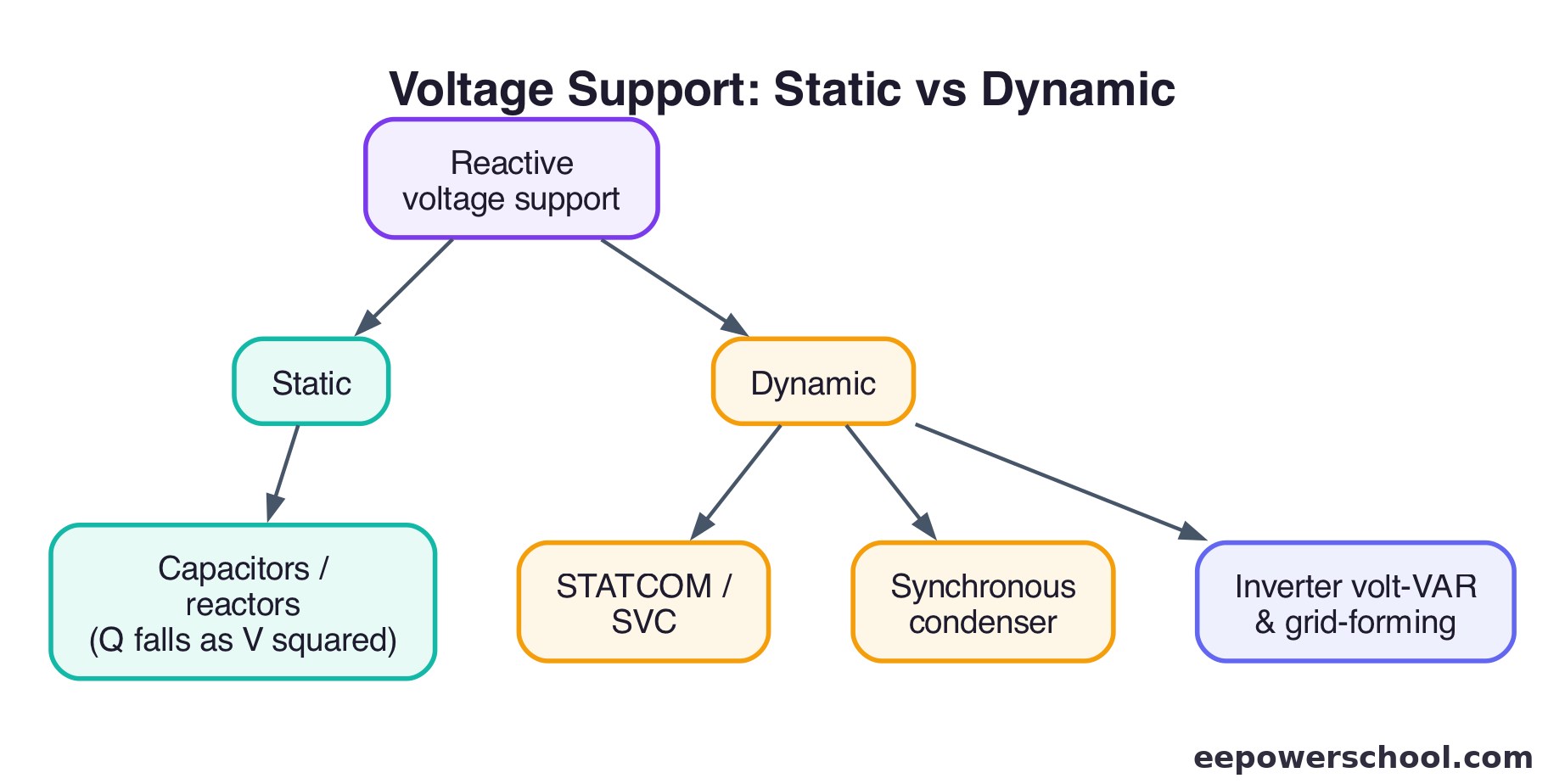
Not all reactive support is equal. Static sources such as switched capacitor banks are cheap, but they have a cruel flaw for voltage stability: the reactive power a capacitor produces falls with the square of voltage, so just when voltage sags and you need vars most, a capacitor delivers least. They can even accelerate a collapse.
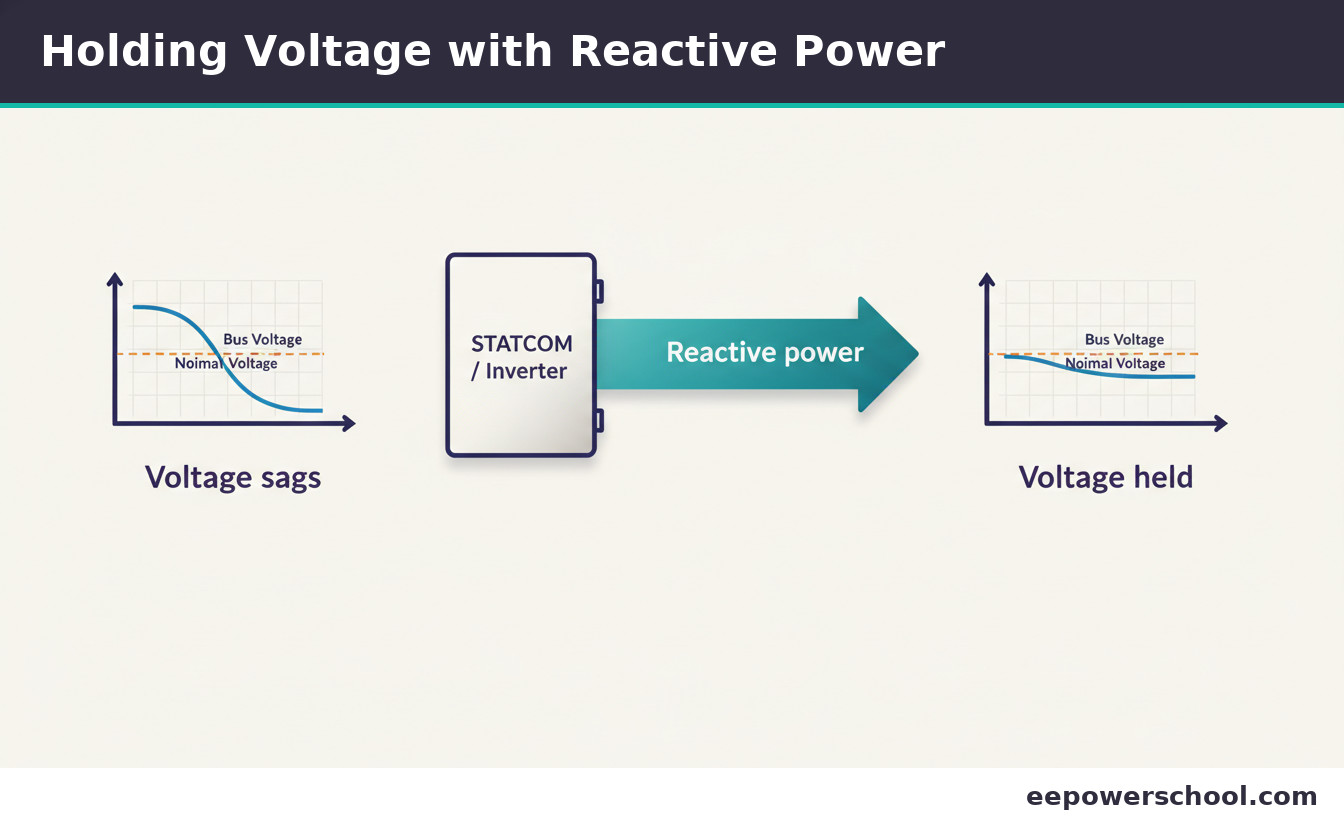
Dynamic sources hold voltage actively and fast: STATCOMs and SVCs, synchronous condensers, and the reactive capability of modern inverters. These maintain or increase their reactive output as voltage falls, which is exactly the behaviour voltage stability demands. The figure compares the two families.
How Inverters Help, and Where They Stop
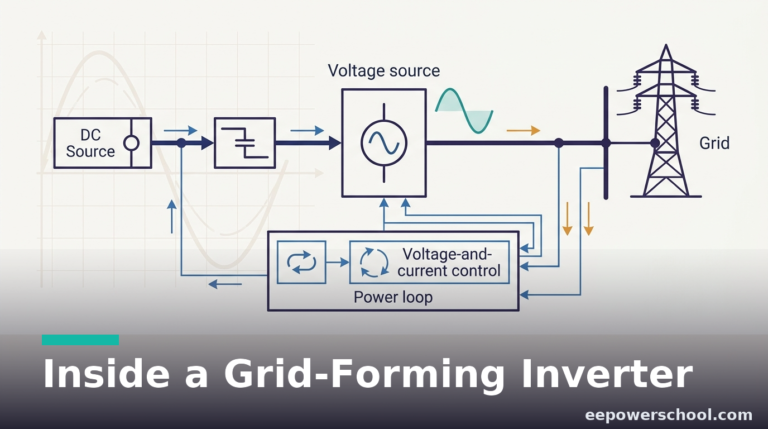
Modern inverter-based resources are genuine contributors to voltage stability. Through volt-VAR control they regulate steady-state voltage, and through fault ride-through they inject reactive current during dips to hold voltage up. Grid-forming inverters go further, supporting the voltage waveform in weak grids where grid-following units would become unstable.
But there are limits. An inverter’s reactive capability is bounded by its current rating, so it cannot match the several-times-rated reactive surge a synchronous machine briefly provides during a deep fault. Inverter support also depends on correct settings and coordination. They are a powerful part of the answer, not a complete drop-in replacement for machine reactive capability.
Keeping Voltage Stable: The Toolbox
Maintaining voltage stability in a high-IBR grid combines several measures:
- Synchronous condensers restore fast, robust dynamic reactive power and fault current exactly where strength is short.
- STATCOMs and SVCs provide fast, continuous dynamic voltage control.
- Grid-forming inverters support the voltage waveform and contribute to system strength.
- Smart-inverter volt-VAR settings turn the existing renewable fleet into distributed voltage regulators.
- P-V and Q-V studies in planning keep adequate loadability and reactive margins as the generation mix changes.
The throughline is a shift from cheap static reactive support toward fast dynamic support, deployed deliberately. Voltage stability, like frequency stability, is something a modern grid now has to engineer in rather than inherit for free.
Frequently Asked Questions
What is voltage stability in simple terms?
It is the grid's ability to keep voltages at every bus within acceptable limits, both normally and after a disturbance. The classic failure is voltage collapse, a progressive voltage decline driven by the system being unable to supply enough local reactive power at acceptable voltage.
What is the nose point of a P-V curve?
The nose point is the tip of the P-V curve, the maximum power that can be delivered to a bus. Beyond it there is no stable operating point: demanding more power gives less at a collapsing voltage. The distance to the nose is the loadability margin.
Why does high IBR penetration hurt voltage stability?
Retiring synchronous machines removes fast local reactive sources and their large overload capability, the grid becomes electrically weaker, and inverters provide less reactive current during faults. The reactive reserve shrinks just as a weaker network needs more, stressing voltage stability.
Why are capacitor banks not enough for voltage stability?
A capacitor's reactive output falls with the square of voltage, so when voltage sags and vars are most needed, it delivers the least. Static support can even accelerate a collapse. Dynamic sources like STATCOMs, synchronous condensers, and inverters hold output up as voltage falls.
Can inverters provide voltage support?
Yes. Through volt-VAR control and fault ride-through with reactive current injection, inverters actively support voltage, and grid-forming units help in weak grids. Their limit is the inverter current rating, so they cannot match a synchronous machine's brief several-times-rated reactive surge.
Related reading
- Inverter-based resources: the future of renewable energy
- Grid inertia 101: frequency dynamics and the modern grid
- Faults in power systems: types, causes and arcing
- Electrical Engineering Formula Cheat Sheet (power systems quick reference)
References
- Hatziargyriou et al. (2021), Definition and Classification of Power System Stability – Revisited & Extended, IEEE Trans. Power Systems
- IEEE Std 2800-2022 — interconnection of inverter-based resources
- AEMO — System strength in the NEM explained
- NERC — 2023 Inverter-Based Resource Performance Issues report