Advanced Grid Support (AGS) Services from Inverter-Based Resources
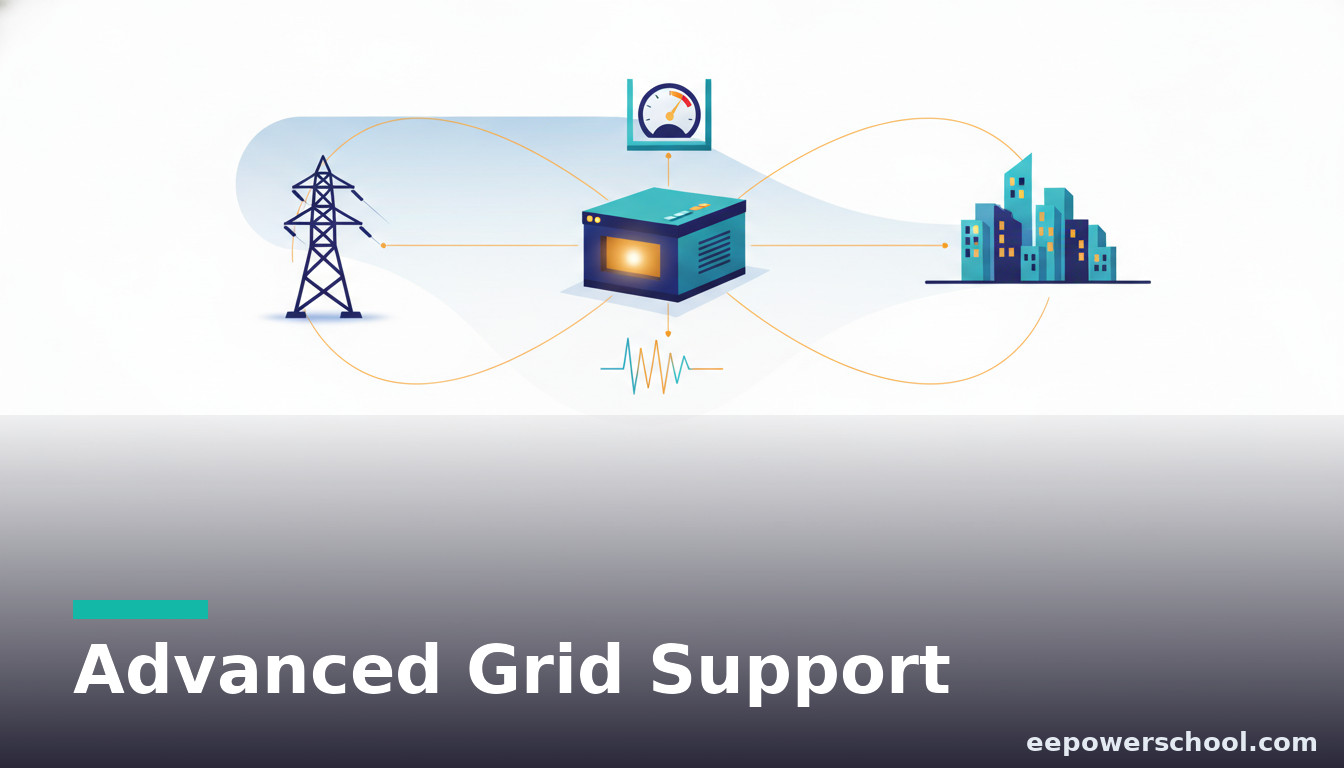
A solar or battery inverter used to have one job: convert DC to AC and push out as many megawatts as possible. That era is over. Modern grid codes expect inverters to actively hold the grid together, and the bundle of capabilities that lets them do it is what the industry calls advanced grid support.
These are the functions that let inverter-based resources replace not just the energy of retiring synchronous machines but the stability services they provided for free. This article walks through the main advanced grid support services, how each one works, what unlocks them, and what standards now require, so you can read a grid-code connection requirement and know exactly what is being asked.
What Advanced Grid Support Actually Means
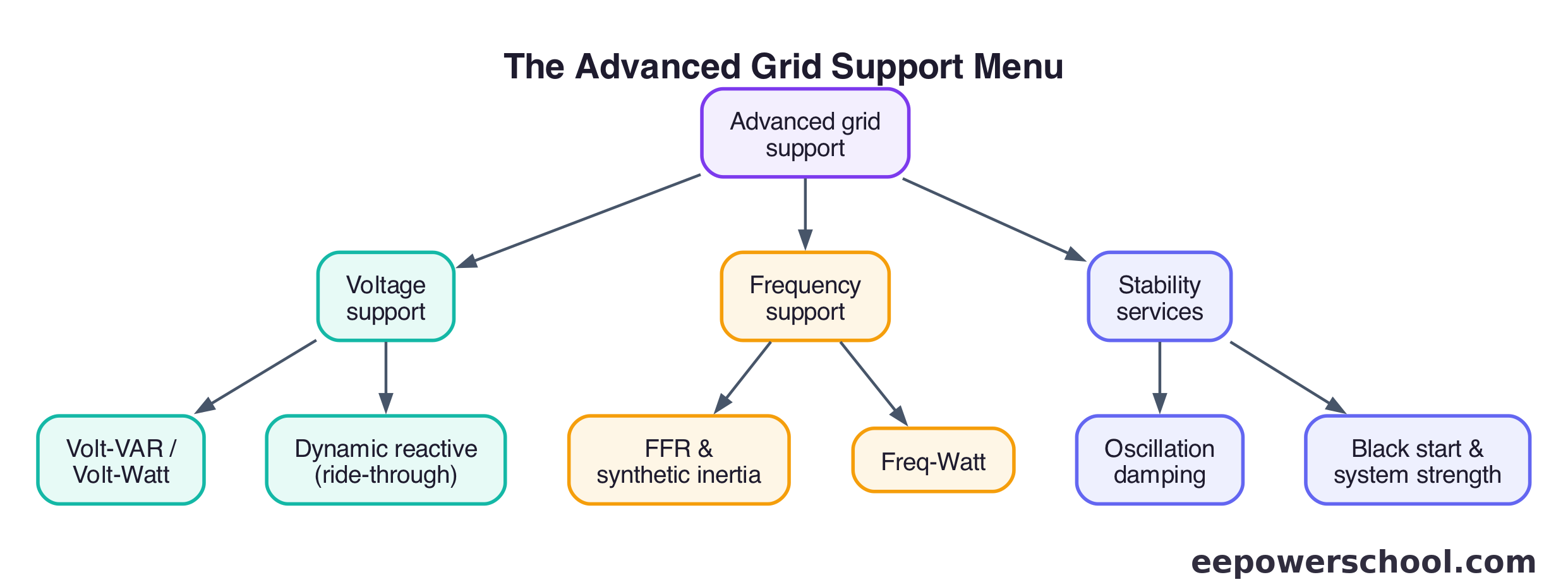
Advanced grid support is the umbrella term for inverter functions that go beyond simply injecting active power. Sometimes called smart-inverter or grid-supporting functions, they let a plant respond to voltage and frequency, ride through disturbances, and actively stabilise the network around it.
The shift is captured in standards. IEEE Std 1547-2018 redefined distributed resources from devices that must disconnect at the first sign of trouble into devices that must stay connected and help, and IEEE Std 2800-2022 extended that philosophy to large, bulk-system inverter-based resources. Reading those documents, advanced grid support is essentially the list of behaviours an inverter must now be capable of to earn its connection.
Voltage Support: Volt-VAR and Volt-Watt
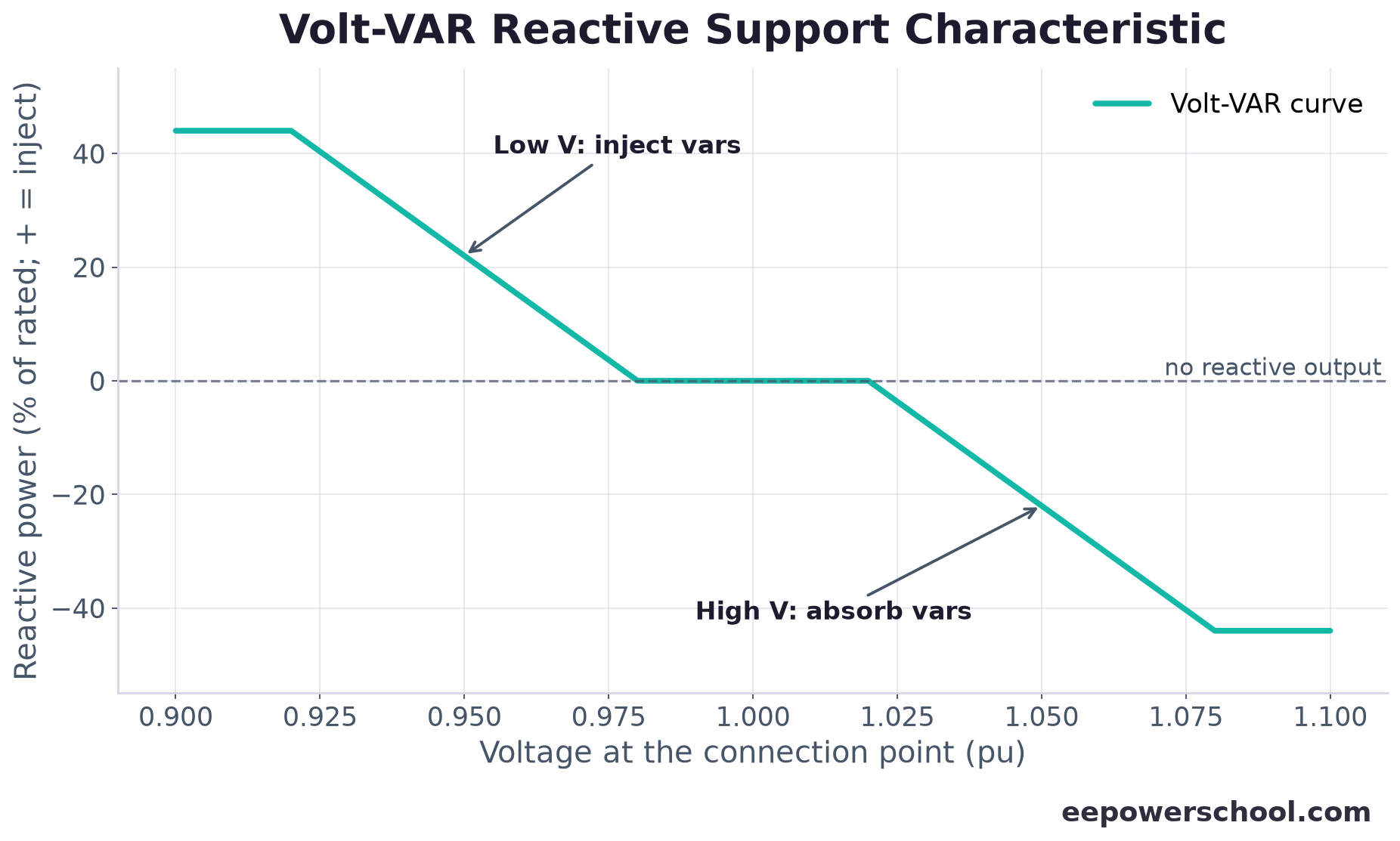
The most established advanced grid support functions manage voltage through reactive power. In volt-VAR control, the inverter absorbs reactive power when local voltage is high and injects it when voltage is low, following a defined characteristic with a deadband around nominal. Because it trades reactive power, it can support voltage without spilling real energy.
When reactive power alone is not enough, volt-watt control curtails active power at high voltage as a backstop. Together they let a fleet of inverters regulate voltage along a feeder or at a connection point, a job once left almost entirely to transformers, capacitors, and synchronous machines. The chart below shows a typical volt-VAR characteristic.
Frequency Support: FFR, Synthetic Inertia, and Freq-Watt
On the frequency side, advanced grid support spans several functions. Fast frequency response injects active power within a second or two to arrest a falling frequency; synthetic inertia responds to the rate of change of frequency to slow the initial fall; and freq-watt (frequency-droop) reduces output during over-frequency events.
These depend on having energy to deliver, which is why batteries are the natural home for them, though curtailed solar or wind running with headroom can contribute too. Frequency services are a deep topic in their own right; the mechanics of arresting the nadir are covered in our dedicated fast frequency response article.
Dynamic Reactive Support During Faults
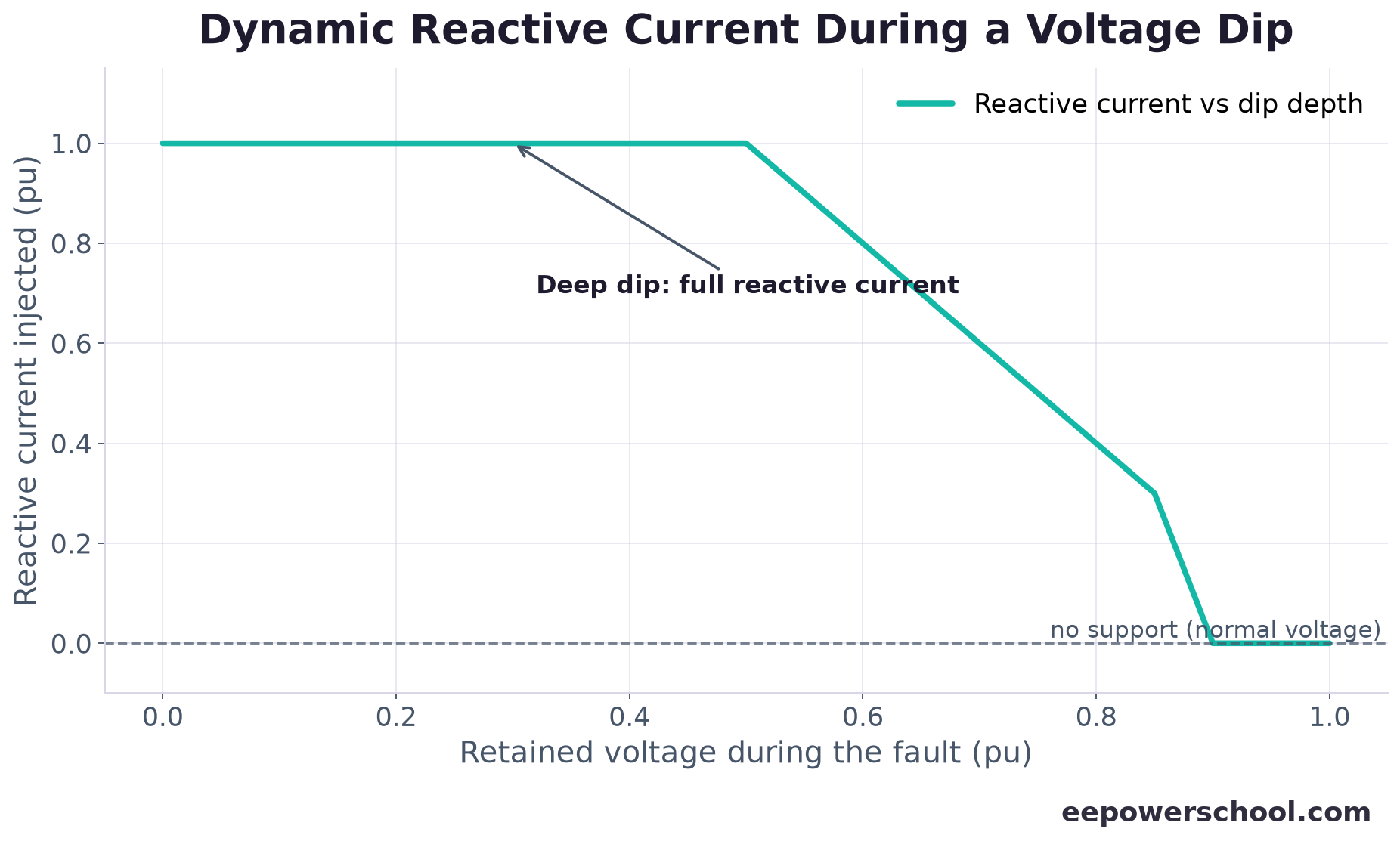
Steady-state voltage control is one thing; surviving a fault is another. Under fault ride-through requirements, an inverter must remain connected through a voltage dip rather than tripping, and modern codes go further and require it to inject reactive current proportional to the depth of the dip, actively helping to hold the voltage up while the fault is cleared.
This is a defining advanced grid support behaviour, and a major departure from older inverters that simply disconnected. The reactive current is delivered within milliseconds and scales with the severity of the dip, as the second chart illustrates. Getting this wrong was a contributing factor in several large disturbances where inverter-based resources tripped en masse instead of supporting the grid.
Power Oscillation Damping
Large interconnected grids have natural electromechanical modes, inter-area oscillations in which groups of generators swing against each other at fractions of a hertz. Poorly damped, these modes can grow and threaten stability.
Because inverters can modulate active and reactive power extremely fast, they can be controlled to actively damp these oscillations, injecting power in counter-phase to the swing much as a power system stabiliser does on a synchronous machine. Power oscillation damping is one of the more advanced grid support services, increasingly valuable as the fast, flexible capability of inverter fleets is harnessed deliberately rather than left idle.
System Strength and Black Start
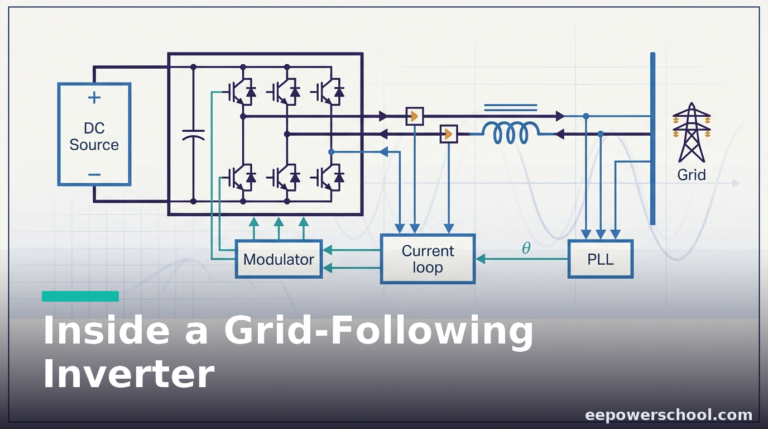
At the frontier of advanced grid support are the services that only grid-forming inverters can really provide. By imposing a voltage reference rather than following one, grid-forming units contribute to system strength, helping hold a stable voltage waveform in weak networks where grid-following inverters would struggle.
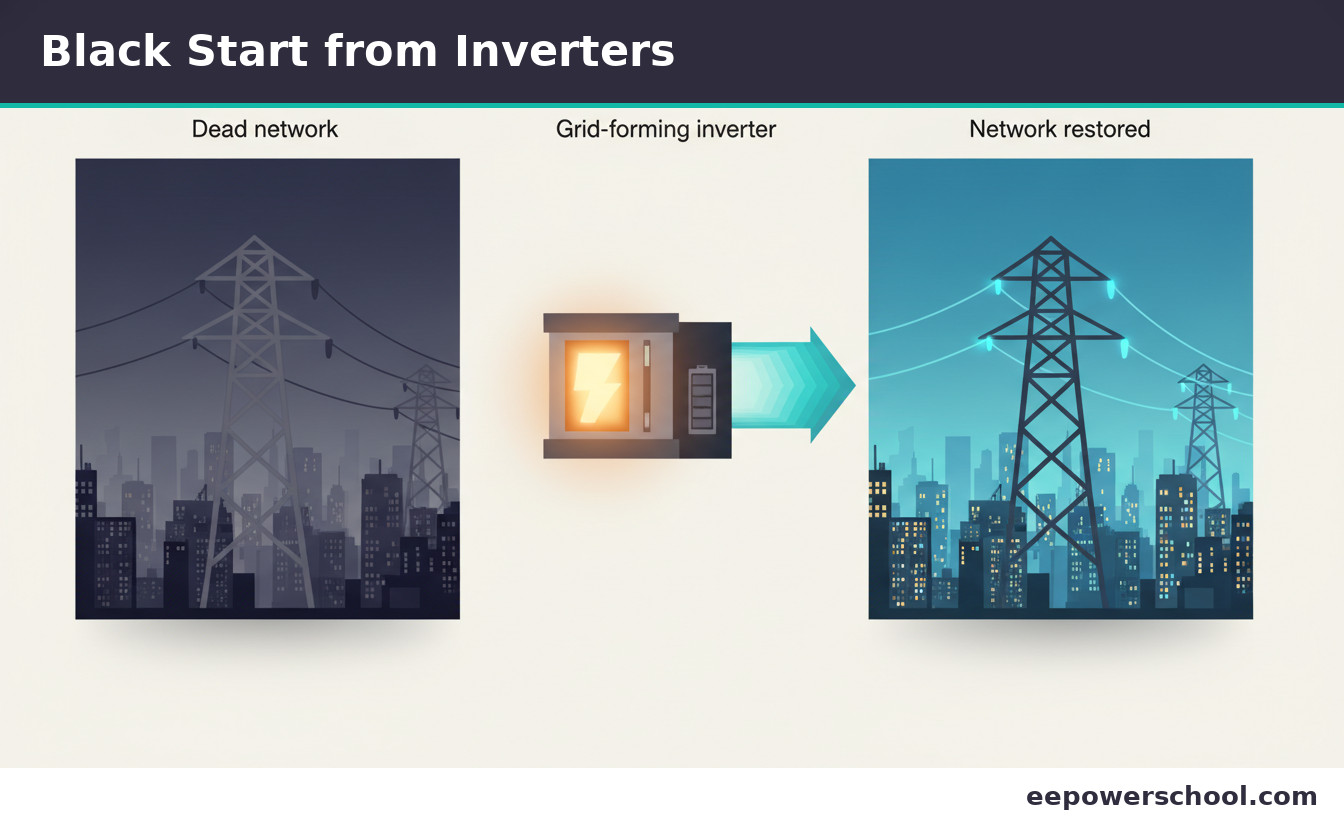
The headline capability is black start: energising a dead network from scratch. Traditionally the preserve of hydro and gas plants, black start from a grid-forming battery has now been demonstrated on real systems. An inverter that can restart a collapsed grid is the clearest sign of how far advanced grid support has come from the disconnect-on-disturbance days.
What Unlocks These Services: Grid-Forming and Headroom
Two practical enablers sit behind the whole list. The first is control type: grid-following inverters can deliver many functions, but the strength and black-start services need grid-forming control. The second is headroom. Active-power services such as fast frequency response require spare capacity or stored energy to deliver, so a solar farm running flat out has nothing to give until it is curtailed or paired with storage.
This is why batteries, with energy in both directions and fast grid-forming-capable inverters, have become the default platform for the full advanced grid support suite, while solar and wind contribute the subset their operating point allows.
Standards and Markets
Advanced grid support is increasingly mandatory, not optional. IEEE Std 1547-2018 requires smart-inverter functions for distributed resources; IEEE Std 2800-2022 specifies ride-through, reactive support, and frequency response for bulk-system inverter-based resources; and operators such as AEMO and EirGrid procure many of these capabilities as paid ancillary services.
For an engineer, the takeaway is that a modern connection agreement is essentially a checklist of advanced grid support functions. Knowing what volt-VAR, dynamic reactive support, fast frequency response, oscillation damping, and grid-forming capability each mean is now part of the basic vocabulary of connecting anything to the grid.
Frequently Asked Questions
What are advanced grid support functions?
They are inverter capabilities beyond simply exporting active power: voltage support (volt-VAR, volt-watt), frequency support (fast frequency response, synthetic inertia, freq-watt), fault ride-through with reactive current injection, power oscillation damping, and grid-forming services like system strength and black start.
What is the difference between volt-VAR and volt-watt control?
Volt-VAR adjusts reactive power against voltage, supporting voltage without spilling real energy. Volt-watt reduces active power output when voltage is high, used as a backstop when reactive power alone cannot bring voltage back into range.
Do inverters help during a fault?
Modern ones do. Under fault ride-through requirements they must stay connected through a voltage dip, and codes increasingly require them to inject reactive current proportional to the dip depth, actively supporting voltage while the fault is cleared, rather than tripping offline.
Which advanced grid support services need grid-forming inverters?
Grid-following inverters can provide many functions, including volt-VAR, fast frequency response, and ride-through. The services that essentially require grid-forming control are strong contribution to system strength in weak grids and black start, energising a dead network from scratch.
Are advanced grid support functions required by standards?
Yes, increasingly. IEEE Std 1547-2018 mandates smart-inverter functions for distributed resources and IEEE Std 2800-2022 specifies performance for bulk-system inverter-based resources. Many functions are also procured as paid ancillary services by system operators.
Related reading
- Inverter-based resources: the future of renewable energy
- Inverter basics: classification and applications
- Grid inertia 101: frequency dynamics and the modern grid
- Electrical Engineering Formula Cheat Sheet (power systems quick reference)