High IBR Penetration: The Grid Stability Challenges, Explained
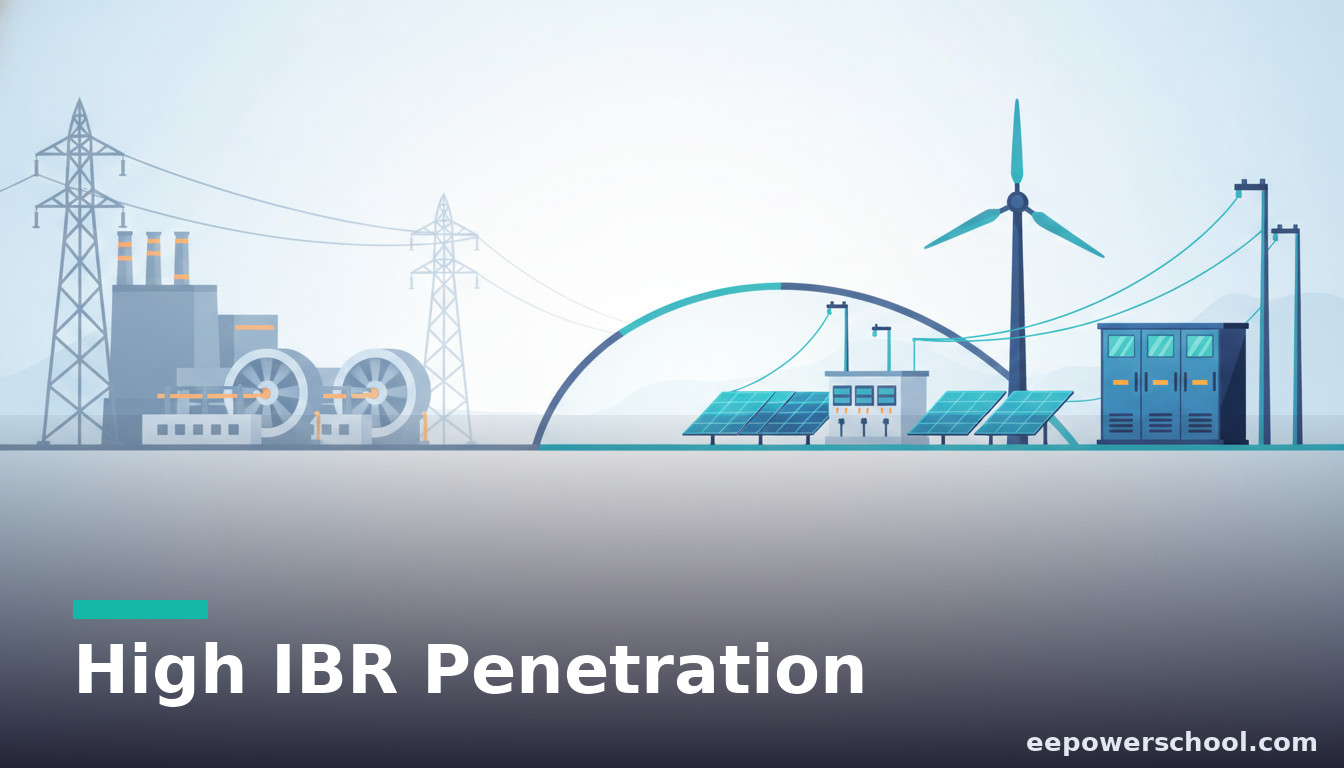
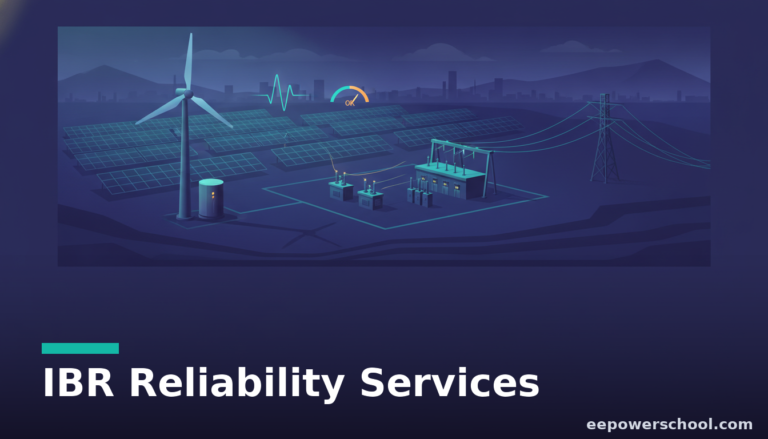
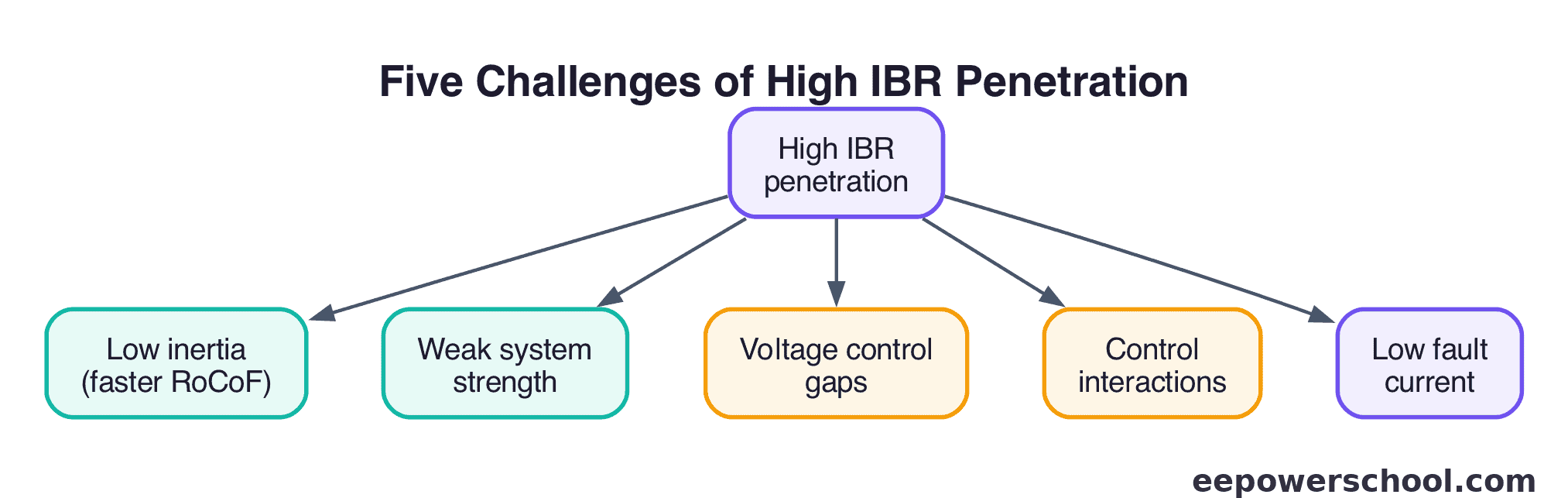
For a century, power system stability rested on the physics of large spinning machines. Synchronous generators stored kinetic energy, dumped huge fault currents, set the voltage and frequency, and damped disturbances almost as a side effect of how they are built. High IBR penetration, the rapid replacement of those machines with inverter-based resources such as solar, wind, and batteries, quietly removes every one of those free services at once.
The result is not that the grid stops working, it is that it behaves differently, and the assumptions baked into decades of planning and protection no longer hold. This article maps the real stability challenges that come with high IBR penetration, why each one happens, and the toolbox engineers are using to manage them. Think of it as the pillar overview; each challenge below deserves, and will get, its own deep dive.
What 'High IBR Penetration' Really Means
It helps to separate two different numbers. Energy penetration is the share of annual energy that comes from inverter-based resources; instantaneous penetration is the share at a single moment. Stability is governed by the instantaneous figure, and it is already extreme in places: grids such as South Australia and the all-island Irish system routinely operate with the majority of their demand met by non-synchronous generation at times, and operators set explicit limits on how high that share can safely go.
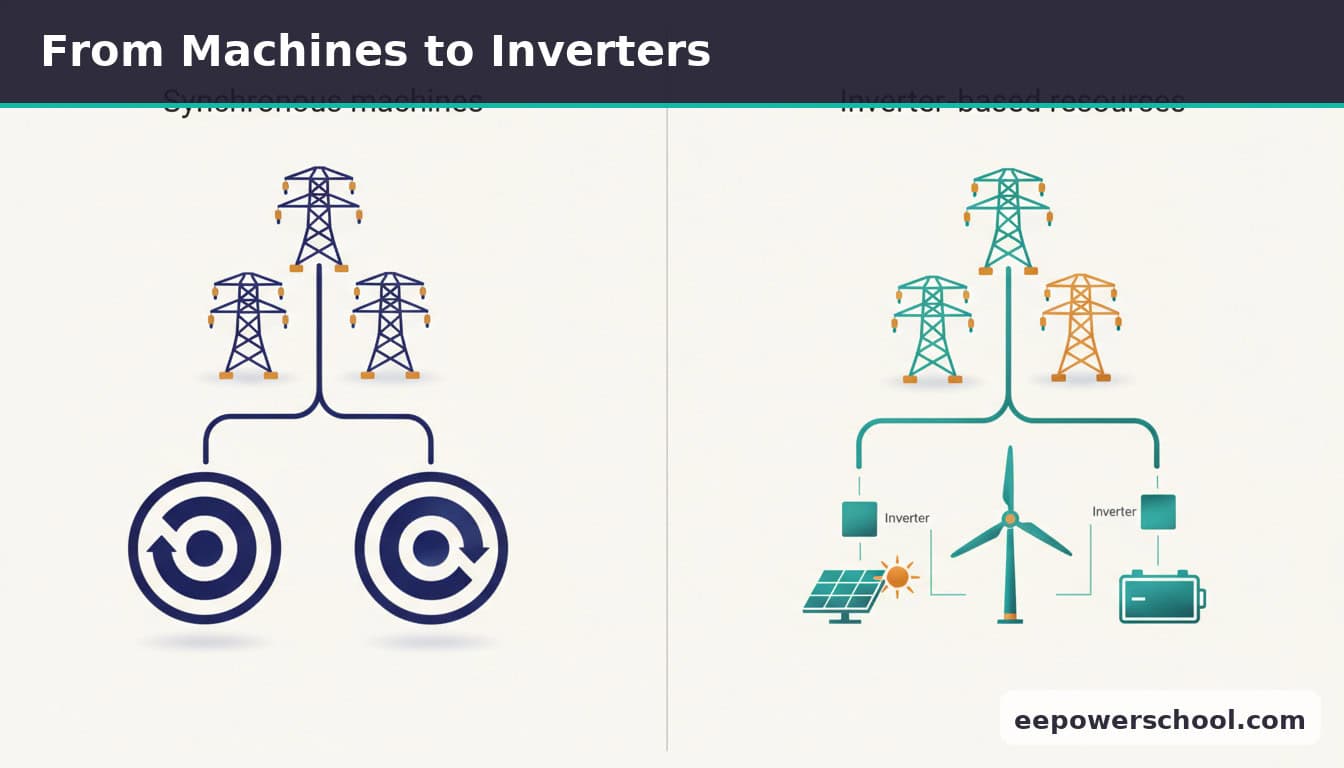
The deeper point is qualitative, not just quantitative. A synchronous generator is a physical mass coupled to the grid by electromagnetic laws; an inverter is a fast switching device that does whatever its control software tells it to. As the mix tips from the former to the latter, the grid stops being governed by rotating-mass physics and starts being governed by control loops. That shift is the root of everything that follows.
Falling Inertia and Faster RoCoF
The most discussed consequence is the loss of inertia. A spinning generator resists frequency change because changing its speed means changing its stored kinetic energy. Inverters, by default, have no such stored energy coupled to frequency, so as they displace machines the total system inertia falls.
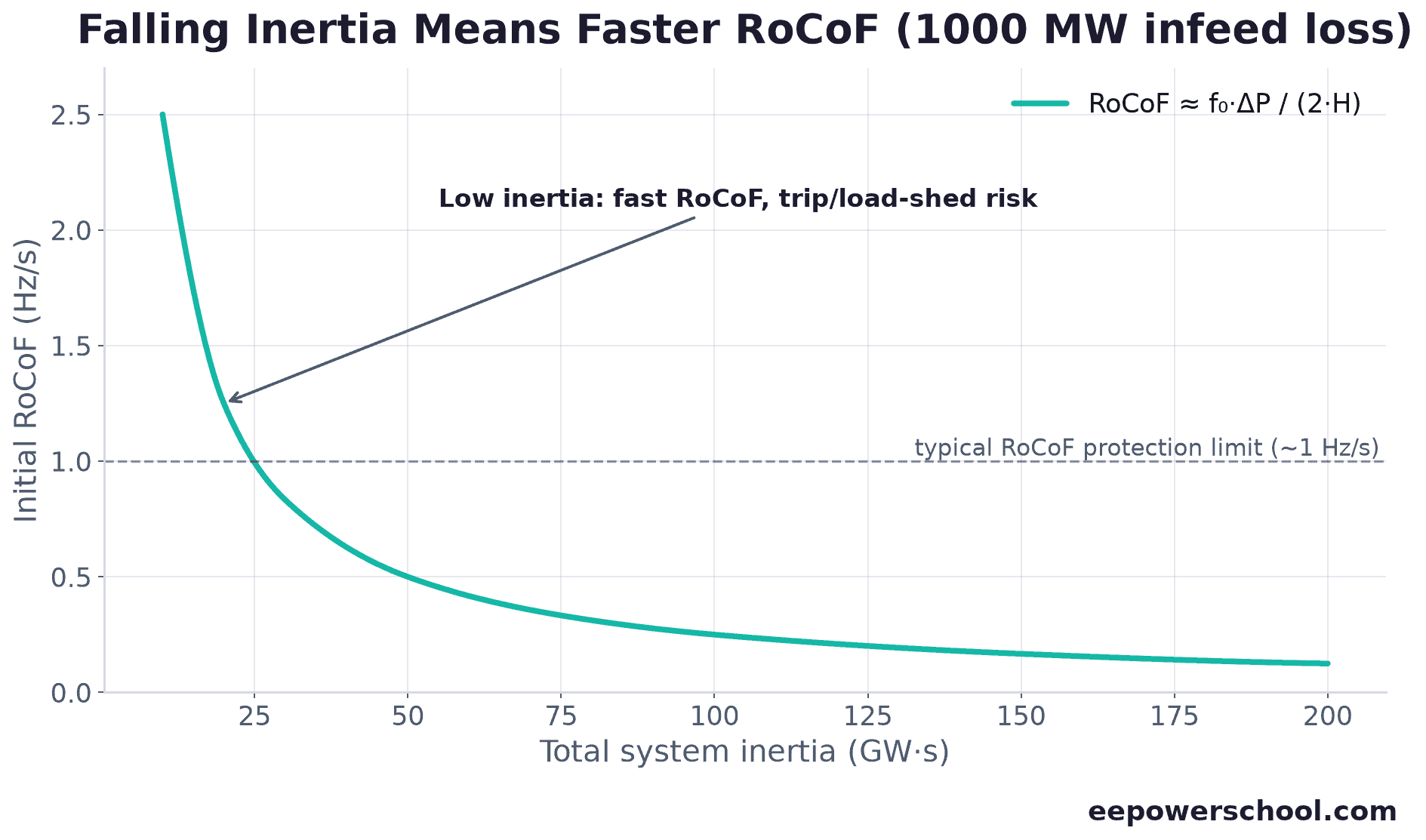
Lower inertia means a steeper rate of change of frequency (RoCoF) after a generator or interconnector trips. The swing equation makes this concrete: RoCoF is proportional to the size of the lost infeed divided by the system inertia, so halving the inertia roughly doubles the initial RoCoF for the same event. A faster RoCoF leaves less time before the frequency nadir, raises the risk of under-frequency load shedding, and can even trip RoCoF-sensitive protection. The chart below shows the relationship for a typical large infeed loss. For a deeper treatment of the mechanism, see our explainer on grid inertia and frequency dynamics.
Shrinking System Strength
Inertia gets the headlines, but system strength fails quietly and often bites first. System strength, the ability of the network to hold a stable voltage waveform, comes largely from nearby synchronous machines and their fault-current contribution. Retire those machines and the fault level falls, the short-circuit ratio (SCR) at connection points drops, and the grid becomes electrically “weak.”
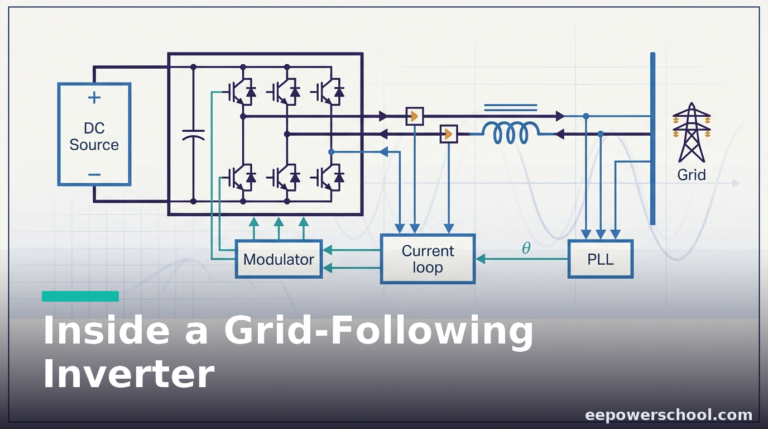
On a weak grid, every change in inverter current produces a large voltage swing, which is exactly the condition under which conventional grid-following controls become poorly damped or unstable. This is why a region can have plenty of energy available yet still be unable to connect another solar farm without remediation: the limit is strength, not megawatts.
Voltage and Reactive Power Control Gaps
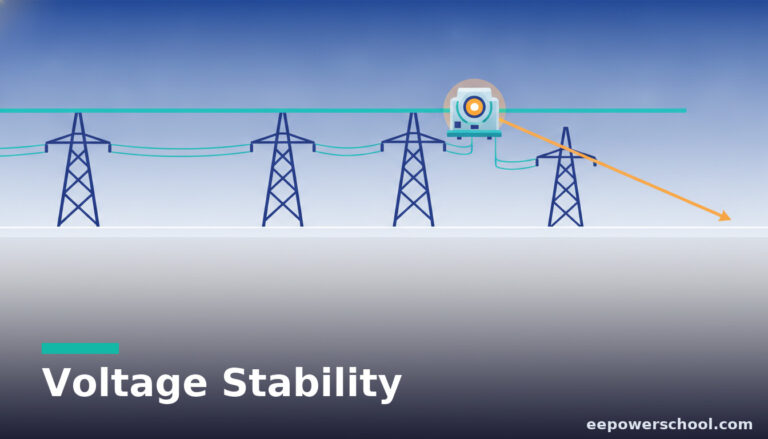
Synchronous machines are excellent, fast, and largely automatic sources of reactive power, the quantity that props up voltage. Their excitation systems and physical overload capability let them pour out vars during a disturbance without being told to. As they retire, that dynamic reactive reserve shrinks just as the weaker network needs it most.
Modern inverters can provide reactive power and fast voltage support, and standards increasingly require them to. But there are caveats: an inverter’s reactive capability is bounded by its current rating, it depends on correct settings and coordination, and during a deep voltage dip its contribution is limited compared with a machine that can briefly deliver several times its rating. Closing this gap is a central part of integrating high shares of renewables.
Converter-Driven Instability and Control Interactions
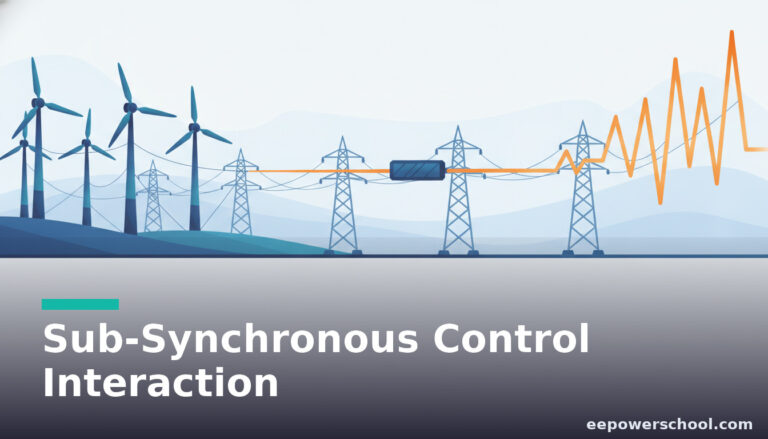
The genuinely new failure modes come from the controls themselves. Because inverters react within milliseconds, their control loops can interact with the network, with each other, and with series-compensated lines in ways that rotating machines never did, producing sustained oscillations across a wide range of frequencies.
This is significant enough that the 2021 IEEE/CIGRE revision of the power system stability definitions added two new categories specifically for it: converter-driven stability (fast and slow interaction) and resonance stability. In other words, the profession formally rewrote the stability taxonomy to accommodate what high IBR penetration introduced. Phenomena such as sub-synchronous control interactions and weak-grid phase-locked-loop instability live in these new categories, and they typically need electromagnetic-transient (EMT) study rather than conventional phasor tools to capture.
Protection Blind Spots
Protection schemes were designed around the behaviour of synchronous sources, which drive 5 to 7 times their rated current into a nearby fault. An inverter is limited by its semiconductors to roughly 1.1 to 1.5 times rated current, and exactly how it behaves during the fault is set by control software, not physics.
That low, control-defined fault contribution undermines several classic elements: overcurrent (50/51) may not pick up or coordinate, distance (21) can misjudge reach, and directional or negative-sequence logic can respond unexpectedly depending on the manufacturer. NERC’s analysis of recent United States disturbances documented inverter-based resources tripping or reducing output during faults, underscoring that protection has to be re-studied, not copied forward. The fundamentals are covered in our guide to faults in power systems.
Frequency Control: From Inertia to Fast Frequency Response
With less inertia to slow the initial fall, frequency control increasingly depends on acting fast rather than acting hard. The answer is fast frequency response (FFR): power injected within a second or two of an event to arrest the decline before the nadir, a role that batteries are exceptionally well suited to because they can change output almost instantly.
Markets have responded. Ireland’s DS3 programme and Great Britain’s fast services were early examples of paying explicitly for sub-second response and synthetic inertia, and similar products are spreading worldwide. The lesson is that frequency security in a high-IBR grid is less about a big spinning reserve and more about a fast, well-coordinated electronic one.
The Mitigation Toolbox
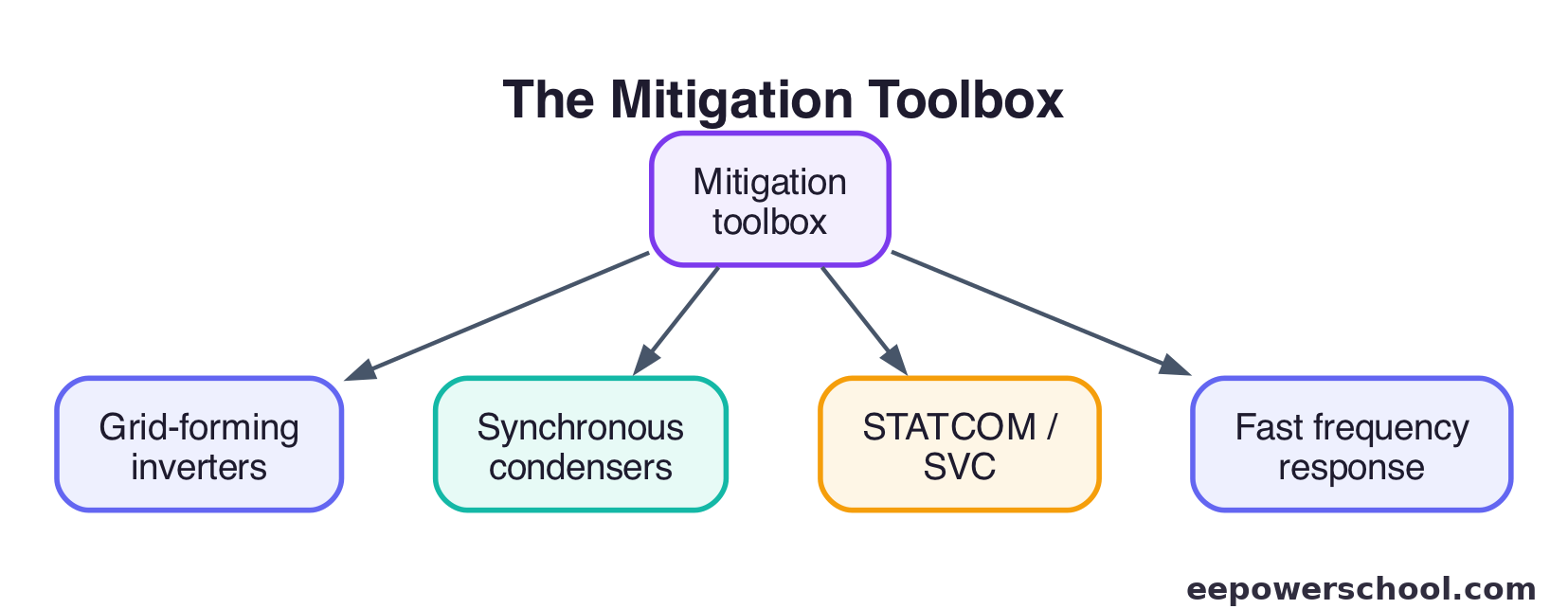
None of these challenges is a dead end; each has engineering answers, usually deployed in combination:
- Grid-forming inverters impose a voltage reference instead of following one, supplying synthetic inertia and behaving well in weak grids. Standards and grid codes increasingly require them, especially on storage.
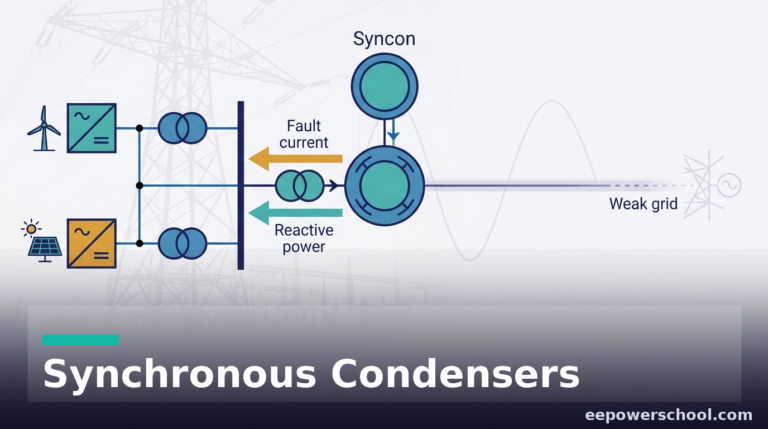
- Synchronous condensers, often retired generators left spinning, directly restore fault level and a little inertia exactly where strength is short.
- STATCOMs and SVCs add fast dynamic voltage support.
- Fast frequency response and advanced grid-support services from batteries and inverters replace the frequency cushion that inertia used to provide for free.
- Stronger grid codes, notably IEEE Std 2800-2022 for bulk-system inverter-based resources, mandate ride-through, reactive support, and stable behaviour across a range of system strengths.
Increasingly the cheapest lever is the control software itself: requiring grid-forming or better-damped behaviour so equipment tolerates the grid it actually connects to. That is the throughline of the whole transition, and the subject of the deep dives that follow this overview.
Frequently Asked Questions
What counts as high IBR penetration?
There is no single threshold, but stability is governed by instantaneous penetration, the share of demand met by inverter-based resources at a given moment. Some grids already operate above 70 percent instantaneously, and operators impose limits on how high that share can safely go at any time.
Why does high IBR penetration reduce grid inertia?
Synchronous generators store kinetic energy in their spinning mass that inherently resists frequency change. Standard inverters have no equivalent energy coupled to frequency, so replacing machines with inverters lowers total system inertia and raises the rate of change of frequency after a disturbance.
Is the problem inertia or system strength?
Both, and they are distinct. Inertia governs how fast frequency changes after an imbalance; system strength governs how stiff the voltage is and how stable inverter controls remain. System strength often becomes the binding constraint on new connections before inertia does.
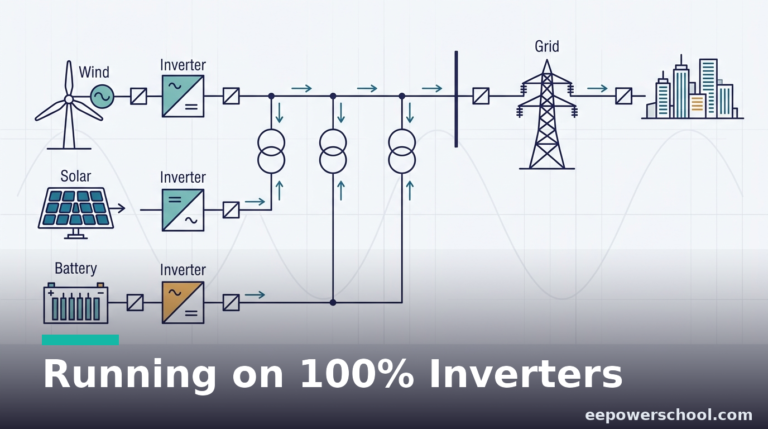
Can the grid run on 100 percent inverter-based resources?
Technically it is increasingly plausible with enough grid-forming inverters, synchronous condensers, and fast frequency response, and several systems are targeting it. It requires deliberate engineering of strength, frequency response, and protection rather than relying on the free services that synchronous machines once provided.
What standard governs inverter-based resources on the bulk grid?
In North America, IEEE Std 2800-2022 sets interconnection and performance requirements for bulk-system inverter-based resources, including fault ride-through, reactive support, and stable operation across system strengths. NERC is also developing mandatory reliability standards for IBR performance.
Related reading
- Grid inertia 101: frequency dynamics and the modern grid
- Inverter-based resources: the future of renewable energy
- Faults in power systems: types, causes and arcing
- Inverter basics: classification and applications
- Electrical Engineering Formula Cheat Sheet (power systems quick reference)
References
- Hatziargyriou et al. (2021), Definition and Classification of Power System Stability – Revisited & Extended, IEEE Trans. Power Systems
- NERC — 2023 Inverter-Based Resource Performance Issues report
- AEMO — System strength in the NEM explained
- IEEE Std 2800-2022 — interconnection of inverter-based resources