Reliability Services From Inverter-Based Resources: What the Grid Code Requires
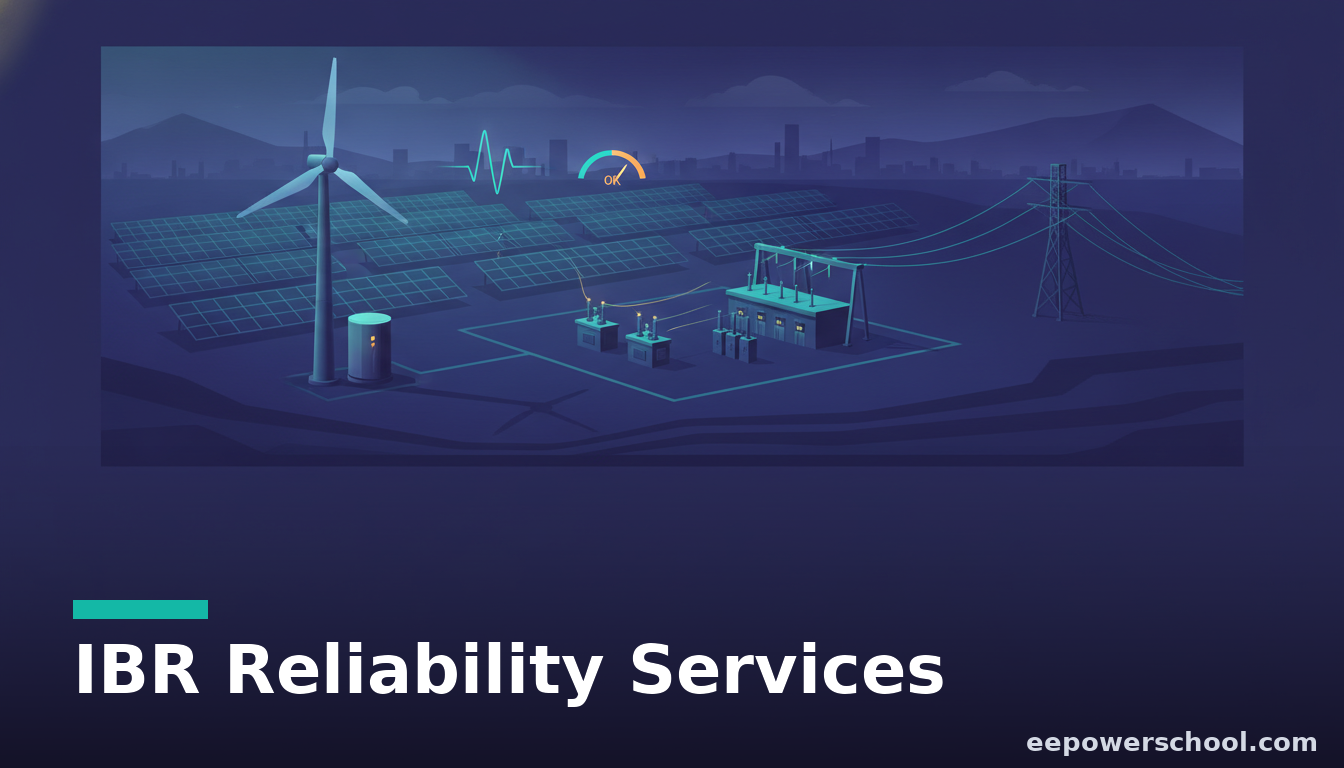
Not long ago, a solar or wind plant could connect, push out active power when the resource was there, and largely leave the hard work of keeping the system stable to the conventional plants around it. That era is over. Grid codes now demand a long list of reliability services from inverter-based resources, and a plant that cannot demonstrate them does not get to connect.
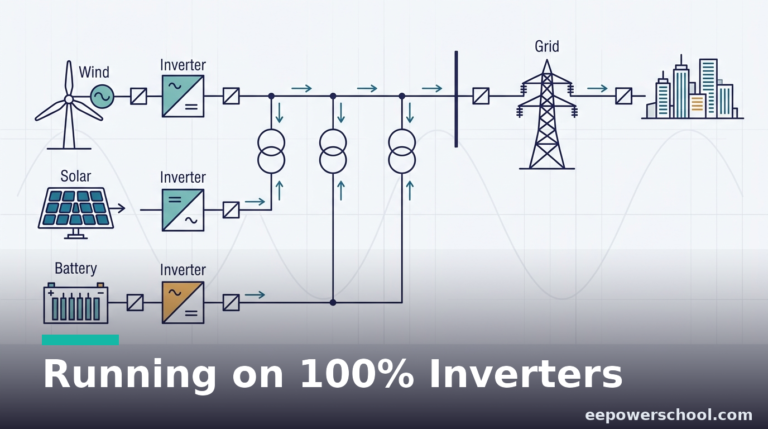
The change is sensible: as inverters take over more of the generation mix, the system cannot keep leaning on a shrinking fleet of synchronous machines for frequency support, voltage control and fault response. This post maps each required service to the inverter control loop that delivers it and the rule that mandates it, then works a real reactive-capability example so the numbers are concrete rather than abstract.
From Passive Generator to Grid Citizen
The phrase to know is essential reliability services: the support a grid needs to stay stable, which NERC groups broadly as frequency support, ramping and voltage support. For decades these came almost as a by-product of large rotating machines. As those retire, regulators have made the services explicit obligations rather than happy accidents.
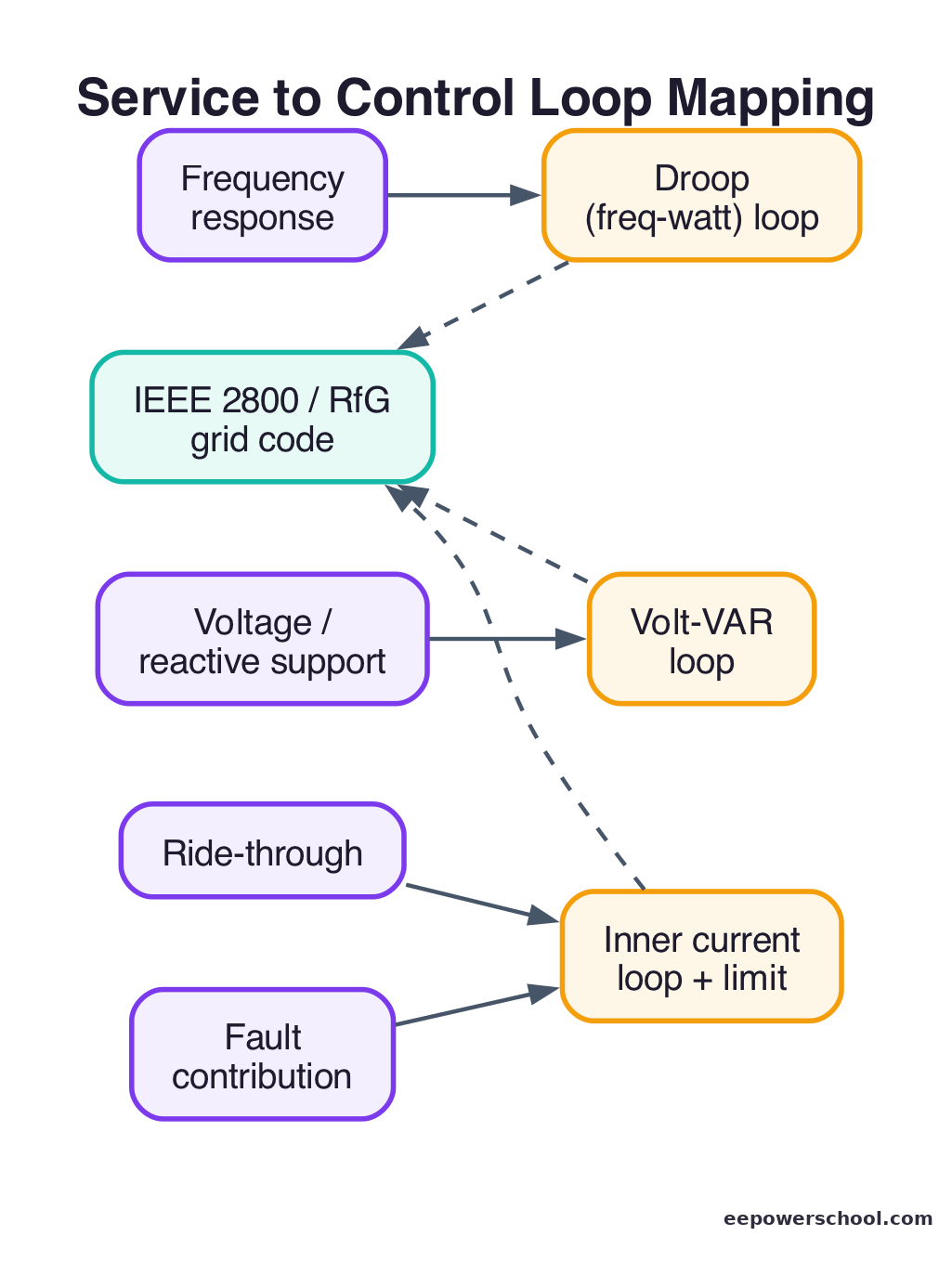
So when we talk about reliability services from inverter-based resources, we mean a defined set of measurable capabilities: respond to frequency, hold voltage with reactive power, ride through disturbances rather than tripping, and contribute a known fault response. Each is now written into interconnection standards with specific numbers attached, and each maps to a particular control loop inside the inverter.
The Standards That Set the Bar
Several standards converge on the same goal, with regional flavour. In North America, IEEE 2800-2022 sets the uniform minimum technical requirements for IBRs on the transmission system, and FERC Order No. 901 (October 2023) directed NERC to close the remaining IBR reliability gaps, leading to mandatory ride-through under PRC-029. In Europe, Commission Regulation (EU) 2016/631, the Requirements for Generators (RfG) network code, plays the same role, and AEMO sets connection performance standards in Australia.
| Standard / rule | Region | What it pins down |
|---|---|---|
| IEEE 2800-2022 | North America (transmission) | Minimum capability: ride-through, reactive control, frequency droop, fault response |
| FERC Order 901 / NERC PRC-029 | United States | Mandatory IBR performance, registration, ride-through |
| EU 2016/631 (RfG) | European Union | P-Q capability, LFSM frequency response, fault ride-through |
| AEMO NER 5.2/5.3a | Australia | Minimum and automatic access standards for each capability |
The detail differs, but the menu of reliability services from inverter-based resources is strikingly consistent across all of them.
Frequency Response: Droop and Deadband
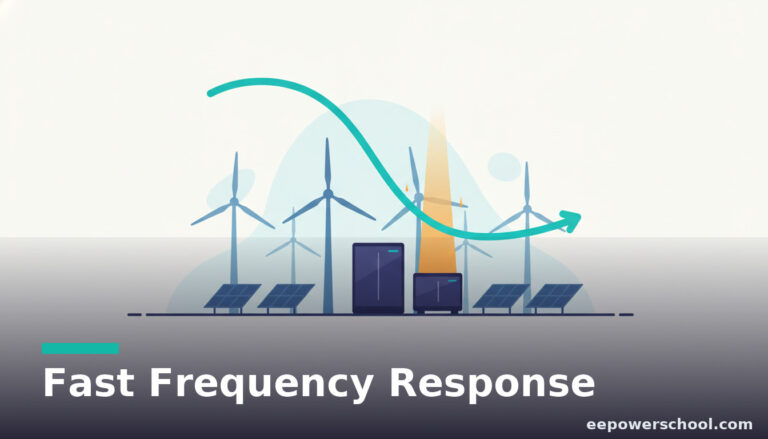
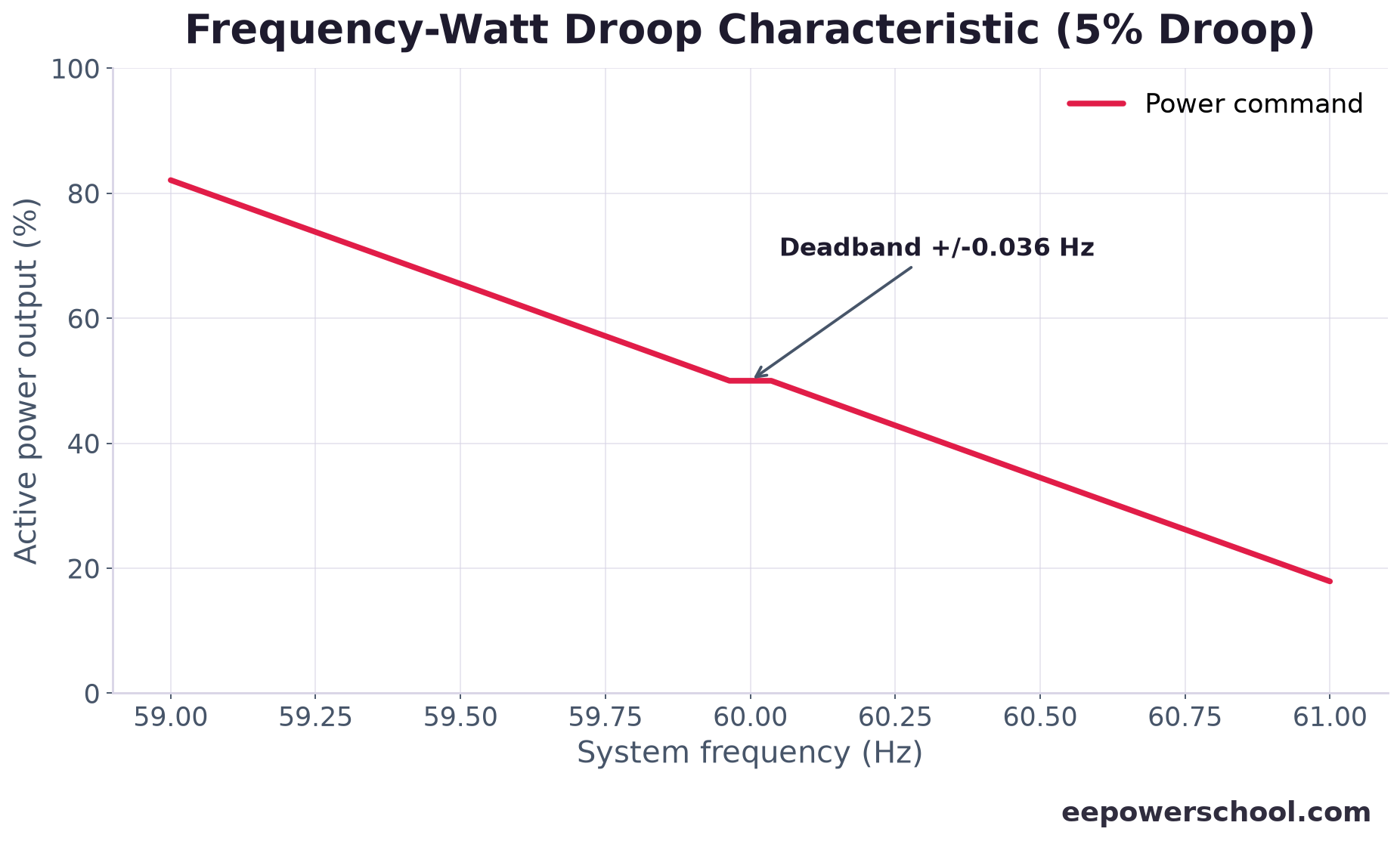
The first service is primary frequency response, delivered through frequency-watt (droop) control. When frequency falls, the inverter raises active power; when it rises, it backs off. IEEE 2800 mandates this in both directions, with a default deadband of \( \pm 0.036 \) Hz around nominal so the plant ignores tiny, normal wobble and only acts on real events.
Outside the deadband, the response follows a droop setting. A representative value is 5% droop, meaning a 5% change in frequency drives a 100% change in active power. In per-unit terms:
\[ \Delta P = -\frac{1}{R} \, \Delta f_\mathrm{pu} \]
where \( R \) is the droop (0.05 for 5%). So a 0.5 Hz drop on a 60 Hz system, about 0.0083 pu, commands roughly \( 0.0083 / 0.05 = 0.167 \) pu more active power, if the plant has the headroom. That last clause matters: to provide upward frequency response a plant must be curtailed below its available power, which is why frequency response is sometimes a market service rather than a free one. The standard specifies a settable range, not a single fixed droop, so treat 5% as typical, not universal.
Reactive Support: A Worked 0.95 Power-Factor Example
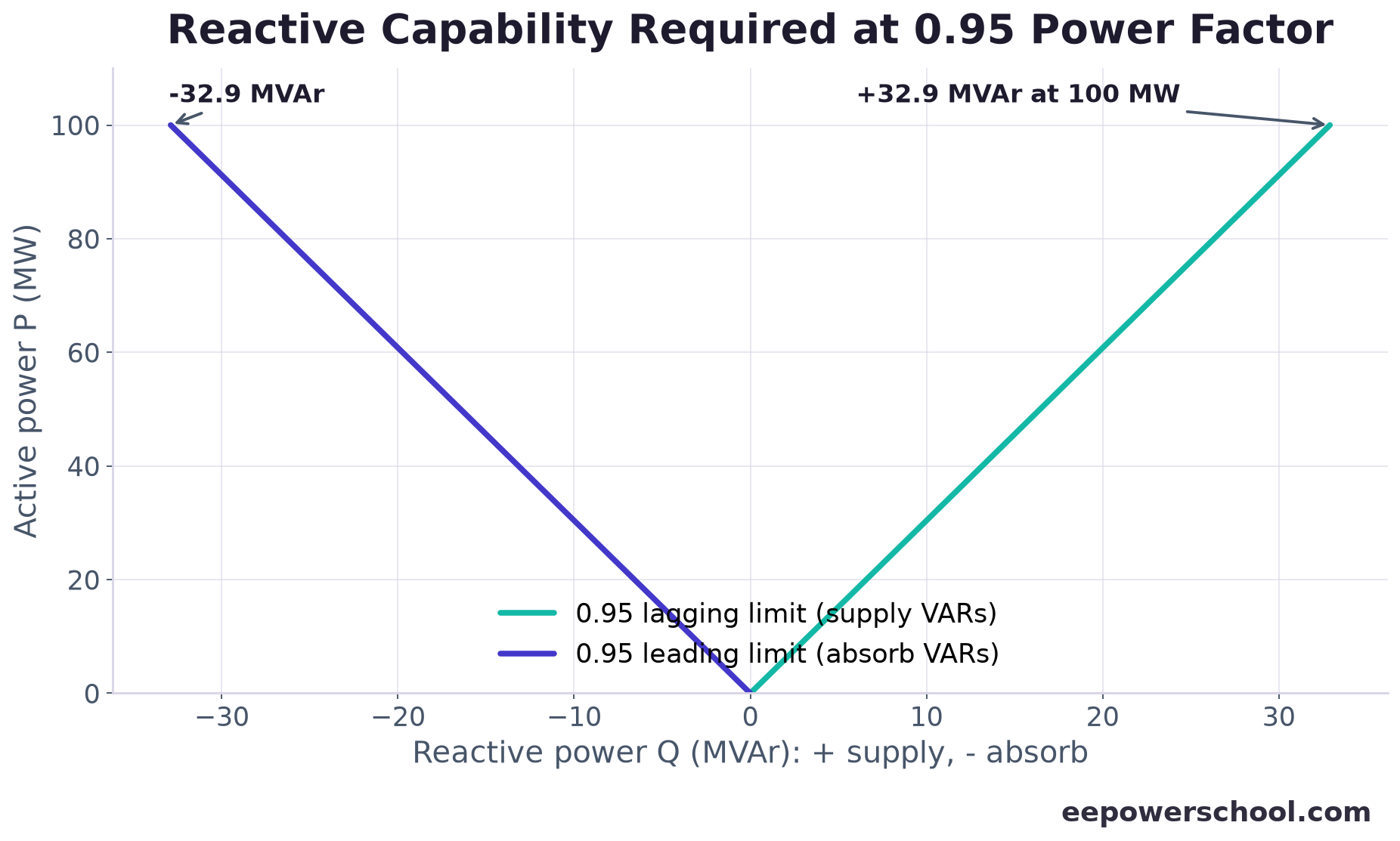
Voltage is held with reactive power, and this is where a concrete number helps most. IEEE 2800 requires reactive capability across a power-factor range of 0.95 leading to 0.95 lagging, evaluated at rated active power near the point of interconnection. Work out what that demands of a 100 MW plant.
The reactive requirement at the power-factor limit is:
\[ Q = P \tan(\cos^{-1}(\mathrm{pf})) = 100 \times \tan(\cos^{-1}(0.95)) = 100 \times 0.3287 = 32.9 \ \mathrm{MVAr} \]
So the plant must be able to supply and absorb about \( \pm 32.9 \) MVAr while still exporting 100 MW. The apparent power at that operating point is:
\[ S = \frac{P}{\mathrm{pf}} = \frac{100}{0.95} = 105.3 \ \mathrm{MVA} \]
That is the quietly expensive part. The inverters and the step-up transformer have to be rated for about 105 MVA, not 100, purely to meet the reactive obligation. The 0.3287 coefficient is not a coincidence: it is exactly the minimum reactive coefficient IEEE 2800 specifies for the 0.95 boundary. The plant delivers this through one of three reactive control modes, voltage control (volt-VAR), constant power factor, or constant reactive power, with voltage control the usual default. The chart shows the P-Q envelope the plant must reach.
Ride-Through: Stay Connected and Help
Early inverter fleets had a dangerous habit: when voltage or frequency stepped outside a narrow band, they tripped to protect themselves. With enough inverters, that self-protection becomes a system-wide event, as several real disturbances proved when large blocks of solar disconnected during faults. So ride-through is now central to reliability services from inverter-based resources.
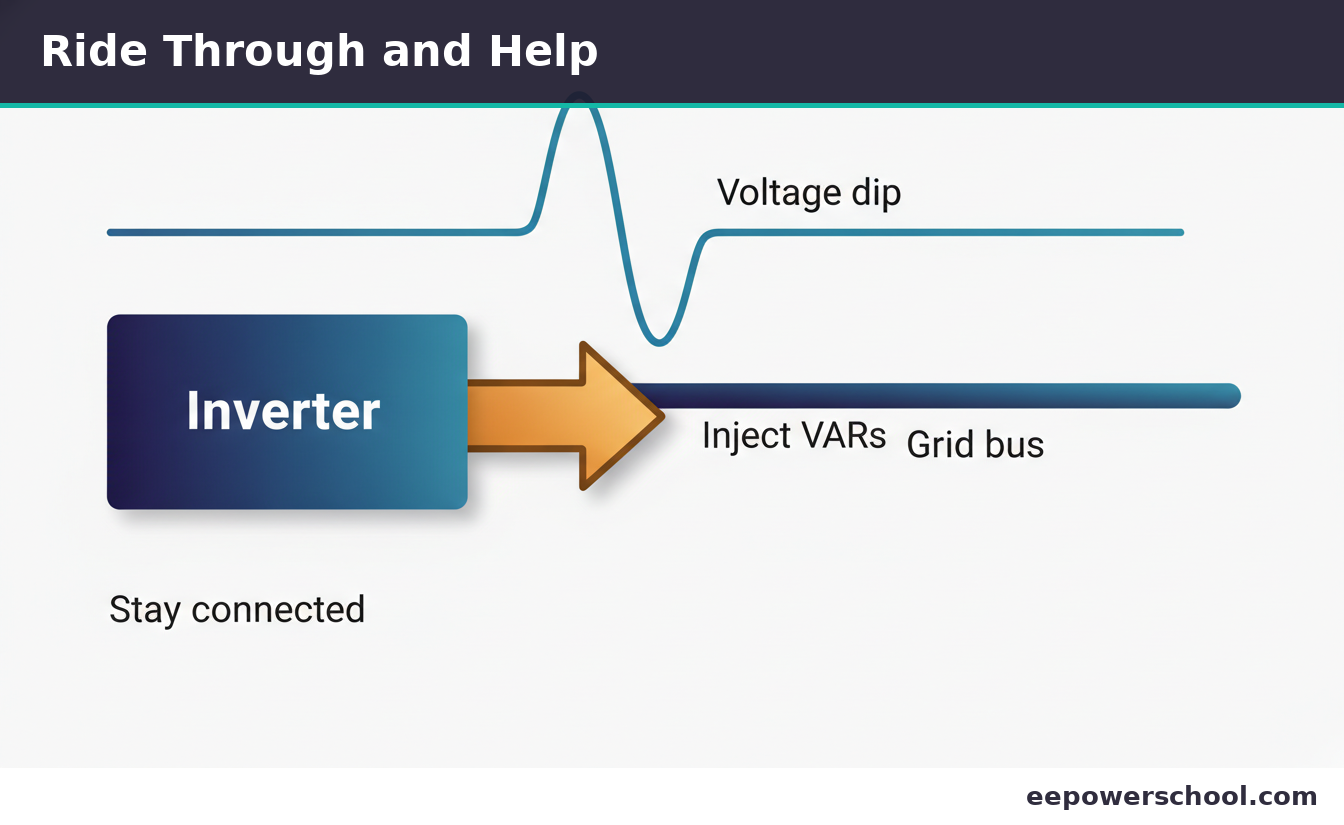
IEEE 2800 defines mandatory voltage ride-through, frequency ride-through and RoCoF ride-through, with frequency operation across roughly 57 to 62 Hz for 60 Hz systems and category-dependent voltage-dip curves. Crucially, an IBR is not just required to stay connected during a voltage dip, it must inject dynamic reactive current to help hold the voltage up, the opposite of walking away. That turns a potential liability into active support during exactly the moments the grid is most stressed.
Fault Current and System Strength
The one service inverters cannot fully replicate is brute fault current. A synchronous machine delivers 5 to 7 times rated current into a fault; an inverter is current-limited to about 1.1 to 1.5 times rated by its semiconductors. That changes protection design and erodes system strength as machines retire.
Standards handle this by specifying a defined, controlled fault contribution, including negative-sequence current injection for unbalanced faults, rather than the large uncontrolled surge of a machine. It is a smaller contribution, but a predictable one that protection can be designed around. Where the contribution is still not enough to keep the local grid stiff, the answer moves outside the plant: synchronous condensers or, increasingly, grid-forming inverters that behave as voltage sources and shore up the reference the rest of the fleet relies on.
Capable Is Not the Same as Enabled
Here is the part that catches projects out. A modern inverter is usually capable of every service above. Whether those services are actually enabled, set correctly, and verified is a separate question, and it is where a lot of compliance effort goes. A volt-VAR curve left at a flat default, a droop disabled, a deadband too wide: each is a service on the datasheet that the grid never actually receives.
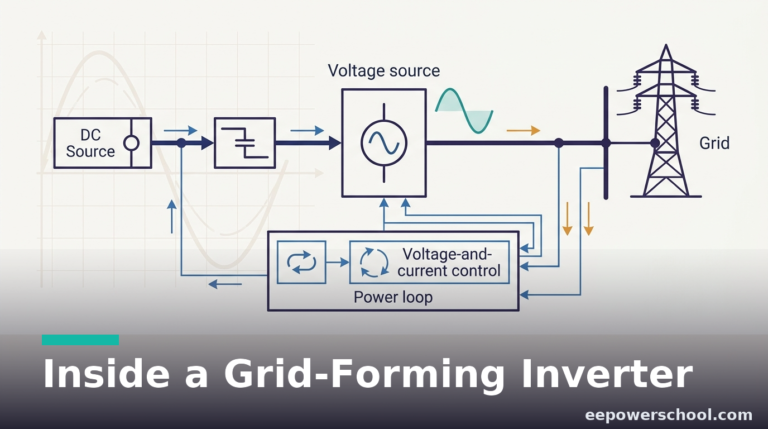
How each service is delivered also depends on the control architecture. A grid-following inverter provides them through outer droop and volt-VAR loops feeding a fast inner current loop, all behind a phase-locked loop and a hard current limit. A grid-forming inverter delivers frequency and voltage support more inherently, as a voltage source, which is why grid codes are steadily moving toward grid-forming-comparable minimums. Either way, the lesson is the same: the value of reliability services from inverter-based resources is realised only when someone tunes, enables and tests them, not when the box ships.
Conclusion
The shift here is cultural as much as technical. An inverter-based plant is no longer a guest that takes power export and leaves stability to others; it is expected to behave like a responsible grid citizen, with measurable obligations written into the connection agreement. Once you see the standards side by side, the list of reliability services from inverter-based resources stops looking like a regulatory burden and starts looking like a sensible spec for any generator that wants to make up most of the fleet.
If you take one practical thing from this, make it the gap between capable and enabled. The hardware almost always can. The reliability the grid actually receives depends on whether the droop is on, the volt-VAR curve is tuned, the ride-through is set to the right category, and someone has tested all of it against the code before energisation.
Key takeaways
- Grid codes now mandate reliability services from inverter-based resources; a plant that cannot demonstrate them does not connect.
- IEEE 2800, FERC Order 901 / NERC PRC-029, EU RfG and AEMO standards converge on the same menu: frequency response, reactive support, ride-through, fault response.
- Frequency droop with a deadband of about 0.036 Hz delivers primary response; upward response needs headroom, so it is often a curtailment cost.
- A 100 MW plant at 0.95 power factor must reach about 33 MVAr, which forces roughly 105 MVA of inverter and transformer rating, not 100.
- Ride-through flips inverters from tripping to injecting dynamic reactive current during faults, turning a liability into active voltage support.
- Capability is not delivery: services must be enabled, tuned and tested, and grid-forming control provides several of them more inherently than grid-following.
Frequently Asked Questions
What are reliability services from inverter-based resources?
They are the measurable grid-support capabilities now required of IBRs: primary frequency response via droop, reactive power and voltage support, voltage and frequency ride-through, and a defined fault-current contribution. NERC groups the underlying needs as frequency support, ramping and voltage support, and standards like IEEE 2800 attach specific numbers to each.
Does IEEE 2800 require a specific power factor?
Yes. IEEE 2800-2022 requires reactive capability across a power-factor range of 0.95 leading to 0.95 lagging at rated active power near the point of interconnection. For a 100 MW plant that means about plus or minus 33 MVAr of reactive capability, which typically forces around 105 MVA of inverter and transformer rating.
Why is ride-through so important for inverters?
Early inverters tripped offline when voltage or frequency left a narrow band. With many inverters, simultaneous tripping during a fault becomes a system-wide event. Ride-through requires IBRs to stay connected through disturbances and inject dynamic reactive current to support voltage, rather than disconnecting when the grid most needs them.
Can an inverter provide the same fault current as a synchronous machine?
No. A synchronous machine supplies roughly 5 to 7 times rated current into a fault, while an inverter is limited to about 1.1 to 1.5 times rated by its semiconductors. Standards instead specify a controlled fault contribution, including negative-sequence injection, and weak areas are reinforced with synchronous condensers or grid-forming inverters.
Related reading
- The future of the electric grid with renewable and green energy
- Single line diagram of a power system
- Power system simulation using PSS/E
- Electrical Engineering Formula Cheat Sheet (power systems quick reference)