Transmission Planning for High-Renewable Grids: A Primer
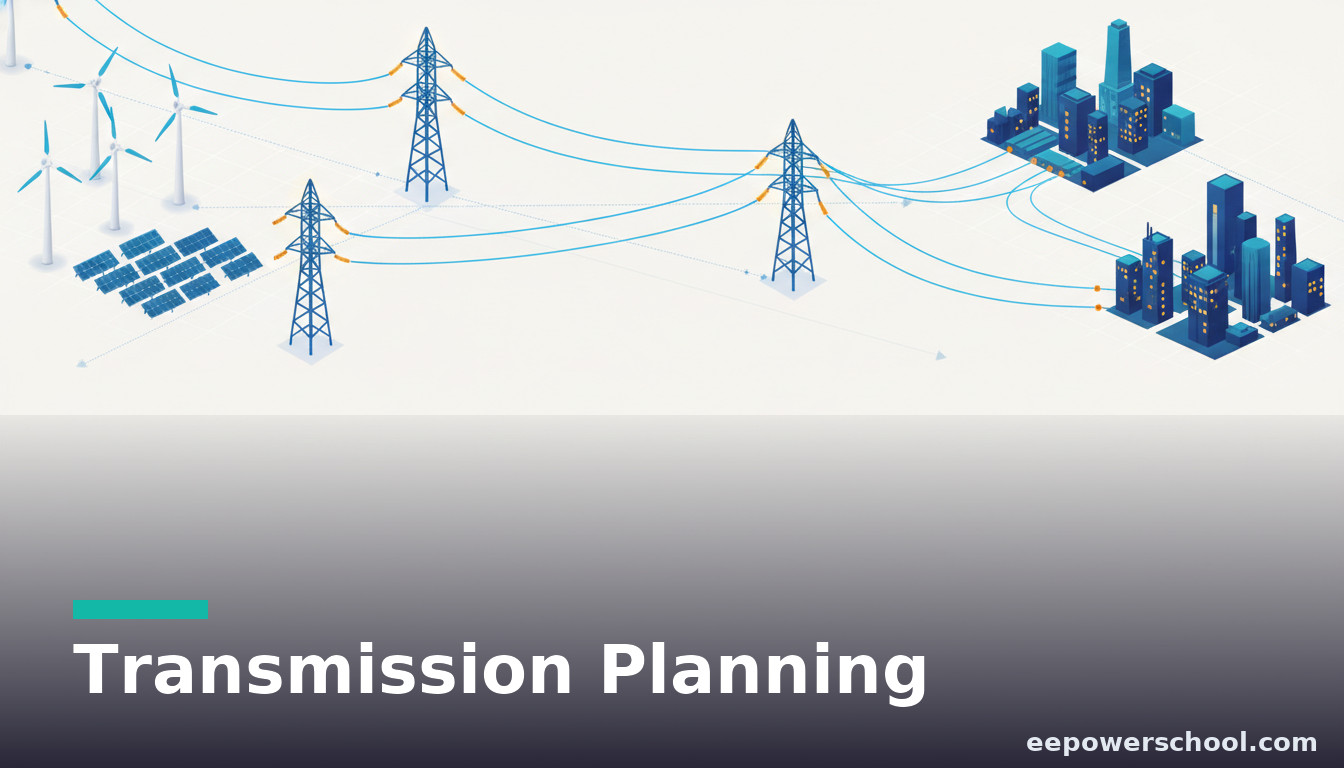
Behind every reliable grid is a quiet, years-long discipline most people never see: transmission planning. It is the work of making sure the high-voltage network can still deliver power, securely, through equipment failures and demand growth, not just today but a decade from now. As wind and solar reshape where and when power is generated, that work has become both harder and more important.
This primer walks through how transmission planning is actually done, from forecasting and reliability criteria to the power-flow, contingency, and stability studies at its core, and then shows how high renewable penetration is changing the process. It is the entry point to a field that sits upstream of almost everything else in power systems.
What Transmission Planning Is
Transmission planning is the process of deciding what the bulk transmission network needs, new lines, transformers, reactive support, or controls, so it can deliver power reliably and economically over a planning horizon of typically 5 to 20 years. It works at the level of the high-voltage backbone, not local distribution.
The guiding question is simple to state and hard to answer: can the grid still serve all demand, within equipment and voltage limits, after credible failures and as the system evolves? Everything in transmission planning is in service of answering that question with confidence, years before the power actually needs to flow.
Forecasting Load and Generation
Planning starts with a view of the future: how much demand there will be, where, and when, and what generation will serve it. Load forecasting blends economic and population trends with newer drivers like electric vehicles, heat pumps, and data centres.
The generation side is where renewables complicate things. Wind and solar are variable and often sited far from load, where the resource is best rather than where the network is strong. So transmission planning must now study many scenarios, different weather, demand, and generation patterns, rather than a single forecast, because the worst case for the grid may be a windy, low-demand night rather than a hot afternoon peak.
Reliability Criteria and N-1 Contingency
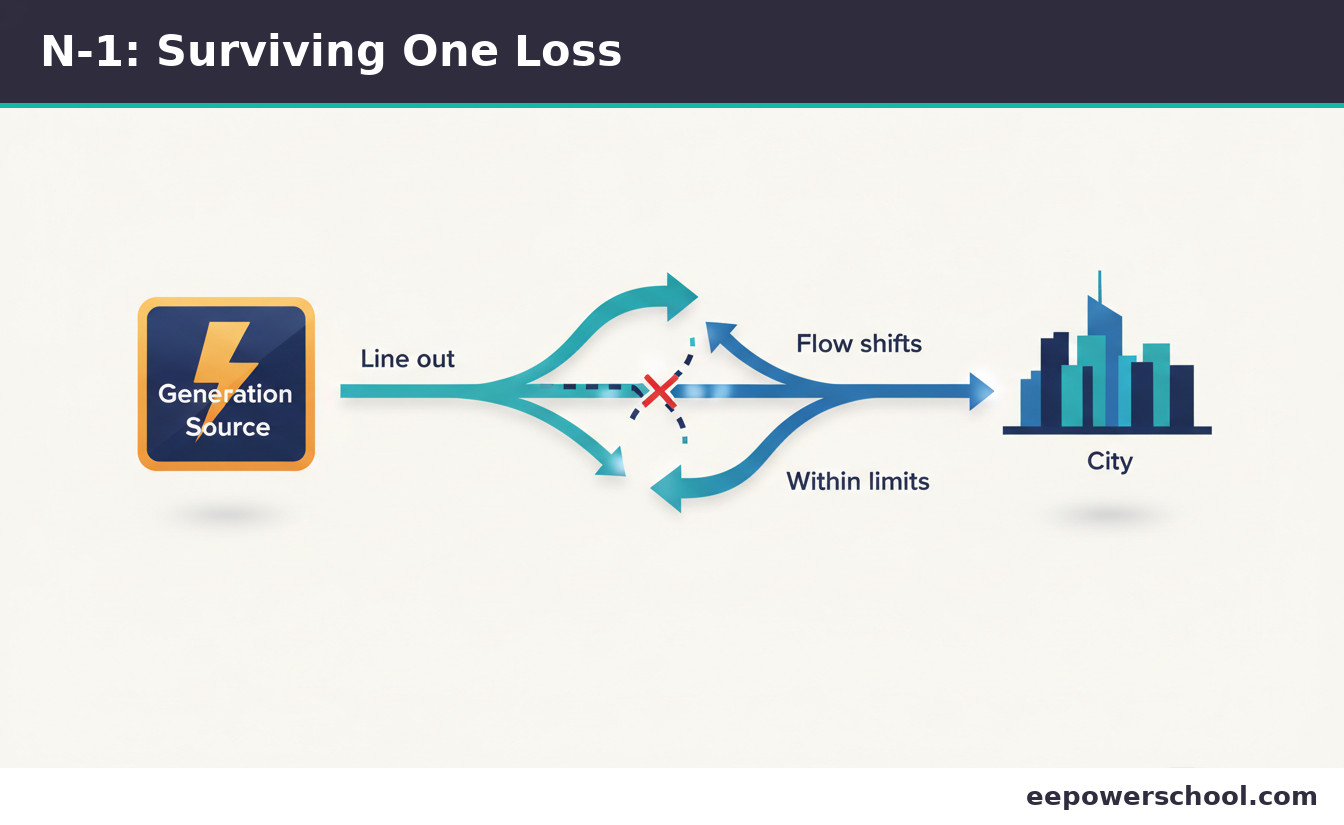
The backbone of transmission planning is the reliability criterion, and its heart is the N-1 rule: the system must withstand the loss of any single bulk element, a line, transformer, or generator, without shedding firm load or violating thermal and voltage limits. In North America this is codified in NERC’s TPL-001 transmission planning standard.
Planners go further with more severe contingencies, N-1-1 (a second loss after the system has been adjusted) and selected multiple outages (N-k), where limited, controlled load loss may be permitted. Designing the grid to ride through these credible failures, rather than just normal operation, is what makes transmission planning fundamentally about resilience.
The Study Workflow: Power Flow, Short Circuit, Stability
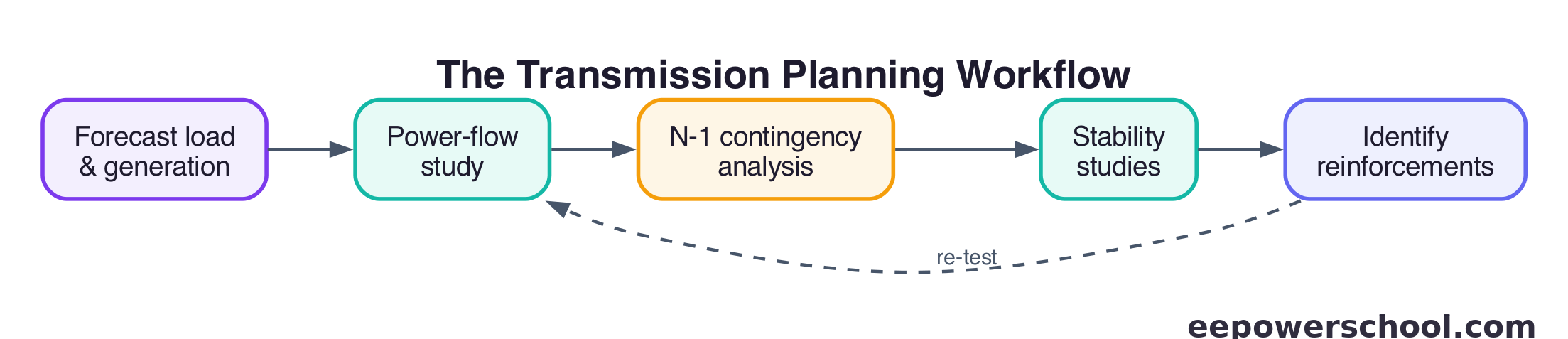
Transmission planning runs on simulation, in a layered workflow:
- Power-flow (load-flow) studies check steady-state voltages and line loadings under normal and contingency conditions.
- Short-circuit studies confirm fault levels and that protection and equipment ratings are adequate.
- Stability studies verify the system stays stable, in rotor-angle, voltage, and frequency terms, after disturbances.
Each contingency is tested across these dimensions, and where a study reveals a violation, the planner proposes a reinforcement and re-runs the analysis. The diagram below shows this loop, which repeats until the plan meets every criterion.
Hosting and Transfer Capacity
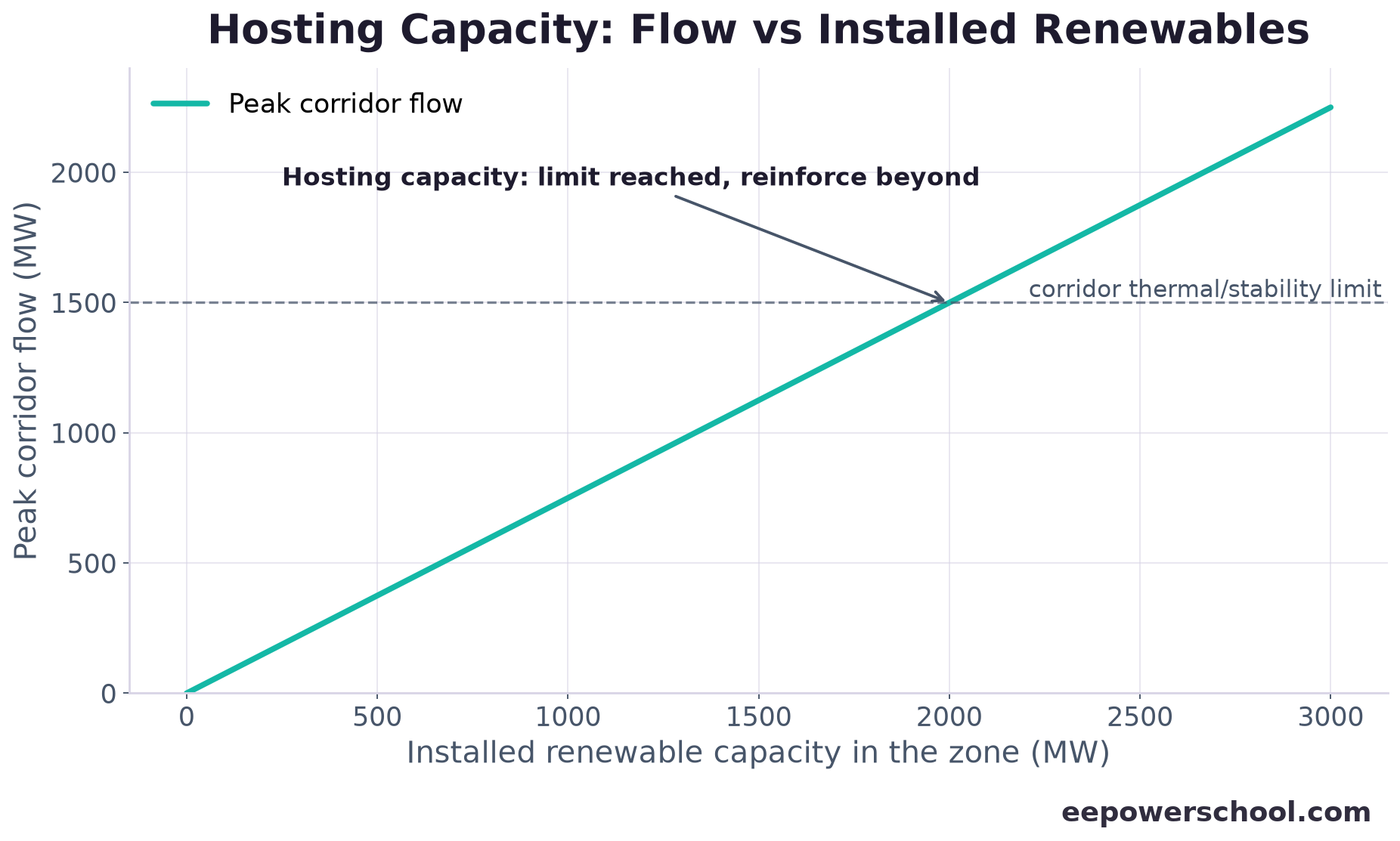
A central planning question for renewables is how much generation a part of the network can absorb, its hosting capacity, and how much power a corridor can move between regions, its transfer capacity. Both are limited by thermal ratings, voltage limits, and stability.
As more generation connects in a resource-rich zone, the flow on the corridor out of it rises until it hits a limit; beyond that point, the network needs reinforcement before more can connect. The chart illustrates this: peak corridor flow climbs with installed renewable capacity until it reaches the corridor limit, defining the hosting capacity of that path.
Interconnection Queues and Studies
New generators connect through an interconnection process: a developer applies, and the operator studies the impact on the grid and assigns any network upgrades needed. With the renewable boom, these queues have swelled enormously, and many projects request connection in the same constrained areas.
To cope, operators have shifted from studying projects one at a time to cluster studies that assess groups together and share the cost of common upgrades. The interconnection study is where transmission planning meets individual projects, and it has become one of the biggest bottlenecks in deploying new clean energy.
How High Renewables Reshape Planning
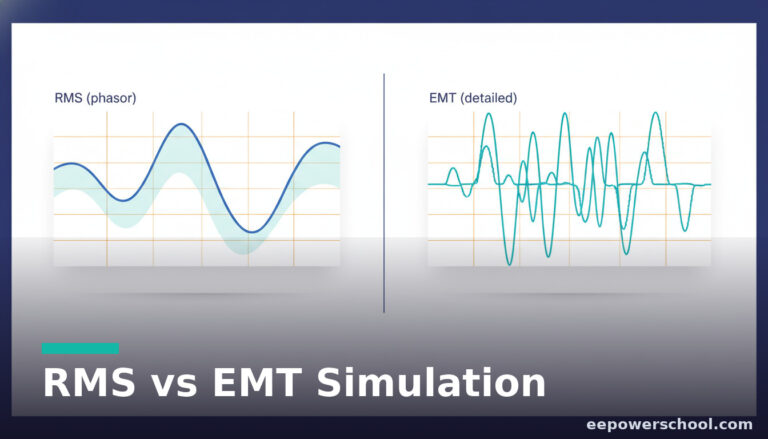
Renewables change transmission planning in several ways at once. Generation is variable and weather-driven, so planners study many scenarios rather than one peak. It is often located far from demand, requiring major new corridors. And as inverter-based resources displace synchronous machines, planning must now account for falling system strength and inertia, which means short-circuit and electromagnetic-transient (EMT) studies join the traditional toolkit.
Increasingly, transmission and storage are planned together, and proactive, scenario-based expansion is replacing reactive, project-by-project upgrades. The discipline is shifting from confirming a known future to planning robustly across many possible ones.
The Modern Transmission Planning Mindset
The throughline is a move from certainty to robustness. Classic transmission planning verified that a largely predictable grid met N-1 at peak. Modern transmission planning must keep that reliability backbone while planning a grid whose generation is variable, electronically interfaced, and remote from load.
That means more scenarios, more dynamic and EMT studies, more coordination with storage and markets, and a longer, more proactive view. The core question is unchanged, can the grid deliver power securely through credible failures, but answering it for a high-renewable system is one of the defining engineering challenges of the energy transition.
Frequently Asked Questions
What is transmission planning?
It is the process of determining what the high-voltage transmission network needs, such as new lines, transformers, or controls, to deliver power reliably and economically over a horizon of about 5 to 20 years, including after credible equipment failures and as demand and generation evolve.
What is the N-1 criterion?
N-1 means the system must withstand the loss of any single bulk element, a line, transformer, or generator, without shedding firm load or exceeding thermal and voltage limits. It is the core reliability rule of transmission planning, codified in North America by NERC's TPL-001 standard.
What studies are used in transmission planning?
Mainly power-flow (load-flow) studies for steady-state voltages and loadings, short-circuit studies for fault levels and equipment ratings, and stability studies for dynamic behaviour after disturbances. Each contingency is tested across these, and reinforcements are added where violations appear.
What is hosting capacity?
Hosting capacity is how much generation a part of the network can absorb before thermal, voltage, or stability limits are reached. As installed renewable capacity in a zone rises, the corridor flow out of it grows until it hits a limit, beyond which the network needs reinforcement.
How do renewables change transmission planning?
Renewables are variable and often far from load, so planners study many weather and demand scenarios and plan major new corridors. As inverter-based resources replace machines, falling system strength and inertia also require short-circuit and EMT studies alongside the traditional analyses.
Related reading
- The future of the electric grid with renewable and green energy
- Power system simulation using PSS/E
- Single line diagram of a power system
- Electrical Engineering Formula Cheat Sheet (power systems quick reference)