Power System Stability Classification (2021 IEEE/CIGRE Update)
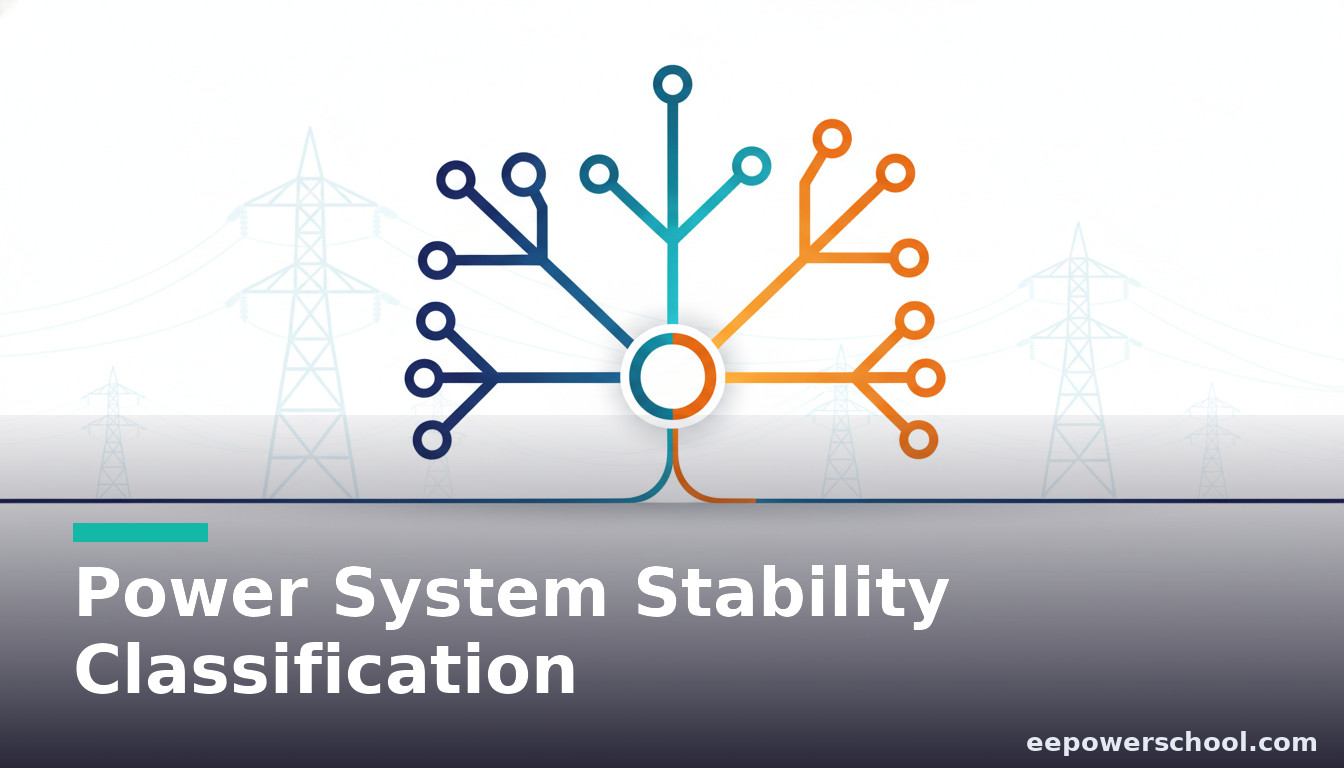
For nearly two decades, engineers shared one mental map of how a grid can lose stability: rotor-angle, voltage, and frequency. That map, the 2004 IEEE/CIGRE power system stability classification, served the synchronous-machine grid beautifully. Then inverter-based resources arrived and started failing in ways the map did not have a box for.
In 2021 a joint IEEE/CIGRE task force revisited and extended the classification, keeping the classic categories and adding two new ones for the inverter age. This article walks through the full, updated taxonomy, what each category means, and why the additions matter, so you can place any stability problem you meet in the right box.
Why a Power System Stability Classification Exists
Stability problems span timescales from microseconds to hours and mechanisms from spinning mass to control software. Without a shared taxonomy, engineers talk past each other and pick the wrong analysis tools. A classification gives each phenomenon a name, a timescale, and a driving mechanism, so the right study method and mitigation follow naturally.
The reference framework was set by Kundur and colleagues in 2004, which organised stability into rotor-angle, voltage, and frequency categories. That structure underpins textbooks and grid codes worldwide, which is exactly why updating it in 2021 was such a significant step rather than a cosmetic one.
The Classic Three Categories
The original power system stability classification rests on three pillars, defined by the quantity that runs away when stability is lost:
- Rotor-angle stability, the ability of synchronous machines to stay in step.
- Voltage stability, the ability to keep voltages within acceptable limits.
- Frequency stability, the ability to keep frequency near nominal after a generation-load imbalance.
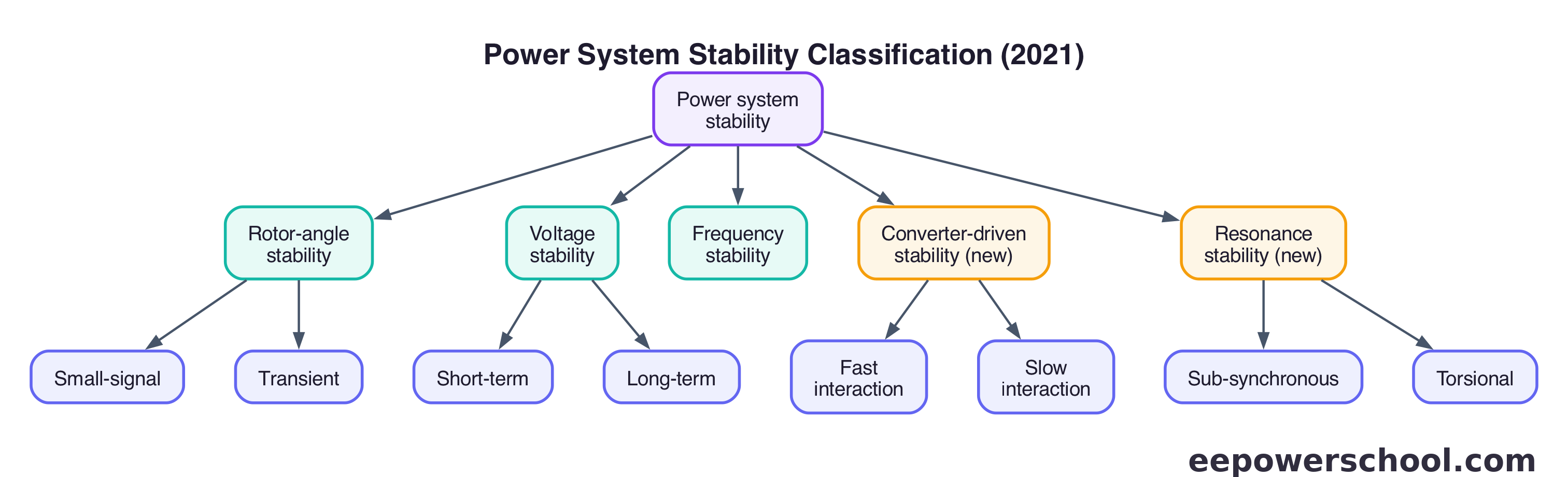
Each splits further by disturbance size and timescale. These three remain fully valid in 2021; the update did not replace them, it added to them. The diagram below shows the complete modern taxonomy.
Rotor-Angle Stability
Rotor-angle stability concerns the synchronous generators that, in a conventional grid, must rotate in lockstep. It divides into two: small-signal stability, the damping of small oscillations such as local and inter-area modes, studied with linearised models; and transient stability, whether machines stay synchronised after a large disturbance like a close-in fault, studied in the time domain.
This category is fundamentally about rotating mass and the angle between machines. As that mass is replaced by power electronics, rotor-angle stability does not vanish, but it shares the stage with the new phenomena the 2021 update introduced.
Voltage Stability
Voltage stability is the ability of the system to maintain steady, acceptable voltages at all buses after a disturbance, governed largely by reactive-power balance. It splits into short-term (seconds, driven by fast loads and dynamic devices) and long-term (minutes, driven by tap changers and thermostatic loads) forms, with voltage collapse as the classic failure.
It remains one of the most practically important categories, and one that high inverter penetration is making more acute as fast, robust reactive sources retire. It is distinct from rotor-angle stability, even though the two can interact during a severe event.
Frequency Stability
Frequency stability is the ability to hold system frequency near nominal following a significant imbalance between generation and load. It depends on inertia to limit the rate of change of frequency and on responsive reserves to arrest and restore it.
The 2021 update did not add a new frequency category, but the falling inertia of inverter-dominated grids has made frequency stability far more challenging in practice, shifting the emphasis toward fast response. It is a clear example of an old category whose engineering reality has changed even though its definition has not.
Why 2021: Inverters Broke the Old Map
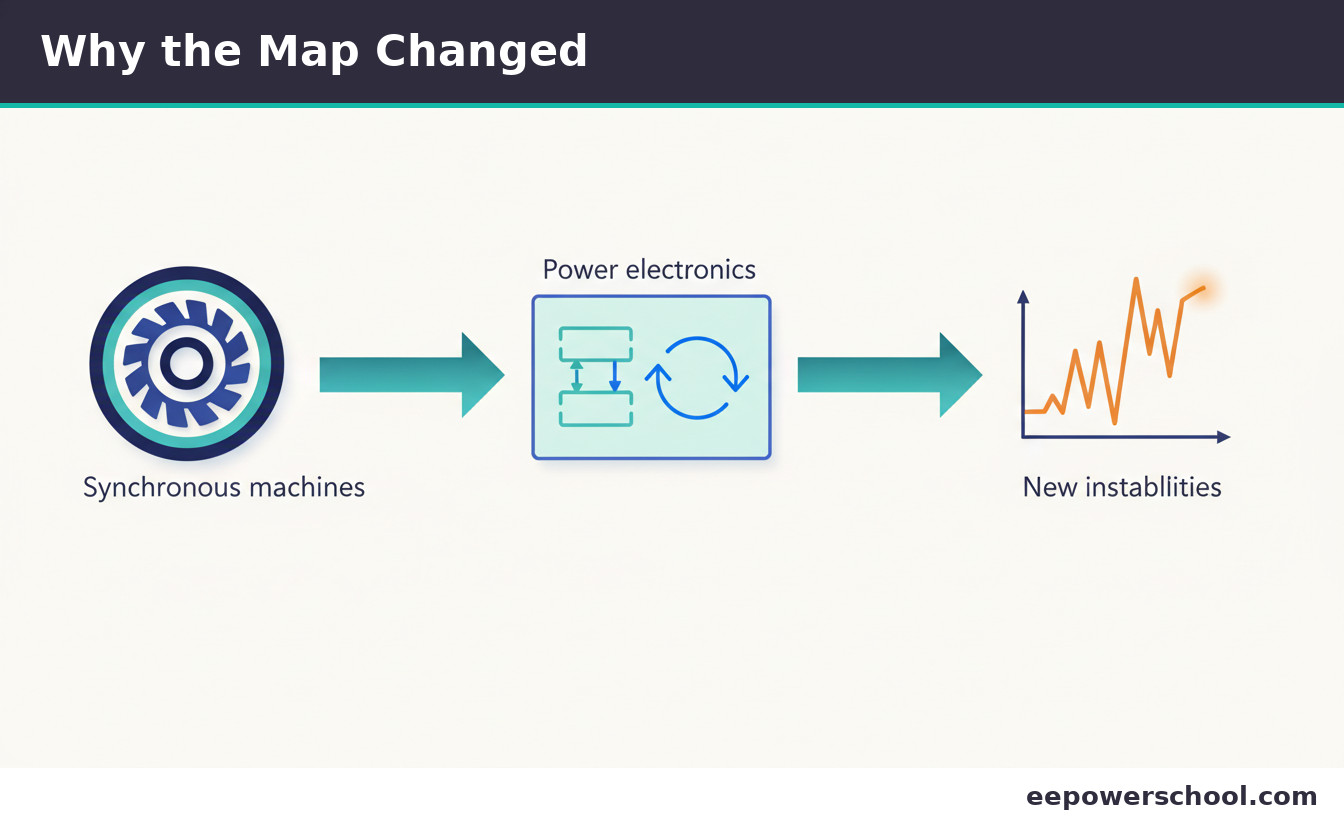
The classic three categories implicitly assume the dynamics are dominated by synchronous machines. Inverter-based resources break that assumption. Their behaviour is set by fast control loops acting in milliseconds, not by physical inertia, and those loops can interact with the network and with each other in ways that do not fit cleanly into rotor-angle, voltage, or frequency.
Real events made this undeniable: sub-synchronous oscillations between wind farms and series-compensated lines, and instabilities of grid-following controls in weak grids. The 2021 IEEE/CIGRE task force responded by extending the power system stability classification with two new categories, explored in our overview of inverter-based resources.
The New Categories: Converter-Driven and Resonance Stability
The 2021 update adds two categories built around power electronics:
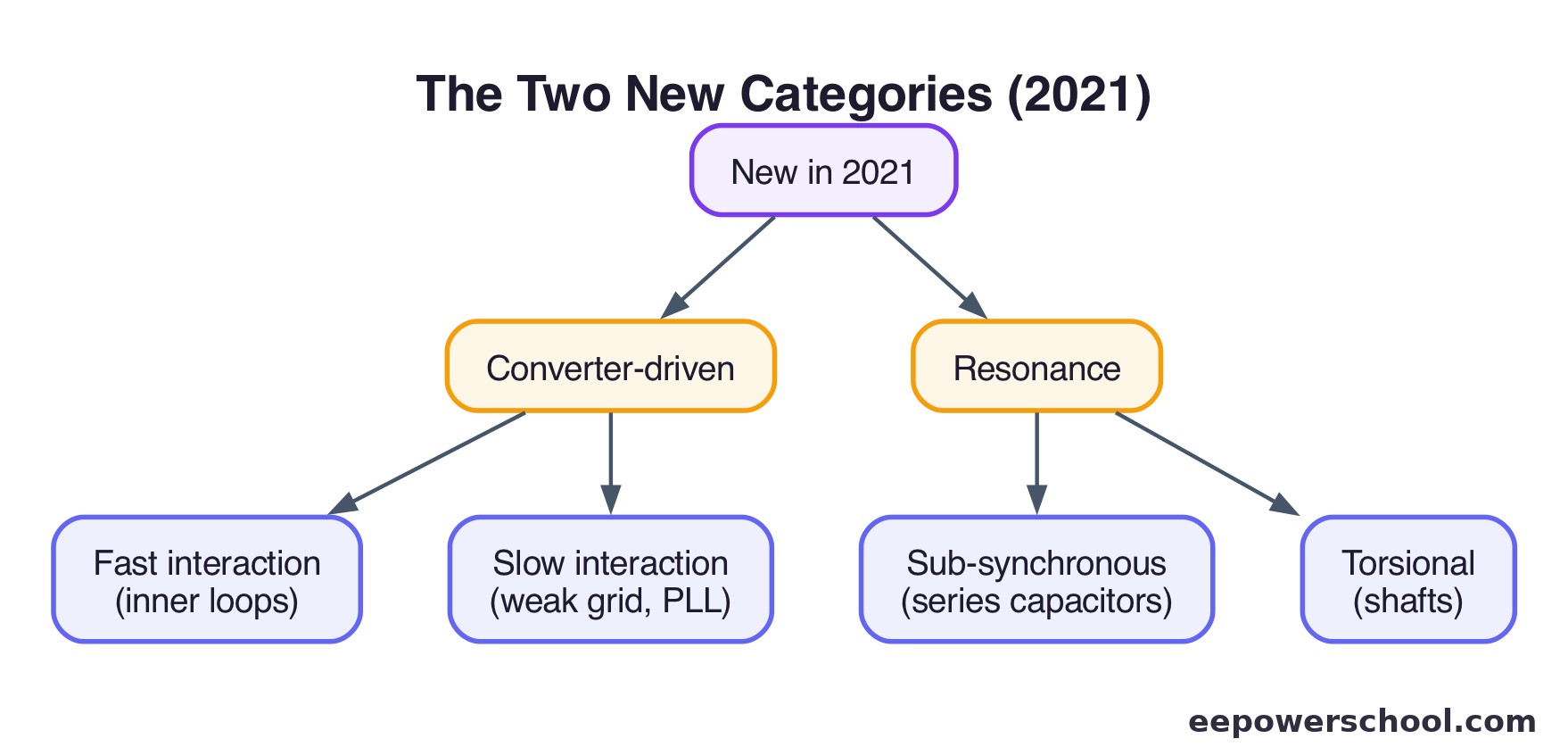
- Converter-driven stability: instabilities arising from the fast controls of inverter-based resources. It splits into fast-interaction phenomena (high-frequency, involving the converter inner loops and the network) and slow-interaction phenomena (lower-frequency, involving outer control loops, weak grids, and phase-locked loops).
- Resonance stability: oscillations from energy exchange with resonant elements, including sub-synchronous resonance with series capacitors and torsional resonance with machine shafts.
Together they give a home to the inverter-era failures that previously had no formal place, which is why the second figure focuses on them.
Using the Classification in Practice
The taxonomy is not academic bookkeeping; it routes your engineering. Identifying which category a problem belongs to tells you the timescale, the model fidelity, and the tool. Rotor-angle, voltage, and frequency questions are usually answered with phasor (RMS) tools; the new converter-driven and resonance categories typically demand electromagnetic-transient (EMT) studies because the phenomena live in the fast waveform.
So when an inverter-heavy connection oscillates, the first move is to classify it. A correct placement in the power system stability classification points straight at the right study method and the right family of mitigations, which is exactly what the 2021 update was designed to enable.
Frequently Asked Questions
What are the categories of power system stability?
The 2021 IEEE/CIGRE classification has five: rotor-angle stability, voltage stability, and frequency stability (the classic three), plus two new ones, converter-driven stability and resonance stability, added to capture the behaviour of inverter-based resources.
What changed in the 2021 stability classification?
The classic rotor-angle, voltage, and frequency categories were retained, and two new categories were added: converter-driven stability (fast and slow control interactions of inverters) and resonance stability (sub-synchronous and torsional). The update reflects grids dominated by power electronics rather than synchronous machines.
What is converter-driven stability?
It is a 2021 category for instabilities arising from the fast control loops of inverter-based resources. It splits into fast-interaction phenomena involving inner control loops and the network, and slow-interaction phenomena involving outer loops, weak grids, and phase-locked loops.
What is resonance stability?
Resonance stability covers oscillations caused by energy exchange with resonant elements. It includes sub-synchronous resonance, typically between generation and series-compensated lines, and torsional resonance involving the mechanical shafts of machines.
Why does the classification matter for analysis?
Because the category tells you the timescale and the right tool. Rotor-angle, voltage, and frequency questions are usually studied with phasor (RMS) tools, while converter-driven and resonance problems generally require electromagnetic-transient (EMT) simulation to capture the fast dynamics.
Related reading
- Inverter-based resources: the future of renewable energy
- Grid inertia 101: frequency dynamics and the modern grid
- Inverter basics: classification and applications
- Electrical Engineering Formula Cheat Sheet (power systems quick reference)