Inverter Fault Current Contribution and What It Breaks in Protection
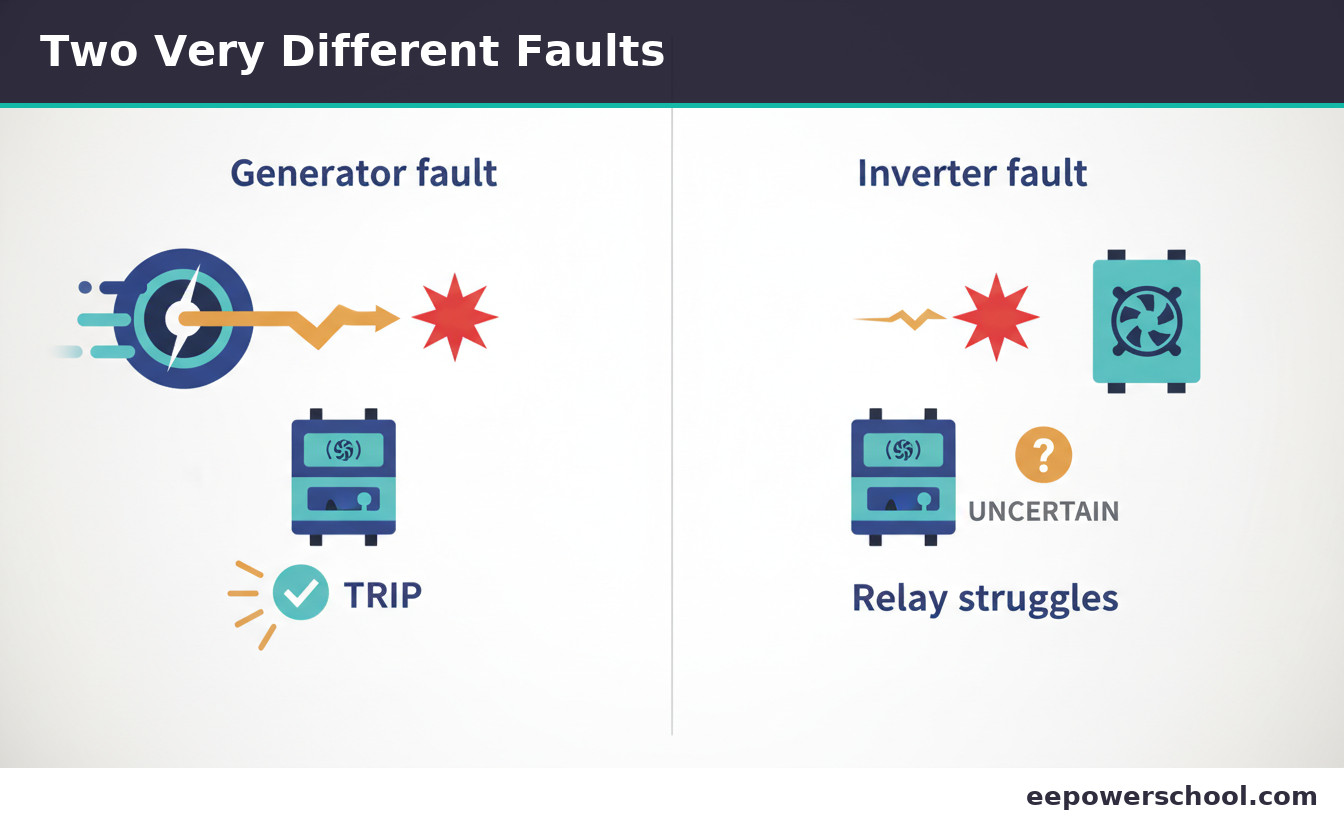
Protection engineering grew up on a simple, dependable fact: when a fault happens, the source slams a huge current into it, five to seven times rated for a synchronous generator, and relays use that surge to detect and locate the fault. Inverter-based resources quietly break that fact. Inverter fault current is limited to barely more than rated, and it is shaped by software rather than physics.
That single change ripples through every protection scheme designed around the old assumption. This article explains why inverter fault current is so low, why it is control-defined, what specifically breaks in overcurrent, distance, and directional protection, and what protection engineers should do as inverters take over the grid.
Why Inverter Fault Current Is So Low
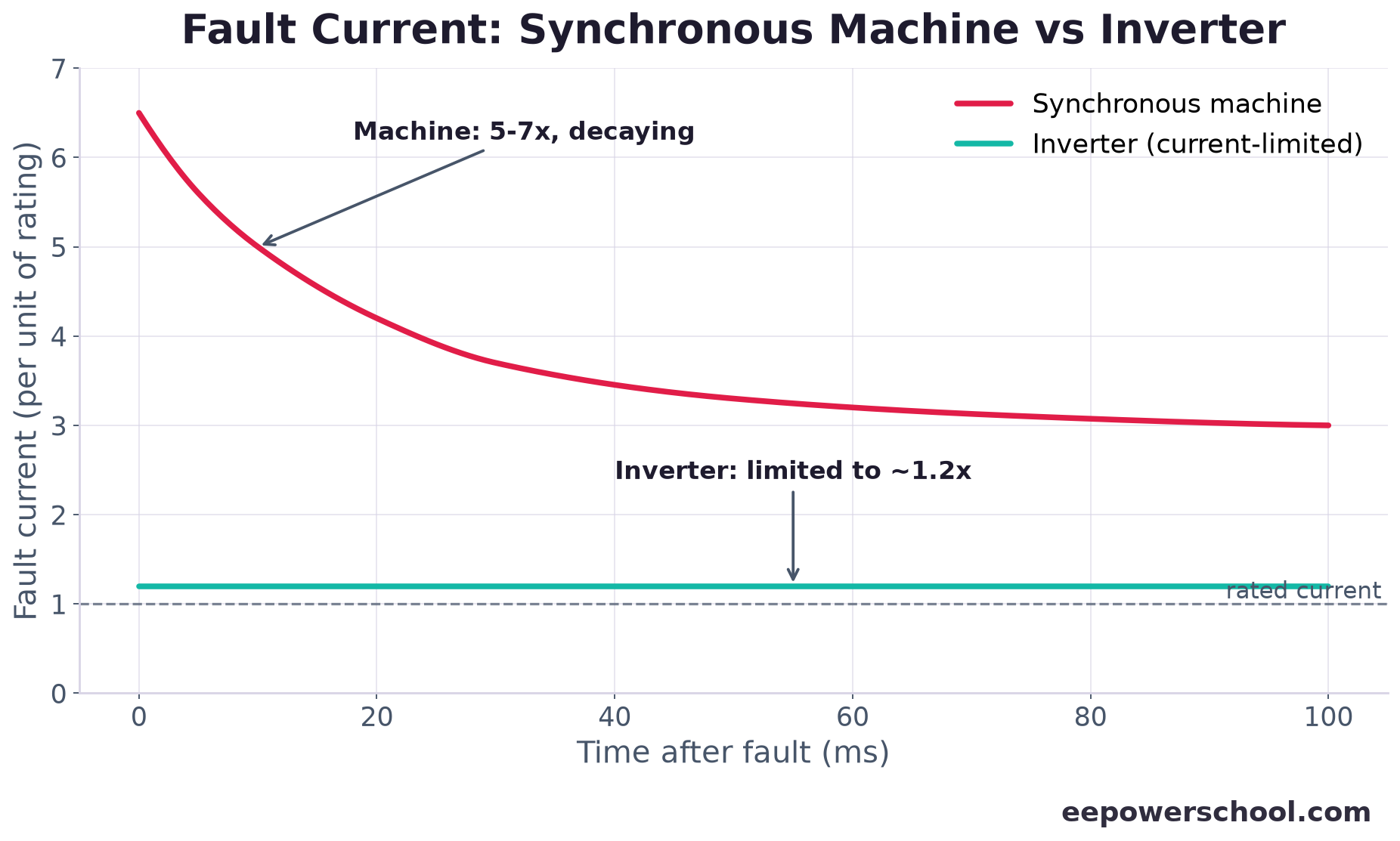
A synchronous generator is an electromagnetic machine: during a nearby fault, its internal voltage drives a large current limited only by its low sub-transient reactance, typically 5 to 7 times rated, decaying over cycles. The semiconductors in an inverter cannot survive that. To protect themselves, inverters actively limit their output current to roughly 1.1 to 1.5 times rated, and only for a controlled window.
So where a machine delivers a brief, massive surge, an inverter delivers a small, flat, tightly controlled contribution. The waveform comparison below makes the gap vivid, and that gap is the root of every protection problem that follows.
It Is Control-Defined, Not Physics-Defined
There is a deeper twist. A machine’s fault current is governed by physical laws, the same for every machine of a given design. An inverter’s fault current is governed by its control software: how much current it injects, at what angle, with how much negative-sequence content, and for how long, are all design choices that vary between manufacturers and even firmware versions.
This means inverter fault current is not only small but also inconsistent and, without the model, unpredictable. A protection engineer can no longer assume a universal fault-response behaviour; the response depends on equipment-specific control that must be obtained from the vendor and modelled explicitly.
What Breaks: Overcurrent (50/51)
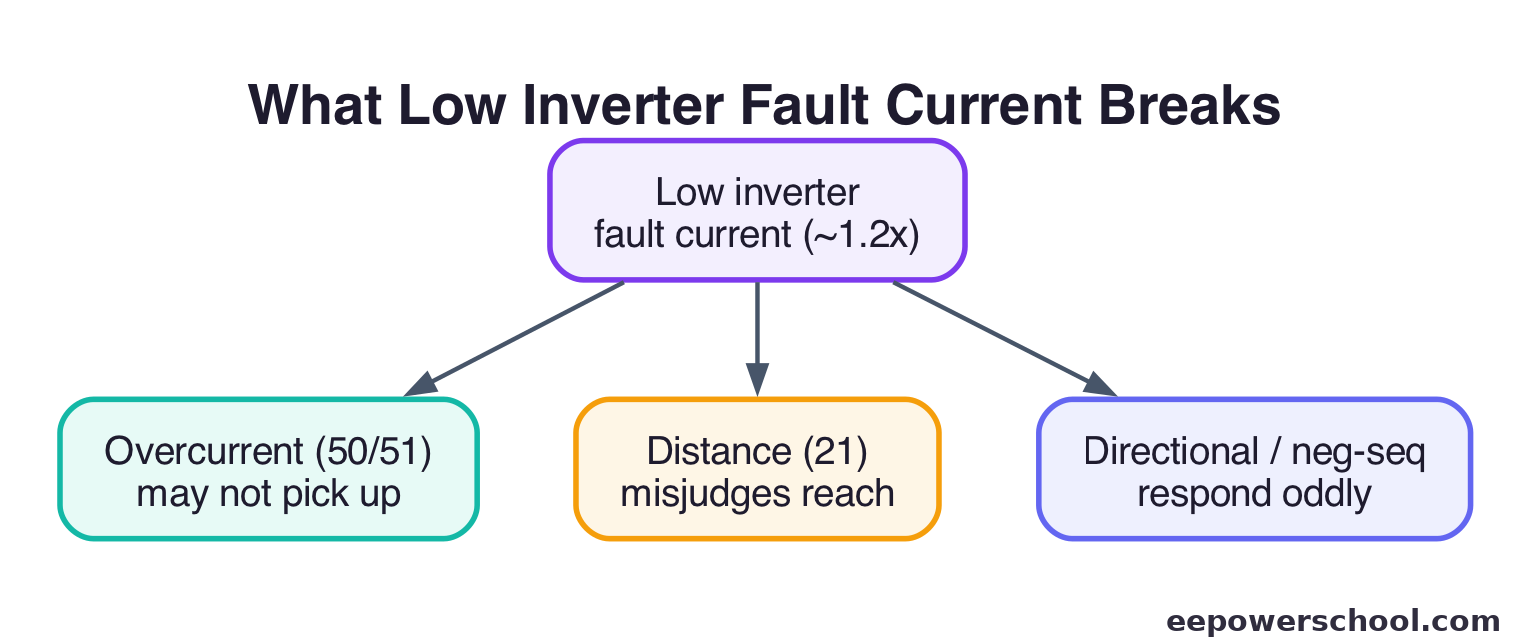
Overcurrent protection is the most directly affected, because it keys entirely on current magnitude. If a fault that a generator would have answered with 6x rated current draws only 1.2x from an inverter, an overcurrent element set to discriminate faults from load may simply fail to pick up, or pick up so slowly that coordination collapses.
Time-overcurrent (51) curves coordinated for high fault currents lose their grading when the available current barely exceeds load. In inverter-fed areas, overcurrent protection can no longer be assumed to see or correctly time a fault, which is a profound change from conventional practice.
What Breaks: Distance (21)
Distance protection estimates the fault location from the apparent impedance, the ratio of measured voltage to measured current. That calculation assumes the current behaves like a conventional source. Because inverter fault current is set by control, its magnitude and especially its angle can differ from what a distance relay expects.
The result is a distorted impedance estimate: the relay may underreach or overreach, misjudging where the fault is, or fail to operate correctly at all. Distance schemes that worked perfectly with machine sources need re-evaluation, and sometimes replacement, when the source behind them becomes an inverter.
What Breaks: Directional and Negative-Sequence Elements
Many schemes rely on directional and negative-sequence elements to decide which way a fault is and to detect unbalanced faults. Both depend on the source producing predictable sequence currents at predictable angles. Inverters do not guarantee this: depending on control, an inverter may produce little or no negative-sequence current, or inject it at an angle that confuses directional logic.
So elements that are rock-solid on a machine grid, directional comparison, negative-sequence overcurrent, can become unreliable behind inverters. As with the other elements, the behaviour is manufacturer-specific and must be verified rather than assumed.
Falling Fault Levels Across the System
Beyond any single connection, replacing synchronous machines with inverters lowers the overall fault level of the network. Every retired generator removes a large fault-current source, so the short-circuit level at buses across the system drifts down over time.
That system-wide decline erodes the margins of protection schemes everywhere, not just at the inverter terminals, and it interacts with the weak-grid problems that low fault levels also cause. Protection studies that were valid a decade ago can quietly become invalid as the generation mix shifts, which is why fault levels must be re-checked, not assumed constant.
How Grid-Forming Changes the Picture
Grid-forming inverters help, partially. Because they behave as a voltage source, they present a more machine-like response in the first instant of a fault, supporting voltage and providing a somewhat more predictable contribution than grid-following units.
But they are still built from the same current-limited semiconductors, so their sustained fault current is still capped near 1.1 to 1.5 times rated. Grid-forming improves the character of the response without restoring the sheer magnitude that protection schemes were designed around. It is an improvement, not a return to the old world.
What Protection Engineers Should Do
The response is to re-study rather than copy forward:
- Re-run short-circuit and coordination studies with accurate, vendor-supplied inverter models, including EMT models where the fast control response matters.
- Lean on schemes that do not depend on high fault current, such as line current differential (87L) and communication-assisted protection, which detect faults by comparing ends rather than by magnitude.
- Apply the standards: IEEE Std 2800-2022 sets fault ride-through and reactive-current behaviour for bulk-system inverter-based resources, giving protection something defined to design against.
The core lesson is simple to state and demanding to apply: as inverters fill the grid, inverter fault current is small and control-defined, so protection must be re-thought for the source it actually has. For the underlying theory, see our guide to faults in power systems.
Frequently Asked Questions
How much fault current does an inverter contribute?
Typically only about 1.1 to 1.5 times its rated current, and only for a controlled window, because the semiconductors must limit current to survive. A synchronous generator, by contrast, can deliver 5 to 7 times its rating into a nearby fault.
Why is inverter fault current called control-defined?
Because how much current an inverter injects during a fault, at what angle, with what negative-sequence content, and for how long, are all set by its control software, not by physical laws. This varies between manufacturers and firmware, so the fault response must be modelled, not assumed.
What protection elements does low inverter fault current affect?
Overcurrent (50/51) may not pick up or coordinate; distance (21) can misjudge reach because the current angle differs from expectation; and directional and negative-sequence elements can respond unpredictably because inverters may not produce the expected sequence currents.
Does grid-forming control restore normal fault current?
Only partially. Grid-forming inverters give a more machine-like, voltage-source response in the first instant, which helps, but they are still built from current-limited semiconductors, so sustained fault current remains capped near 1.1 to 1.5 times rated.
How should protection be adapted for inverter-based resources?
Re-run short-circuit and coordination studies with vendor-supplied (and EMT) inverter models, favour schemes that do not rely on high fault current such as line current differential and communication-assisted protection, and apply standards like IEEE 2800 that define inverter fault behaviour.
Related reading
- Faults in power systems: types, causes and arcing
- Overcurrent relay: concepts and design in Simulink
- Inverter-based resources: the future of renewable energy
- Electrical Engineering Formula Cheat Sheet (power systems quick reference)