Electrical Engineering Formula Cheat Sheet 2026: Power Systems Quick Reference
The right formula at the right moment is the difference between a confident solution and an hour of digging through textbooks. Whether you are on the job, studying for the PE exam, or running a quick sanity check on a power system, having every essential equation in one place is non-negotiable.
This post walks through the six core areas covered in the 2026 EE Power Systems Formula Cheat Sheet — and you can download the free PDF at the bottom of this page.
What Is the EE Power Systems Formula Cheat Sheet?
The Electrical Engineering Formula Cheat Sheet (2026 Edition) is a structured, printable quick-reference guide covering the most-used equations in power systems engineering. It was designed for:
- Practicing electrical engineers who need instant field references
- EE students preparing for exams or the PE/FE
- Industrial electricians working with motors, transformers, and capacitor banks
- Anyone who works with three-phase systems, transmission lines, or fault analysis
The cheat sheet is organized into six sections, each color-coded and formatted for speed — no fluff, just formulas, variables, and practical tips.
Section 1: Basic Power Equations
Every power systems calculation starts here. The cheat sheet covers:
| Formula | Equation |
|---|---|
| Single-Phase Real Power | P = V × I × cos(φ) |
| Three-Phase Real Power | P = √3 × V_L × I_L × cos(φ) |
| Apparent Power | S = V × I (1φ) · S = √3 × V_L × I_L (3φ) |
| Reactive Power | Q = V × I × sin(φ) |
| Power Factor | PF = cos(φ) = P / S |
| Power Triangle | S² = P² + Q² |
Key tip from the cheat sheet: cos(φ) = 1 for purely resistive loads. Lagging power factor is inductive (motors); leading is capacitive.
Understanding the relationship between real power (W), reactive power (VAR), and apparent power (VA) is the foundation of everything else in power systems. If the power triangle is fuzzy for you, the cheat sheet includes a visual breakdown.
Section 2: Power Factor Correction Formulas
Low power factor costs money — utilities penalize it, and your cables carry more current than they need to. The PF correction section is one of the most practical parts of the sheet.
The key formula:
Q_c = P × (tan φ₁ − tan φ₂)
This gives you the capacitive kVAR needed to improve power factor from cos(φ₁) to cos(φ₂).
The sheet also includes:
- Single-phase capacitor sizing: C = Q_c / (2π f V²)
- Three-phase delta cap bank sizing: C = Q_c / (2π f V_L²)
- Current savings formula: how much line current you save after correction
- kVAR Multiplier Table: look up your original PF and target PF — multiply your kW load by the table factor to get the required kVAR. No calculator needed.
Worked example (from the cheat sheet):
A factory runs a 200 kW load at PF = 0.70. The utility requires PF ≥ 0.95. From the multiplier table: 0.70 → 0.95 = 0.691. Therefore Q_c = 200 × 0.691 = 138.2 kVAR. Select the nearest standard capacitor bank: 150 kVAR.
Section 3: Transformer Calculations
Transformers are in every power system. The cheat sheet covers the four formulas you reach for most often:
Turns Ratio:
a = N₁/N₂ = V₁/V₂ = I₂/I₁
This single equation ties together primary-to-secondary voltage, current, and turns relationships.
Transformer Efficiency:
η = P_out / (P_out + P_cu + P_core)
Where P_cu (copper losses) scales with I² and P_core (iron/core losses) stays constant.
Three-Phase kVA Rating:
S = √3 × V_L × I_L / 1000
Voltage Regulation:
VR% = (V_NL − V_FL) / V_FL × 100
A VR below 5% is acceptable; below 2% is excellent. The sheet includes a sizing rule of thumb: kVA = Total_kW / PF × 1.25 safety factor.
Section 4: Transmission Line Voltage Drop & Losses
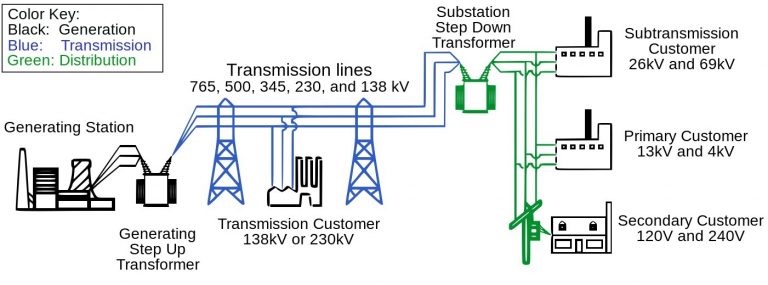
Transmission and distribution engineers use these constantly. The cheat sheet separates single-phase and three-phase voltage drop:
Single-Phase Voltage Drop:
V_drop = 2 I L (R cos φ + X sin φ)
Three-Phase Voltage Drop:
V_drop = √3 I L (R cos φ + X sin φ)
NEC limits: Branch circuit ≤ 3% drop · Total system ≤ 5% drop
Three-Phase Line Losses:
P_loss = 3 × I² × R × L
One of the most important insights here: doubling the transmission voltage reduces losses by a factor of four for the same transmitted power. This is why high-voltage transmission exists.
The sheet also includes the cable derating formula with NEC 310.16 correction factors for temperature, grouping, and burial depth:
I_rated = I_base × CF_T × CF_G × CF_B
Section 5: Short Circuit and Fault Analysis
Protective device coordination and equipment ratings depend on knowing your available fault current. The cheat sheet covers:
Symmetrical (3-Phase Bolted) Fault Current:
I_fault = V_base / (√3 × Z_total)
Fault MVA:
MVA_fault = S_base / Z_pu(total)
Per-Unit Impedance:
Z_pu = Z_actual / Z_base
where Z_base = V²_base / S_base (S_base is typically 100 MVA)
The per-unit system is the single most powerful tool in multi-voltage power system analysis. The cheat sheet notes its key advantage: per-unit values stay constant through ideal transformers, which simplifies calculations enormously.
Section 6: Motor Calculations
Motors are the largest single load category in most industrial facilities. The cheat sheet covers the formulas you use every day:
Synchronous Speed:
n_s = 120 f / P
Slip:
s = (n_s − n_r) / n_s
Typical full-load slip: 2–5%. Zero slip means zero torque.
Motor Horsepower:
HP = (V × I × η × PF) / 746
Full Load Amps (Quick Estimate):
FLA ≈ HP × 1.25 (at 480V 3-phase)
FLA ≈ HP × 2.5 (at 240V 3-phase)
Always verify against NEC Table 430.250 for code compliance.
The sheet also includes a Common Motor Speeds table for 60 Hz systems:
| Poles | Sync Speed | Typical Full-Load | Common Use |
|---|---|---|---|
| 2 | 3,600 RPM | 3,450–3,550 | Pumps, compressors |
| 4 | 1,800 RPM | 1,725–1,770 | General purpose, HVAC |
| 6 | 1,200 RPM | 1,140–1,175 | Conveyors, crushers |
| 8 | 900 RPM | 850–880 | Low-speed drives |
This reference is built for:
- Electrical engineers doing load flow, short circuit, or design studies
- PE/FE exam candidates who need a reliable formula reference
- Field engineers and industrial electricians who want fast answers without opening a textbook
- Facilities and maintenance engineers working with motors, transformers, and capacitor banks
It is intentionally compact and print-ready — designed to live on your desk, inside a binder, or pinned above your workstation.
Download the Free PDF
⬇ Download the 2026 EE Power Systems Formula Cheat Sheet (PDF)
The PDF is formatted for US Letter size and prints cleanly on a single sheet (front and back). It includes all six sections, the kVAR multiplier table, the motor speed table, and the worked PF correction example.
Frequently Asked Questions
What formulas are in the EE cheat sheet?
The 2026 edition covers basic power equations (single- and three-phase), power factor correction and capacitor sizing, transformer turns ratio and efficiency, transmission line voltage drop and losses, short circuit / fault analysis using per-unit system, and motor speed, slip, horsepower, and FLA calculations.
Is this cheat sheet useful for the FE or PE exam?
Yes. All formulas in this reference appear in the NCEES FE and PE electrical and computer exam specifications. It is an effective study companion alongside your NCEES-approved reference handbook.
What is the power factor correction formula?
Q_c = P × (tan φ₁ − tan φ₂), where Q_c is the required capacitor bank rating in kVAR, P is the real power load in kW, φ₁ is the original power factor angle, and φ₂ is the target power factor angle.
What is the synchronous speed formula?
n_s = 120 f / P, where f is the supply frequency in Hz and P is the number of motor poles.
What is the three-phase power formula?
P = √3 × V_L × I_L × cos(φ), where V_L is line-to-line voltage, I_L is line current, and cos(φ) is the power factor.
What is the per-unit system in electrical engineering?
The per-unit system normalizes electrical quantities (voltage, current, power, impedance) to a common base, making it easier to analyze power systems with multiple voltage levels. Z_pu = Z_actual / Z_base, where Z_base = V²_base / S_base.