Stability Screening for IBR-Rich Systems Using SCR, RMS, and EMT

Every time a developer wants to connect a new wind or solar plant, the host operator has to answer one deceptively simple question: is the grid strong enough at this spot, or will the plant misbehave? Stability screening is how that question gets answered, and getting it wrong in either direction is costly. Screen too loosely and you energise an oscillation; screen too tightly and you block good projects or demand expensive studies that were never needed.
In an IBR-rich system the screening problem is harder than it looks, because the simple metric everyone reaches for first, the short-circuit ratio, quietly breaks down when many inverters cluster in one weak pocket. This post walks the full screening ladder, from a quick SCR check to a full electromagnetic-transient study, shows where each rung is blind, and works a weighted short-circuit ratio example end to end.
Why Screening Exists
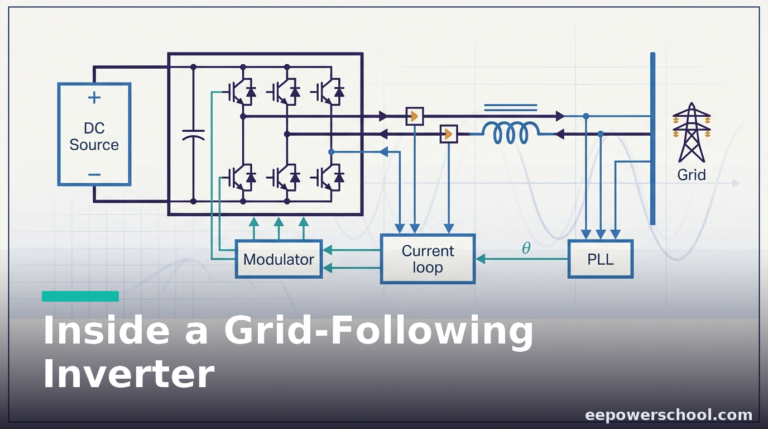
Grid-following inverters, which still make up most of the installed fleet, lean on the grid to stay stable. They track the local voltage with a phase-locked loop and inject current in step with it. In a strong grid that is fine. In a weak one, the inverter’s own current swings the local voltage and angle, the loop chases its own tail, and the result can be a sustained oscillation or a tripped plant.
Stability screening is the triage step that flags which connections sit in that danger zone before anyone runs an expensive detailed study. It does not prove stability on its own. It sorts connections into clearly fine, clearly risky, and needs-a-closer-look, so engineering effort lands where it matters. The whole discipline rests on a single idea: cheap checks first, expensive studies only where the cheap checks raise a flag.
SCR: The First Screen
The classic first metric is the short-circuit ratio (SCR) at the point of interconnection:
\[ \mathrm{SCR} = \frac{S_\mathrm{sc}}{P_\mathrm{IBR}} \]
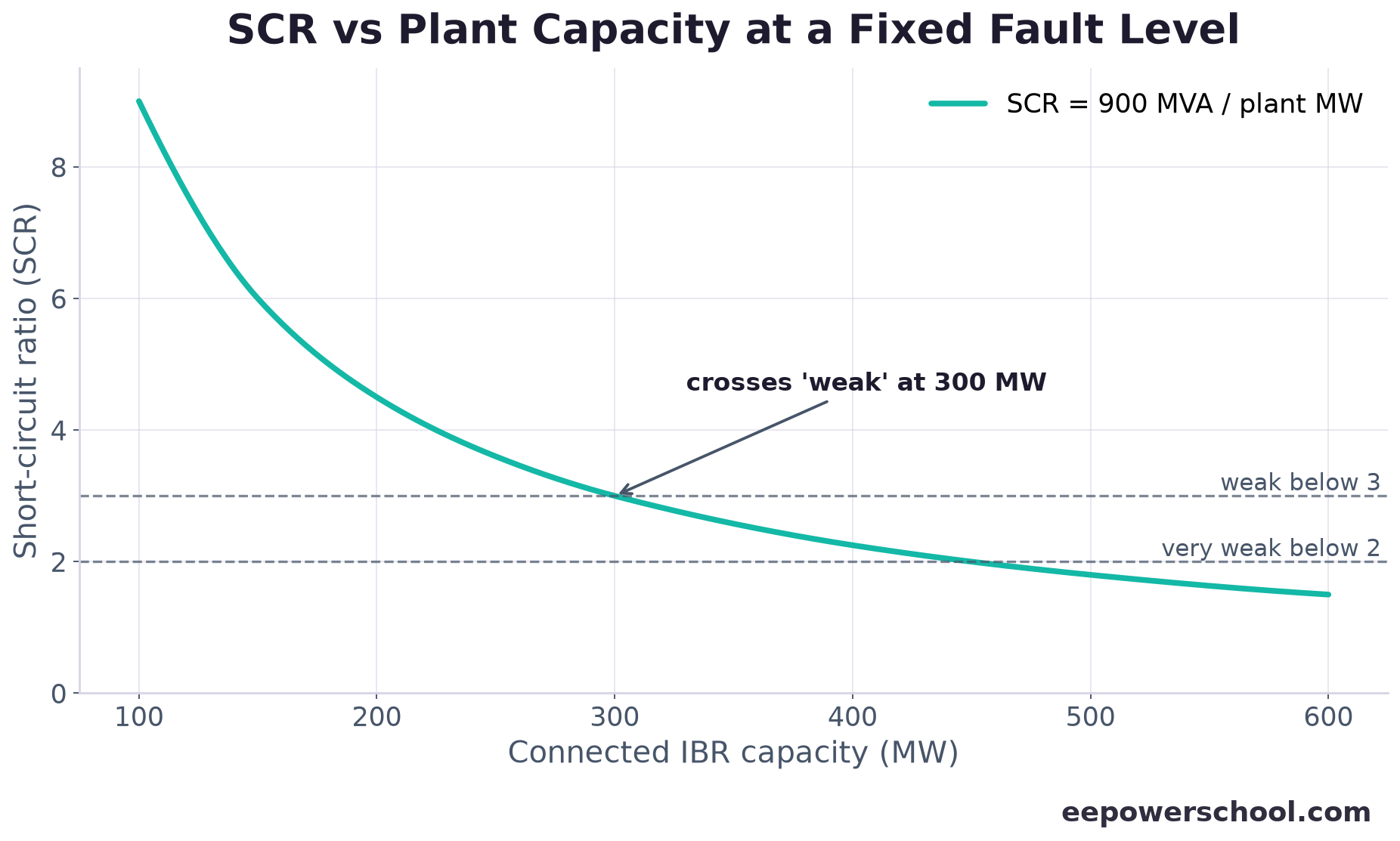
where \( S_\mathrm{sc} \) is the three-phase short-circuit level (MVA) at the connection point with the plant out, and \( P_\mathrm{IBR} \) is the plant’s rated power (MW). It is a ratio of how stiff the grid is to how hard the plant pushes on it. The rough, widely used thresholds are simple to remember:
- SCR > 3: strong grid, few issues expected.
- 2 < SCR < 3: weak, watch for control and voltage problems.
- SCR < 2: very weak, classic grid-following controls often need help.
The chart shows the trap built into this metric: at a fixed connection-point fault level, SCR falls as you add plant capacity, so the same location flips from strong to very weak simply because more megawatts connected. Treat the 3 and 2 thresholds as heuristics for stability screening, not hard physics.
Why Nodal SCR Breaks With Many IBRs
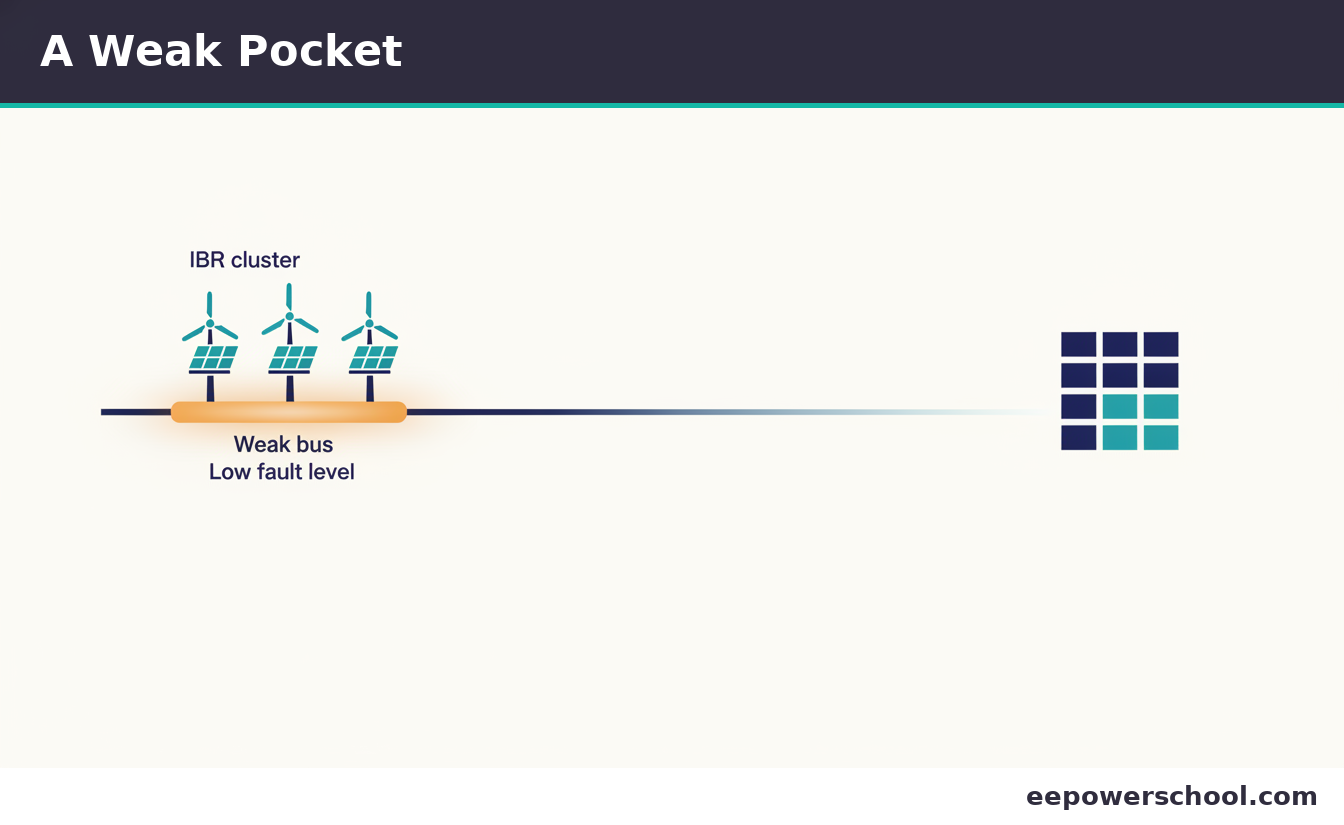
Plain nodal SCR assumes one plant at one bus. Put several inverter plants close together in a weak pocket and it lies to you: each plant sees a fault level that includes contributions the neighbours are also counting on, so the strength gets double-counted and the metric reads too high. The interactions between electrically close inverters, the very thing that causes weak-grid instability, are invisible to it.
The industry responded with weighted and composite metrics that treat a cluster as a group:
| Metric | Origin | What it adds |
|---|---|---|
| WSCR (weighted SCR) | ERCOT | Aggregates a cluster, weighting fault contributions by plant size |
| CSCR (composite SCR) | GE Energy Consulting | Aggregates IBRs inside a defined interaction boundary |
| ESCR (equivalent SCR) | Network-impedance based | Uses the full impedance matrix, capturing weak coupling between IBRs |
AEMO bakes the same thinking into its System Strength Impact Assessment, using available fault level and a locational factor rather than a bare nodal number. The point for stability screening is that in an IBR-rich pocket you screen the group, not each plant alone.
A Worked WSCR Example
ERCOT’s weighted short-circuit ratio for a cluster is:
\[ \mathrm{WSCR} = \frac{\sum_i S_{\mathrm{sc},i} \, P_i}{\left( \sum_i P_i \right)^2} \]
where \( S_{\mathrm{sc},i} \) is the short-circuit MVA at plant \( i \)’s bus (without IBR contribution) and \( P_i \) is that plant’s rated MW. Take three wind plants sharing a weak corridor:
| Plant | \( S_{\mathrm{sc},i} \) (MVA) | \( P_i \) (MW) |
|---|---|---|
| A | 1800 | 200 |
| B | 1500 | 150 |
| C | 1200 | 250 |
Numerator: \( 1800(200) + 1500(150) + 1200(250) = 360000 + 225000 + 300000 = 885000 \). Denominator: \( (200 + 150 + 250)^2 = 600^2 = 360000 \). So:
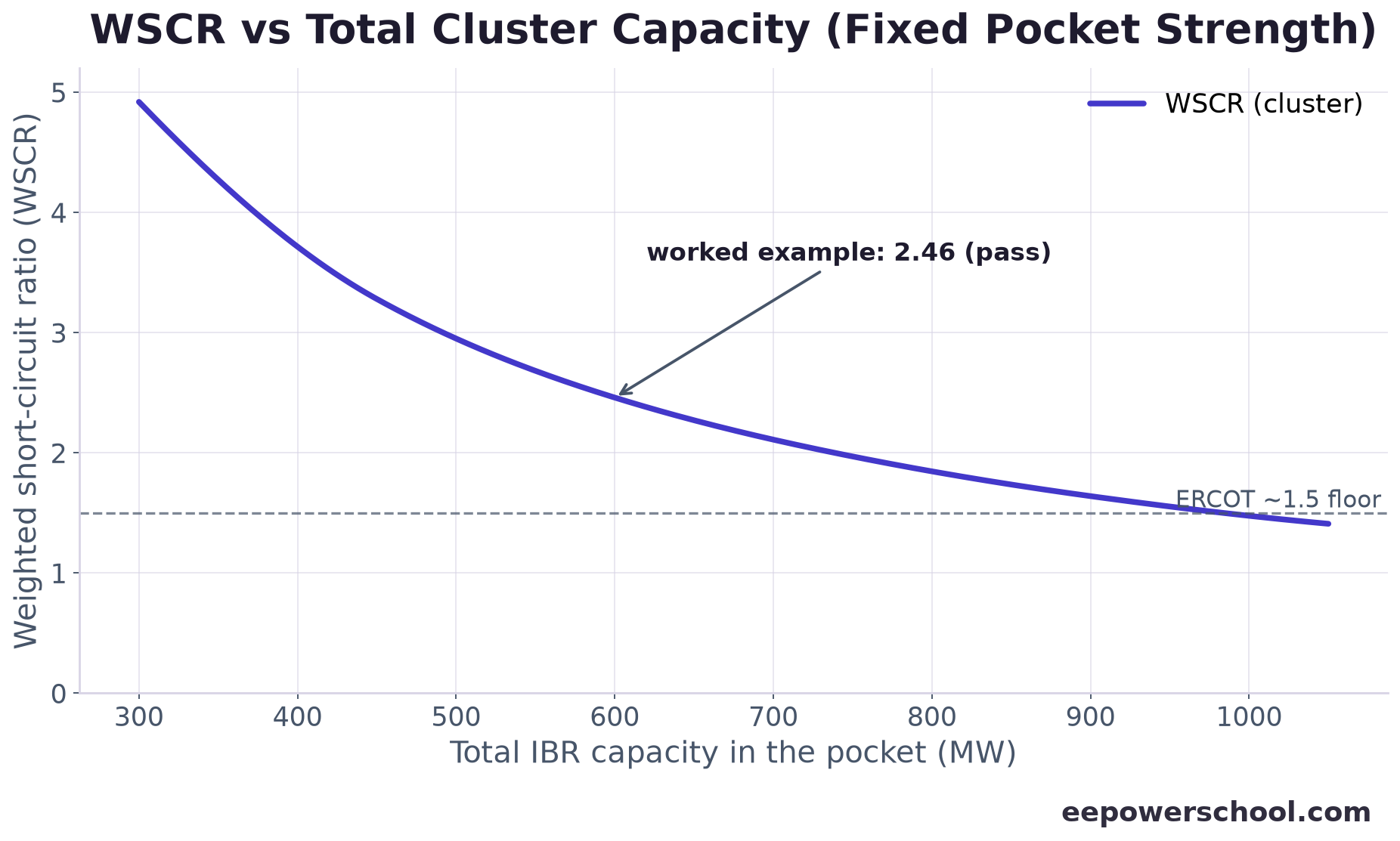
\[ \mathrm{WSCR} = \frac{885000}{360000} \approx 2.46 \]
Against ERCOT’s roughly 1.5 minimum WSCR in its constrained zones, 2.46 is a clear pass: the cluster goes ahead without weak-grid remediation on this basis. But watch what growth does. The second chart holds the pocket’s strength fixed and adds capacity; WSCR slides down a \( 1/\text{MW} \)-like curve and crosses 1.5 near 1,000 MW. That is exactly how a healthy corridor becomes a curtailment headache: nobody changed the network, the queue just kept filling. Note that 1.5 is an ERCOT area-specific operating value, not a universal limit.
The Escalation Ladder: Screen, RMS, EMT
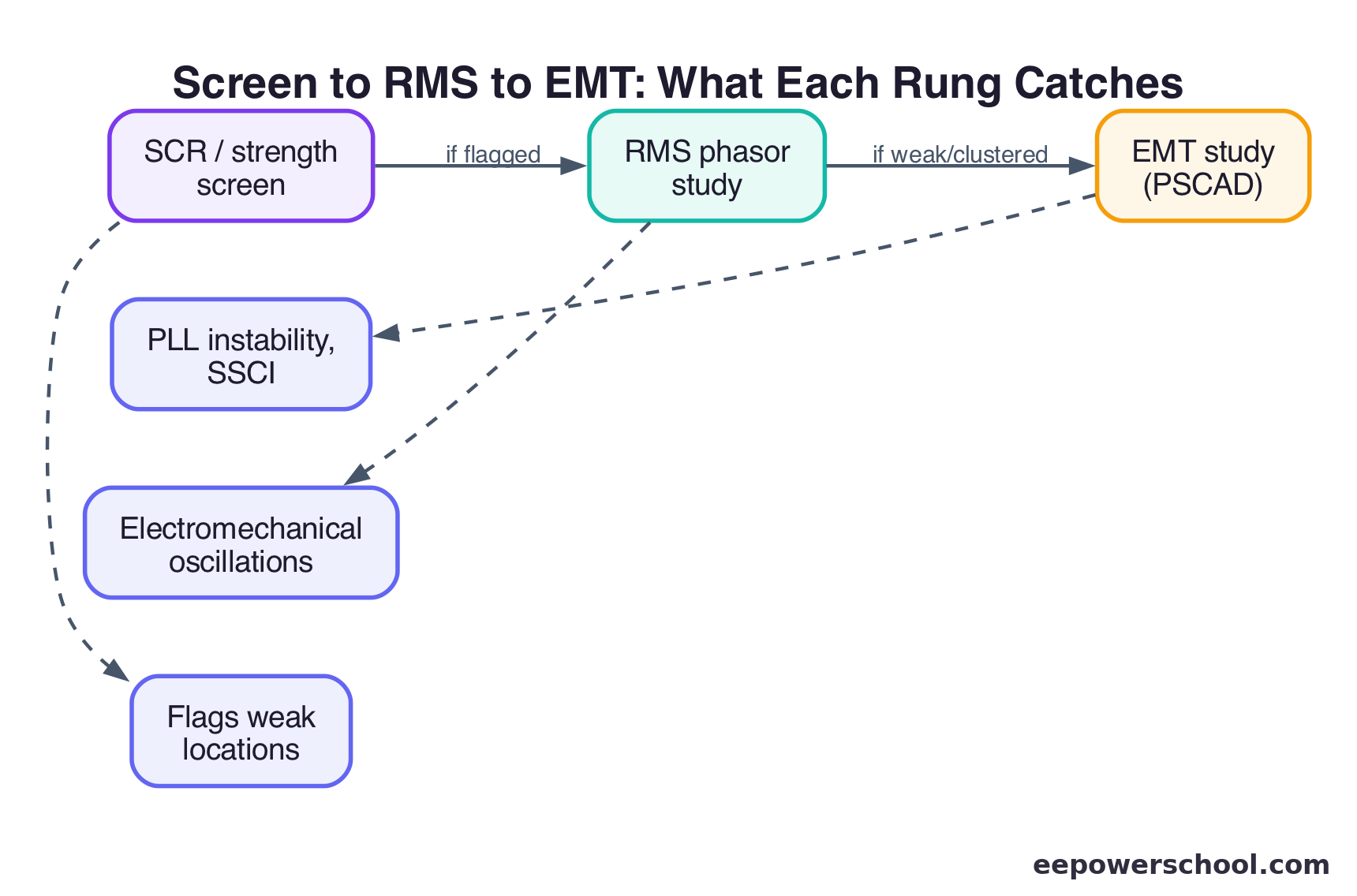
Screening is the first rung of a three-step ladder, and each step sees things the one before cannot:
- SCR / grid-strength screening. Fast, static, network-wide. Triages locations and clusters. Cannot confirm stability, only flag suspects.
- RMS (phasor) study. Balanced, positive-sequence, fundamental-frequency dynamic simulation in tools like PSS/E or PowerFactory. Captures electromechanical dynamics and oscillations from a fraction of a hertz up to a few hertz. Blind to sub-cycle converter controls and unbalanced, phase-by-phase behaviour.
- EMT study. Three-phase, point-on-wave, sub-cycle simulation in tools like PSCAD. Slow and data-hungry, but the only level that represents fast inverter control loops faithfully.
The art of stability screening is deciding how far up the ladder a given connection has to climb. Most projects stop at SCR plus an RMS study. The weak-grid and clustered cases get pushed to EMT, which is where the expensive, slow, and genuinely conclusive work happens.
What Slips Past Phasor Screening
Two failure modes are the reason EMT exists, and both are invisible to an RMS phasor model. The first is PLL synchronisation instability: in a low-SCR grid the phase-locked loop introduces negative damping within its own bandwidth, and a grid-following inverter can spiral into instability that a fundamental-frequency model simply does not contain.
The second is sub-synchronous control interaction (SSCI), where an inverter’s control loops exchange energy with a network resonance, often a series-compensated line, at sub- or super-synchronous frequencies. The 2009 south Texas event between DFIG wind turbines and a series capacitor is the canonical case. Both phenomena live in the sub-cycle, control-bandwidth world that only EMT resolves. This is precisely why a clean SCR number is not a stability guarantee: stability screening tells you where to look, EMT tells you what is actually there.
When the Screen Fires: Real Cases
These are not hypothetical. In ERCOT’s Panhandle, low system strength produced voltage oscillations around 2 Hz, and ERCOT applied a WSCR floor of about 1.5 to cap IBR output in the corridor until synchronous condensers and transmission upgrades raised the strength enough to retire the constraint.
In Australia’s West Murray Zone in 2019, five solar farms in a weak corner of the network produced voltage oscillations after a line fault, and AEMO curtailed their combined output by 50% and froze nearby connection applications. The fix came from new inverter control firmware, validated in EMT, after which the constraints were lifted. Both cases follow the same arc: a screen fires, detailed EMT study finds the mechanism, and remediation, whether firmware, synchronous condensers, or curtailment, restores stable operation. Good stability screening is what turns these from blackouts into managed constraints.
Conclusion
If there is one habit worth building, it is to treat a good SCR number with healthy suspicion. It is a screen, not a verdict. In an IBR-rich pocket the metric you actually want is a weighted or composite one computed over the whole cluster, and even that only tells you whether to spend money on an EMT study, not whether the system is stable.
The encouraging part is how well the ladder works in practice. The ERCOT Panhandle and West Murray stories both started with a screen firing and ended with stable, if constrained, operation, because the screening pointed engineers at the right detailed study. Done well, stability screening is quietly one of the highest-leverage activities in connecting renewables: a few hours of analysis that decide whether a corridor delivers clean power or oscillates.
Key takeaways
- Stability screening is triage: cheap checks first, expensive EMT studies only where the cheap checks raise a flag.
- SCR = short-circuit MVA divided by plant MW; rough thresholds are strong above 3, weak 2 to 3, very weak below 2.
- Nodal SCR double-counts strength when many inverters cluster, so use weighted or composite metrics (WSCR, CSCR, ESCR) on the group.
- Worked WSCR for three plants gives 2.46, a clear pass over ERCOT's roughly 1.5 floor, but it slides toward the limit as the queue fills.
- The ladder runs screen to RMS to EMT; RMS phasor models cannot see sub-cycle converter dynamics.
- PLL instability and SSCI are invisible to phasor screening and need EMT, which is why a clean SCR number is not a stability guarantee.
Frequently Asked Questions
What is stability screening in power systems?
Stability screening is the triage step that flags which proposed connections sit in a weak-grid danger zone before any detailed study runs. It uses fast metrics like the short-circuit ratio to sort connections into clearly fine, clearly risky, and needs-a-closer-look, so detailed RMS and EMT studies are spent only where they are needed.
Why does plain SCR fail for clustered inverters?
Nodal SCR assumes one plant at one bus. When several inverter plants sit close together in a weak pocket, each sees fault-level contributions the others also rely on, so strength is double-counted and SCR reads too high. Weighted and composite metrics like WSCR, CSCR and ESCR treat the cluster as a group to fix this.
When do you need an EMT study instead of RMS?
When the phenomena of concern are sub-cycle and control-driven. RMS phasor models capture electromechanical dynamics up to a few hertz but cannot represent fast inverter control loops, PLL instability, or sub-synchronous control interaction. Weak-grid and clustered IBR connections are usually pushed to EMT, in tools like PSCAD, for a conclusive answer.
What is a typical WSCR threshold?
ERCOT has used a weighted short-circuit ratio floor of about 1.5 in constrained zones such as the Panhandle, capping IBR output below it. This is an area-specific operating value rather than a universal limit, and other operators use different system-strength criteria, but it illustrates the order of magnitude for weak-grid screening.
Related reading
- Power system simulation using PSS/E
- The future of the electric grid with renewable and green energy
- Single line diagram of a power system
- Electrical Engineering Formula Cheat Sheet (power systems quick reference)