Grid-Forming Inverter Requirements: Specs and Compliance Testing
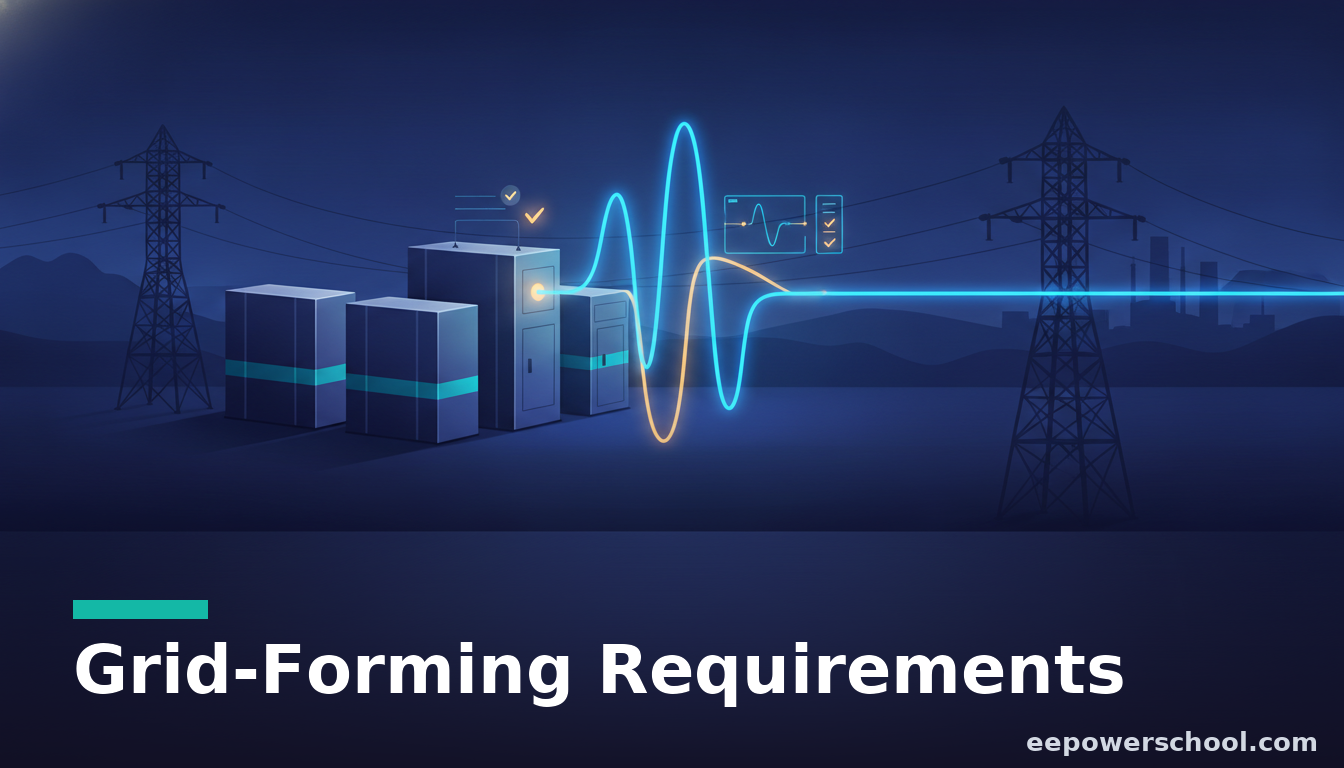
For years, grid-forming inverters lived mostly in research papers and a handful of pilots. That is changing fast, and with it the question engineers ask has shifted from “can an inverter form the grid?” to something far more practical: what exactly must it demonstrate, and how do you prove it? The answer is a growing stack of grid-forming inverter requirements from grid codes and standards bodies, each with specific tests attached.
This matters because grid-forming is moving from optional to mandated in weak and renewable-heavy networks, and a plant that claims the capability now has to pass real compliance tests to connect. This post lays out what defines a grid-forming inverter in specification terms, surveys the main requirement sets, walks through the headline tests, and works a phase-jump example that exposes the single hardest design trade-off: current limiting.
Capability Became a Requirement
The driver is simple. As synchronous machines retire and system strength falls, grid-following inverters start to destabilise, and someone has to provide a voltage reference, fast response and strength. Grid-forming inverters can, so operators have moved from hoping vendors offer the capability to writing it into the rules.
That shift creates a need that did not exist a few years ago: a precise, testable definition. Vague marketing claims of “grid-forming” capability are not good enough when system security depends on it. The grid-forming inverter requirements now emerging exist to turn a fuzzy label into a set of measurable behaviours that a plant either passes or fails, under defined disturbances, in simulation and on site.
What Grid-Forming Means in Spec Terms
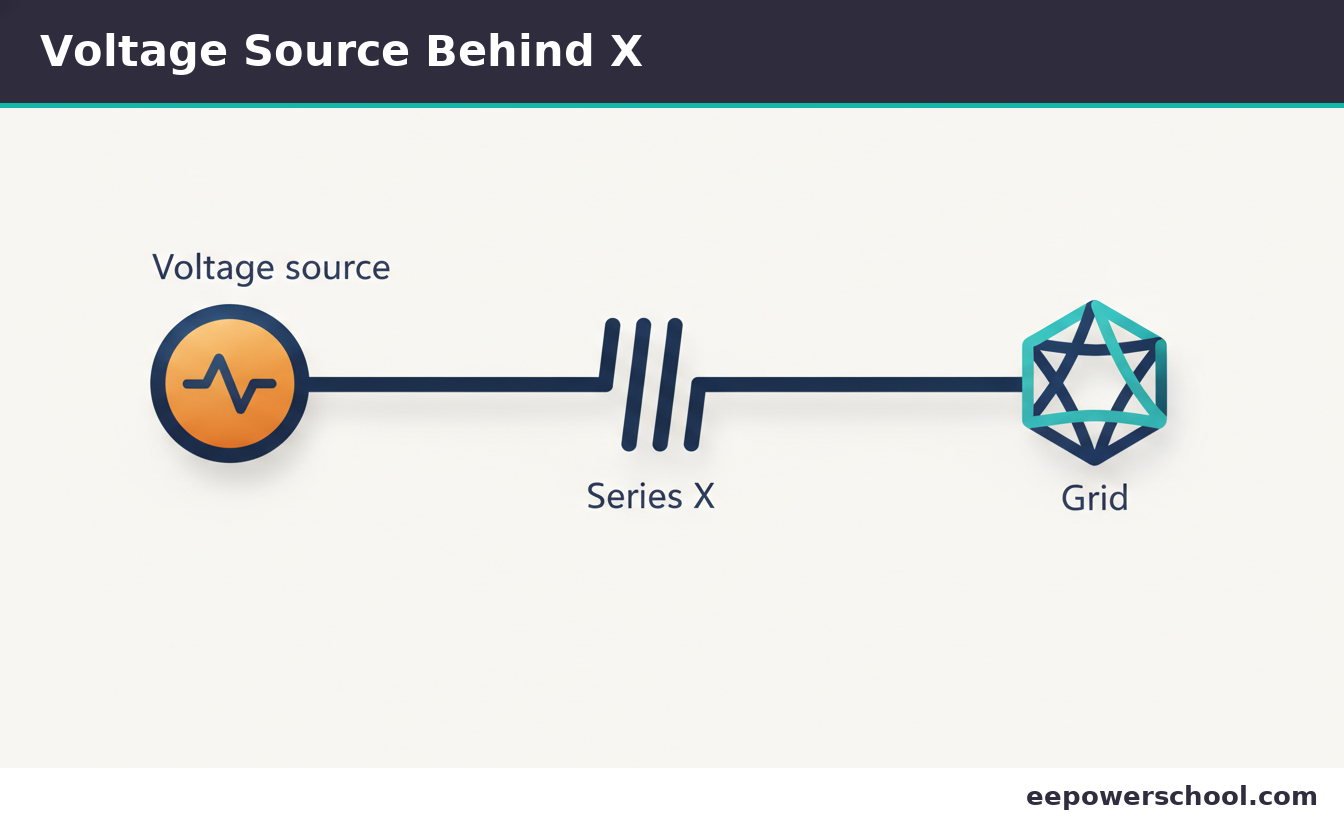
Strip away the marketing and there is a clean technical definition. A grid-forming inverter controls its voltage, behaving as a voltage source behind an impedance, and holds its internal voltage phasor nearly constant through the first cycles of a disturbance. A grid-following inverter controls its current and relies on a phase-locked loop to follow an existing grid voltage.
That distinction has consequences. Because it holds a voltage behind an impedance, a grid-forming unit responds to a disturbance almost instantly, typically within a few milliseconds, supplying inertial and fault support inherently rather than after a controller measures and reacts. It can also operate into a very weak or even passive network, where a grid-following inverter has nothing to lock onto. The UNIFI Consortium specification builds directly on this voltage-source definition, and it is the conceptual anchor under every set of grid-forming inverter requirements that follows.
The Requirements Landscape
Several bodies have published specifications, and while the numbers differ, they test the same behaviours. These are the main grid-forming inverter requirements engineers will meet:
| Specification | Origin | Notable requirements |
|---|---|---|
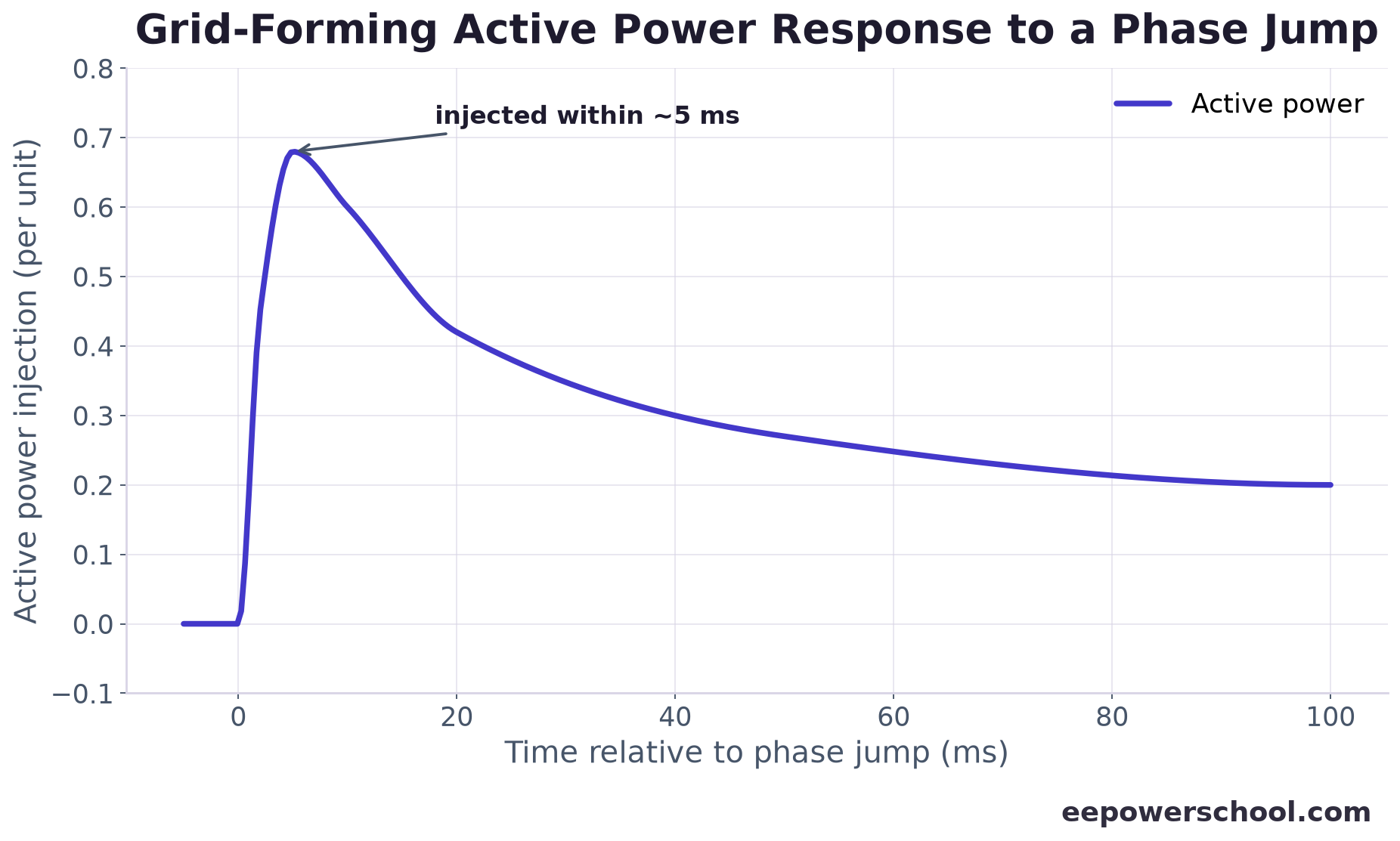
| GC0137 (GB Grid Code) | NESO, Great Britain | Phase-jump withstand to 60 degrees; active phase-jump power within 5 ms; RoCoF withstand 1 Hz/s (2 Hz/s for power park modules) |
| Voluntary GFM Specification | AEMO, Australia | Phase-jump tests at plus or minus 10, 30, 60 degrees; RoCoF ramp at 4 Hz/s; stability required down to SCR 1.25 |
| IEEE 2800.2 | IEEE (approved 2026) | Conformity and verification procedures for IEEE 2800, from inverter-level tests to commissioning |
| UNIFI specification (v3) | UNIFI Consortium / NREL | Vendor-agnostic functional requirements at both system and inverter level |
The takeaway is convergence. A plant designed to the demanding end of these grid-forming inverter requirements will look broadly the same regardless of which jurisdiction it connects in.
The Headline Tests
Compliance comes down to a handful of demonstrations, run in EMT simulation and then validated on the equipment:
- Phase-jump response. The grid voltage angle steps suddenly (10 to 60 degrees), and the unit must inject a fast active-power transient to oppose it, then ride through without tripping.
- RoCoF response. Frequency ramps hard (GC0137 specifies 1 Hz/s withstand, AEMO tests at 4 Hz/s) and the unit must contribute inertial power and stay connected.
- Fault ride-through with current limiting. The unit must survive faults while keeping current within its rating, the subject of the next two sections.
- Low-SCR operation. Stable operation into a very weak grid. AEMO requires stability down to SCR 1.25, and CIGRE evaluations show good grid-forming designs remaining stable down to a post-contingency SCR near 0.9.
- Multi-unit paralleling. Several grid-forming units must share load and stay stable together, since real plants are never a single inverter.
The compliance diagram lays this sequence out as the test campaign a plant actually goes through.

A Worked Phase-Jump Example
The phase-jump test is the clearest window into grid-forming behaviour. Model the unit as a voltage source \( E \) behind a reactance \( X \), connected to a grid voltage \( V \). The active power transfer is the classic power-angle relation:
\[ P = \frac{E V}{X} \sin \delta \]
When the grid angle jumps by \( \Delta\theta \) before the controller reacts, the angle across the reactance changes by that amount, so the transient power surge is approximately:
\[ \Delta P \approx \frac{V^2}{X} \sin(\Delta\theta) \]
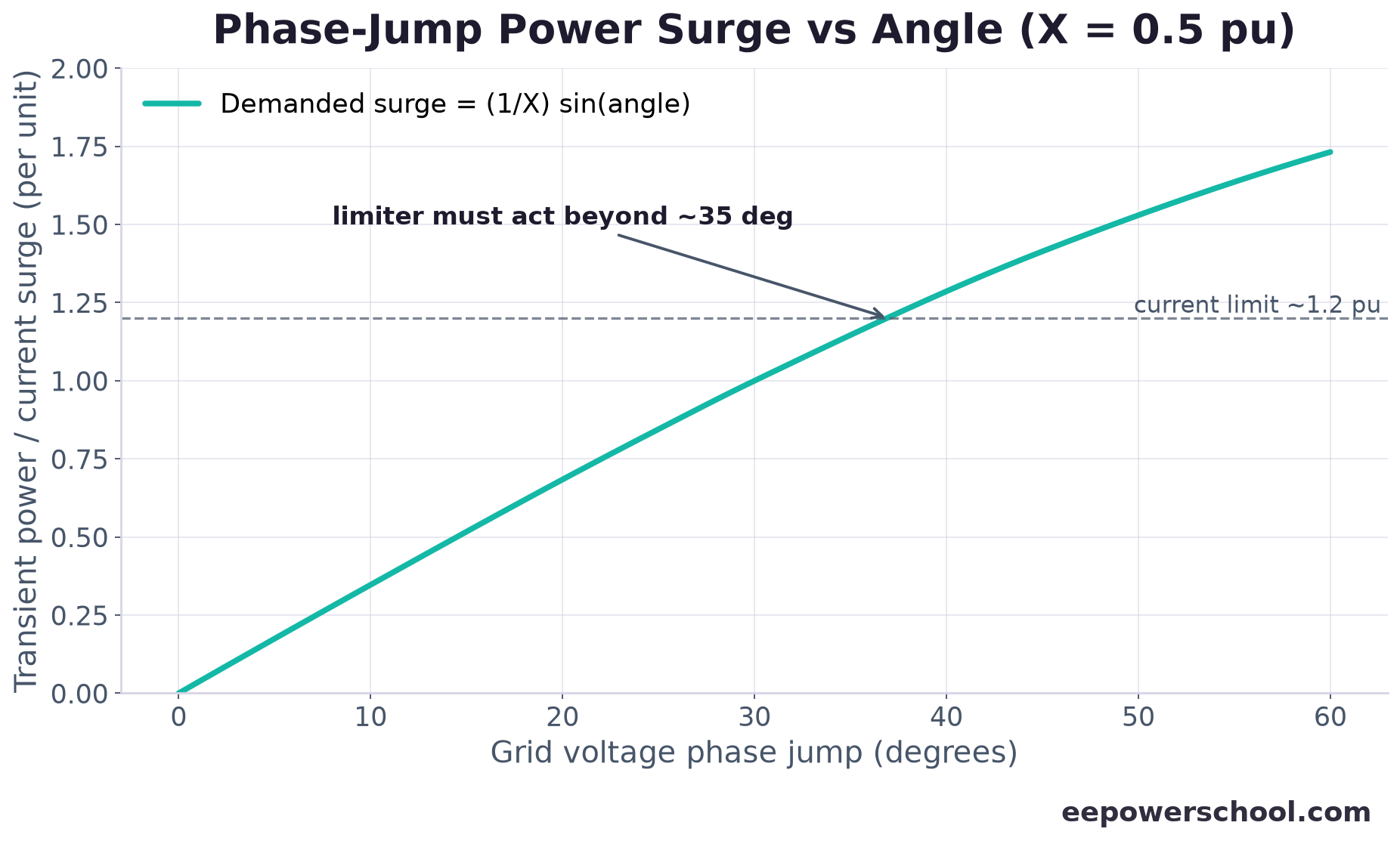
Take \( V = 1.0 \) pu and a total reactance \( X = 0.5 \) pu (filter plus transformer plus a weak grid). At unity voltage the per-unit power surge equals the per-unit current surge, so we can compare directly to a current limit of about 1.2 pu:
| Phase jump \( \Delta\theta \) | \( \Delta P \approx (1/X)\sin\Delta\theta \) (pu) | vs 1.2 pu limit |
|---|---|---|
| 10 degrees | 0.35 | within limit |
| 20 degrees | 0.68 | within limit |
| 30 degrees | 1.00 | approaching limit |
| 60 degrees | 1.73 | exceeds, limiter must act |
The chart plots this curve against the limit. The unit wants to inject the full \( \Delta P \) to oppose the jump, the very thing that makes it grid-forming, but somewhere between a 30 and 60 degree jump the surge crosses the current limit and the inverter has to clamp. That is exactly why AEMO focuses pass or fail criteria on 20 to 30 degree jumps and treats 60 degrees as a withstand (ride-through) rather than a full proportional response.
Current Limiting: The Central Trade-Off
The worked example points straight at the hardest problem in grid-forming design. A grid-forming inverter is supposed to behave as a stiff voltage source. But its semiconductors can only carry around 1.1 to 1.5 times rated current before they are destroyed, so during a large disturbance it must limit current, which means it can no longer behave as an ideal voltage source at the worst possible moment.
How that limit is implemented separates a good design from a fragile one. Crude current limiters effectively flip the unit into a current-limited, grid-following-like mode during the fault, throwing away the voltage-source behaviour just when the grid needs it. Smarter approaches, such as virtual-impedance limiting, keep the unit closer to a voltage source while respecting the current ceiling. This is the active research frontier, and it is why the grid-forming inverter requirements lean so heavily on fault and phase-jump tests: they are precisely where the current limiter reveals whether the design holds its grid-forming character under stress, or quietly abandons it.
Conclusion
Grid-forming has crossed the line from a promising idea to a connection requirement, and the specifications are what make that real. Once you read GC0137, the AEMO framework, IEEE 2800.2 and the UNIFI document side by side, the grid-forming inverter requirements stop looking like four competing standards and start looking like one engineering consensus expressed four ways: behave as a voltage source, respond within milliseconds, ride through hard disturbances, and stay stable in a weak grid.
The phase-jump example is the part I would keep in mind. It shows, in two lines of algebra, why current limiting is the make-or-break design choice. A grid-forming inverter is only as good as its behaviour at the limit, which is exactly where the compliance tests push it. Get that right and the label means something; get it wrong and it is grid-following wearing a better datasheet.
Key takeaways
- Grid-forming is moving from optional to mandated, so grid-forming inverter requirements now turn a fuzzy label into testable behaviours.
- In spec terms, a grid-forming inverter controls voltage as a source behind an impedance; a grid-following inverter controls current behind a PLL.
- GC0137, AEMO's voluntary spec, IEEE 2800.2 and the UNIFI specification differ in numbers but test the same behaviours, and they are converging.
- Headline tests: phase-jump response, RoCoF withstand, fault ride-through with current limiting, low-SCR operation (AEMO to SCR 1.25), and multi-unit paralleling.
- Worked phase jump: at X = 0.5 pu, a 60 degree jump demands a 1.73 pu power surge, well above a 1.2 pu current limit, so the limiter must act.
- Current limiting is the central trade-off: the unit must stay a voltage source yet protect its semiconductors, and how it does so defines a good design.
Frequently Asked Questions
What are grid-forming inverter requirements?
They are the testable behaviours a grid-forming plant must demonstrate to connect, set by grid codes and standards such as GB's GC0137, AEMO's voluntary specification, IEEE 2800.2 and the UNIFI specification. They cover phase-jump and RoCoF response, fault ride-through with current limiting, stable operation in weak grids, and multi-unit paralleling.
How is a grid-forming inverter different from grid-following?
A grid-forming inverter controls its voltage, acting as a voltage source behind an impedance, and holds its internal voltage phasor through the first cycles of a disturbance. A grid-following inverter controls its current and uses a phase-locked loop to follow an existing grid voltage, so it needs a reference that something else provides.
Why is current limiting the hardest part of grid-forming design?
A grid-forming inverter should behave as a stiff voltage source, but its semiconductors can only carry about 1.1 to 1.5 times rated current. During a large disturbance it must limit current, which conflicts with voltage-source behaviour at the worst moment. How the limit is implemented, for example virtual impedance, determines whether the unit keeps its grid-forming character.
What SCR can a grid-forming inverter operate at?
Much lower than a grid-following inverter. AEMO requires stable operation down to a short-circuit ratio of 1.25, and CIGRE evaluations show good grid-forming designs remaining stable down to a post-contingency SCR near 0.9, where grid-following control would have failed. This weak-grid capability is a core reason grid-forming is being mandated.
Related reading
- The future of the electric grid with renewable and green energy
- Power system simulation using PSS/E
- Single line diagram of a power system
- Electrical Engineering Formula Cheat Sheet (power systems quick reference)