Inside a Grid-Forming Inverter: Droop, VSM and Power Synchronization
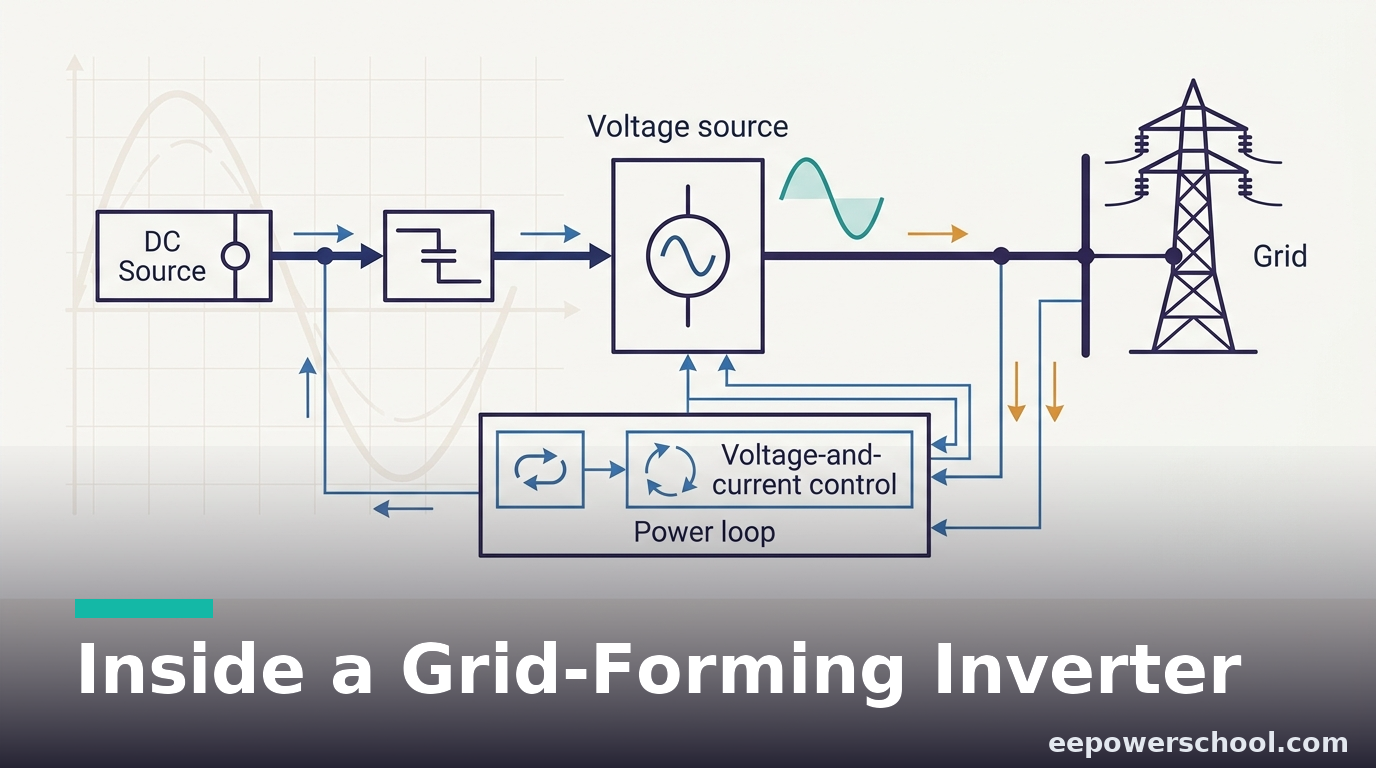
If a grid-following inverter is a current source that leans on the grid, a grid-forming inverter is the opposite: a voltage source that holds up the grid for others to lean on. That single inversion changes everything about the control, and it is why grid-forming control has gone from a research curiosity to the technology operators are now mandating in weak and renewable-heavy networks.
But “grid-forming” is an umbrella over several quite different control methods, and they are rarely laid side by side at an engineering level. This post does that. We will look at the three main families, droop, the virtual synchronous machine, and power-synchronization control, show the inner cascade they all share, and put real numbers on a droop gain and an emulated inertia so the difference between them is concrete rather than philosophical.
Setting the Voltage Instead of Following It
The core of grid-forming control is that the inverter controls its own voltage magnitude and angle and presents itself to the network as a voltage source behind an impedance. It does not need to measure and chase the grid angle the way a grid-following unit does, because it sets that angle itself. Connect it to a passive or very weak network and it still works, because it is the thing defining the voltage.
That is the property the grid needs as synchronous machines retire: something to establish the reference, supply a stiff voltage, and respond instantly to disturbances. The interesting engineering question is not whether to control voltage, all grid-forming methods do, but how the inverter decides what its voltage angle and magnitude should be as load and grid conditions change. The three families are three different answers to that question.
The Skeleton Every Method Shares
Before the differences, the common structure. Almost every grid-forming control implementation is a hierarchy with the same bones:
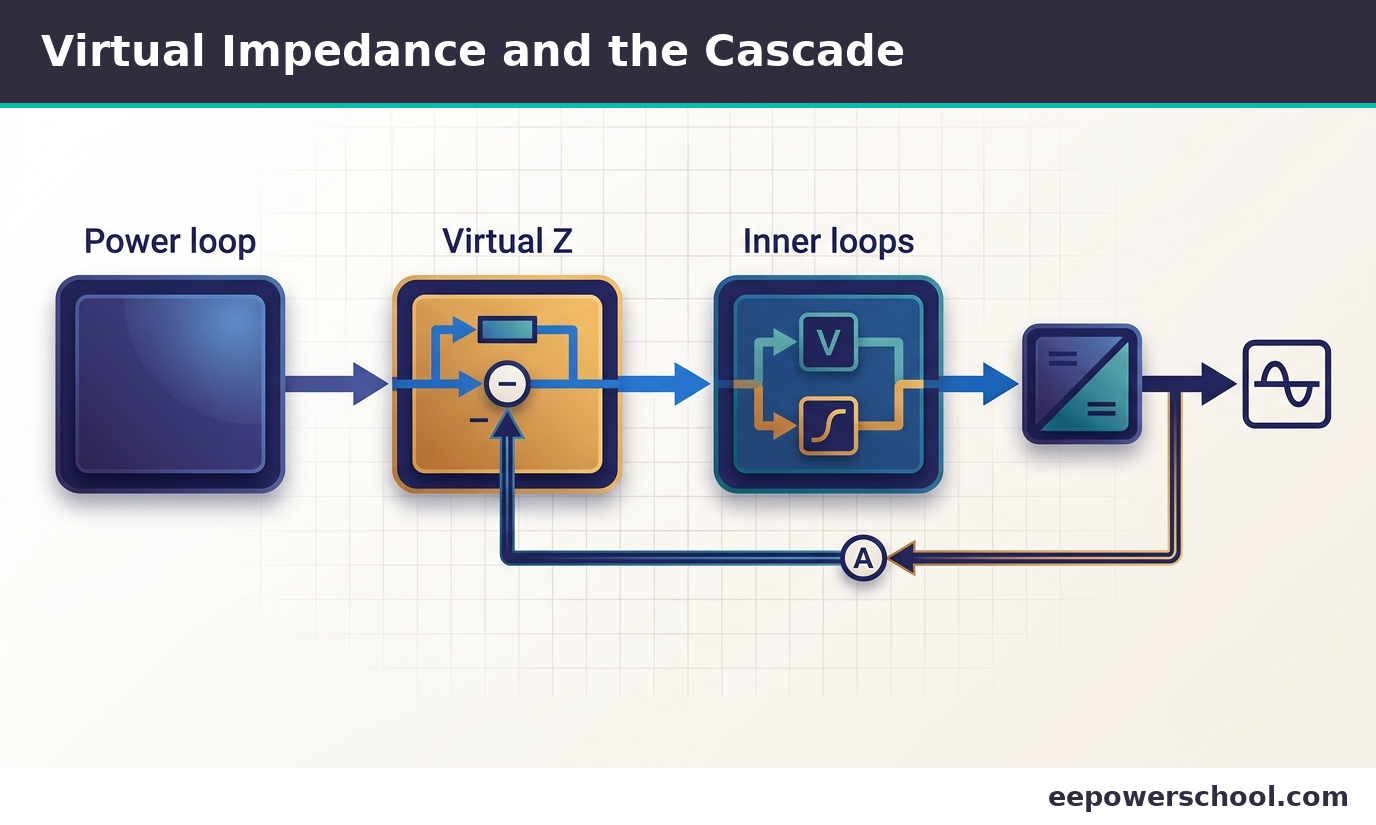
- An outer power loop that decides the internal voltage angle and magnitude from the measured active and reactive power. This is where droop, VSM and power-synchronization differ.
- An inner voltage-and-current cascade that makes the converter actually produce that commanded voltage, a voltage loop setting a current reference, and a fast current loop beneath it.
- A virtual impedance inserted between the power loop and the voltage reference, which shapes the output impedance for clean power sharing and provides a route to limit current during faults.
So the inner machinery looks a lot like the grid-following current loop we already know, the difference in grid-forming control is the outer layer that commands voltage rather than current. Keep that picture in mind: the families below are all just different outer power loops bolted onto the same cascade.
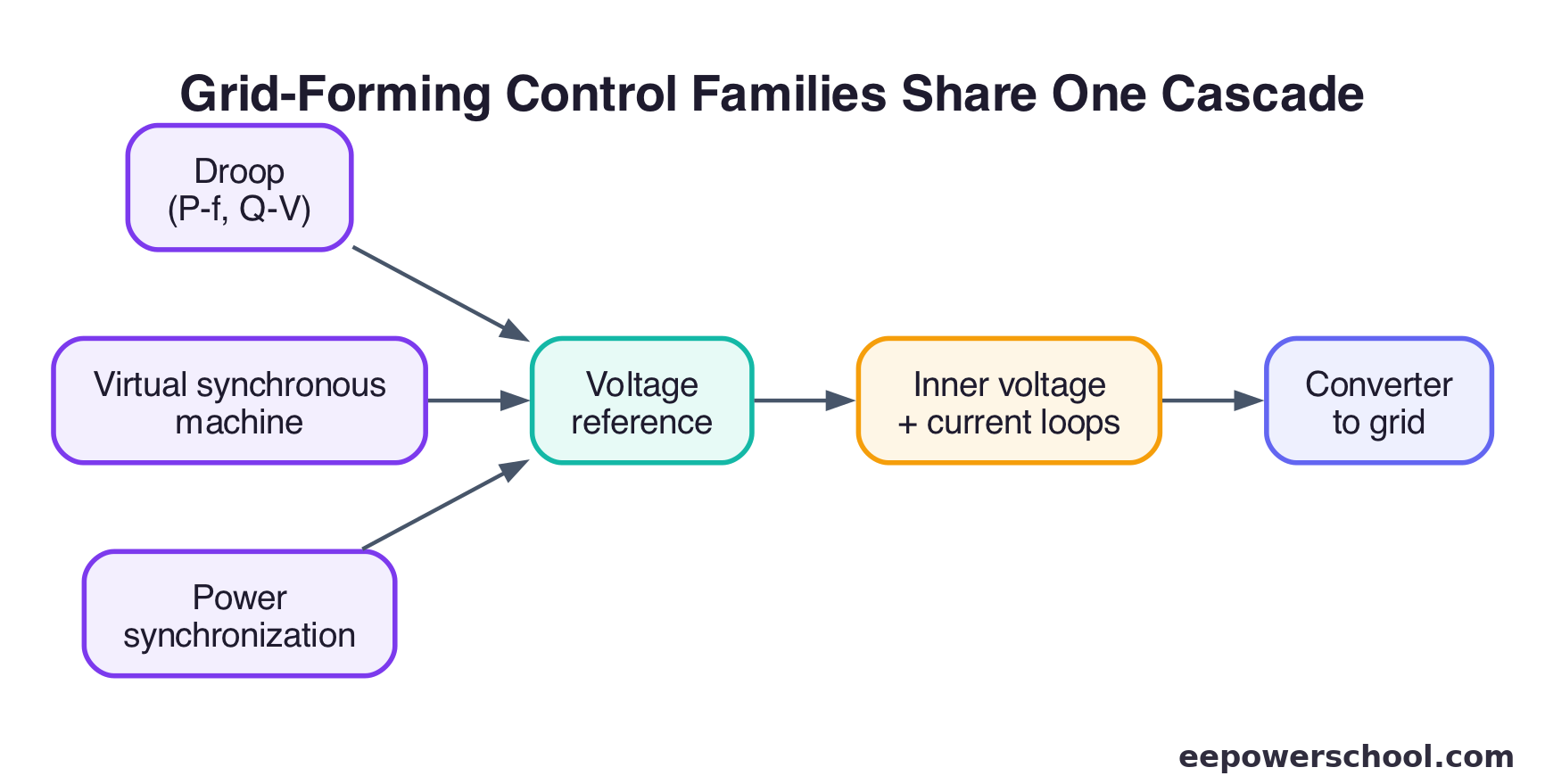
Family 1: Droop Control
Droop is the original and simplest grid-forming control method, borrowed straight from how synchronous generators share load. Two linear relations set the voltage:
\[ \omega = \omega^* – m_p (P – P_0), \qquad V = V_0 – n_q (Q – Q_0) \]
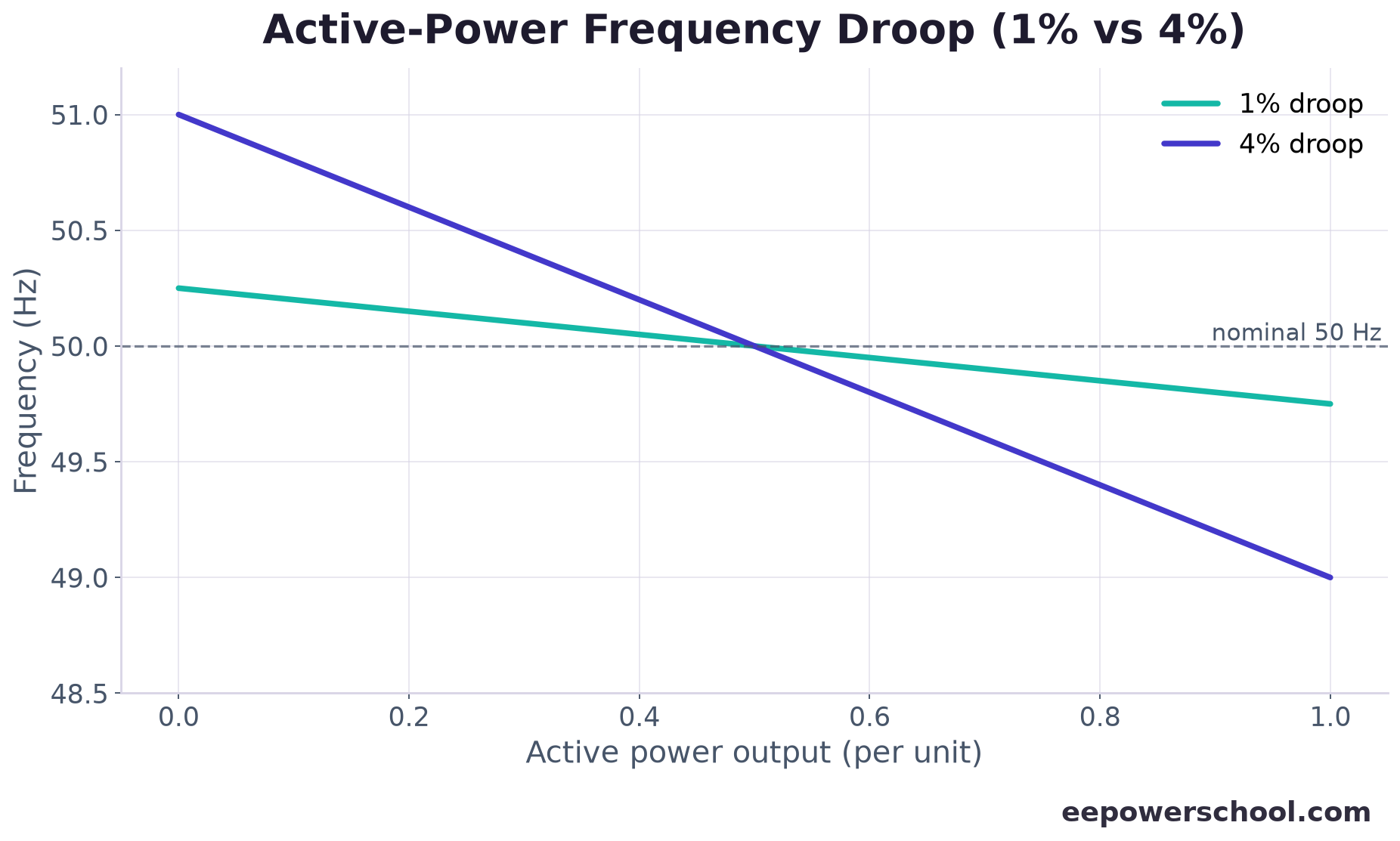
As the unit supplies more active power, it lowers its frequency slightly; as it supplies more reactive power, it lowers its voltage slightly. The negative slopes are what let multiple units share load without communicating: they all settle at a common frequency, each carrying a share set by its droop gain. The active-power droop gain is just the allowed deviation over the power range, \( m_p = \Delta\omega / \Delta P \).
Put a number on it. A common choice is 1% droop: full rated power for a 0.5 Hz change on a 50 Hz grid. In per unit that is \( m_p = 0.01 \). The droop chart shows two settings, a stiff 1% and a softer 4%, the steeper line shares load more aggressively for a given frequency change. Simple, robust, decentralised. The one thing pure droop does not give you is inertia: it moves to the new frequency essentially as fast as it can measure power, with no rate limit. That gap is what the next family fills.
Family 2: The Virtual Synchronous Machine
The virtual synchronous machine (VSM), also called a synchronverter, makes the inverter imitate the equation that governs a real generator rotor, the swing equation:
\[ 2H \frac{d\omega}{dt} = P_m – P_e – D\,\Delta\omega \]
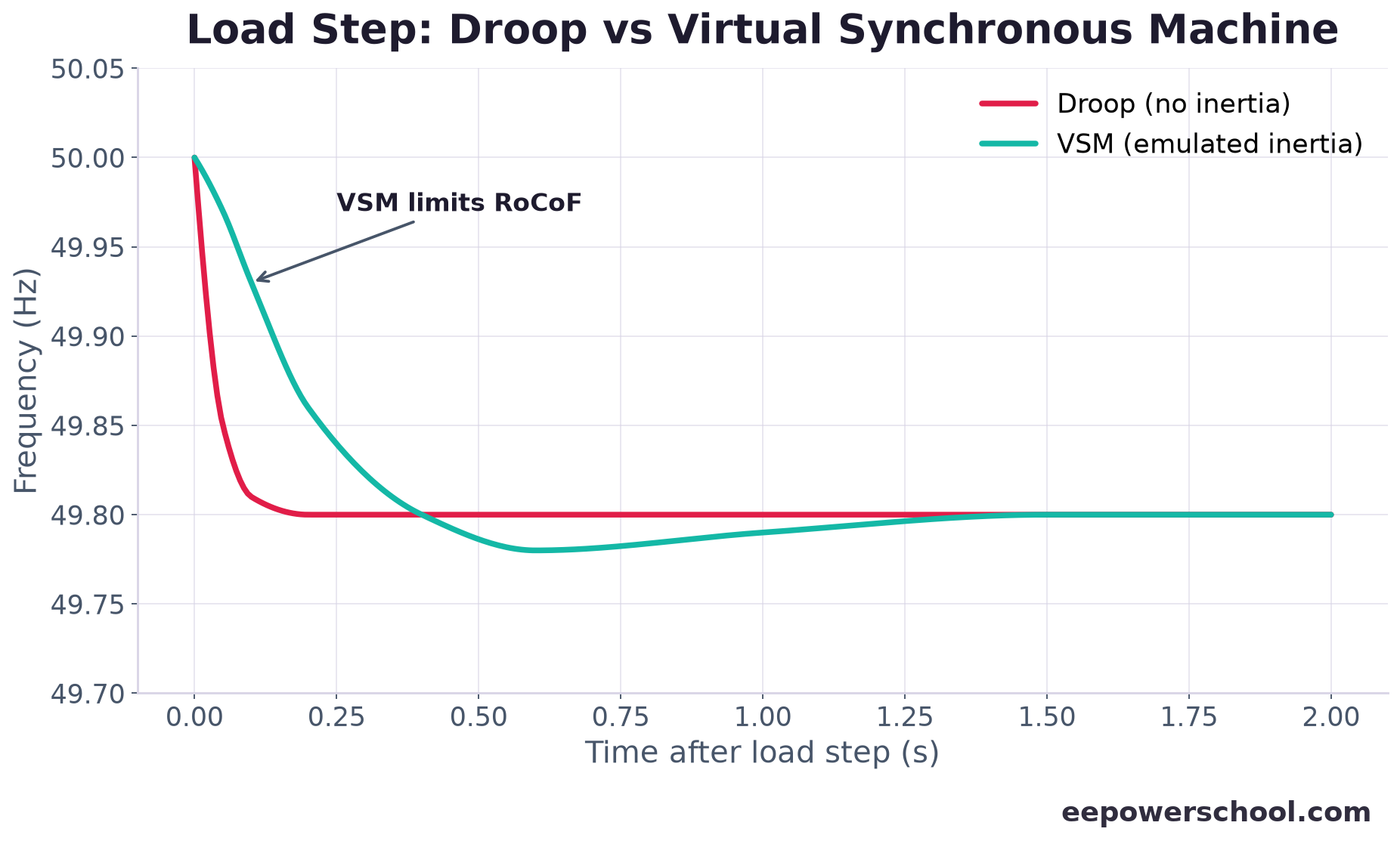
Here \( H \) is an emulated inertia constant and \( D \) an emulated damping, both free parameters in software rather than physical iron. The payoff is a genuine inertial response: the unit resists fast frequency change exactly as a spinning machine would. Work the rate of change after a power imbalance, with the damping term small initially:
\[ \frac{d\omega}{dt} = \frac{\Delta P}{2H} \]
For an emulated \( H = 5 \) s and a 0.1 pu power step, \( d\omega/dt = 0.1 / 10 = 0.01 \) pu/s, which is 0.5 Hz/s on a 50 Hz grid, a gentle, controlled slope instead of a step. The VSM chart shows this against droop: same final frequency, but the VSM gets there with a limited rate of change. A lovely result from D’Arco and Suul ties the two families together: a VSM is small-signal equivalent to a droop controller with a low-pass filter on the power measurement, where the filter time constant plays the role of inertia. So VSM is not a different universe from droop, it is droop with deliberate dynamics added. That is grid-forming control maturing from steady-state sharing to transient behaviour.
Family 3: Power-Synchronization Control
The third family, power-synchronization control (PSC) from Zhang, Harnefors and Nee, takes a more radical step: it throws away the PLL entirely. Instead of a separate loop measuring the grid angle, it uses the active-power loop itself to synchronise. The angle the inverter adopts is driven by the power balance, mimicking how a real machine naturally pulls into step through the power it exchanges.
Why bother? Because in a very weak grid, a PLL is exactly the component that tends to go unstable, it injects negative damping as system strength falls. Removing it and synchronising through power instead makes the converter far more robust at low short-circuit ratio, which is precisely where grid-forming control earns its keep. PSC was originally developed for VSC-HVDC into weak AC systems, and the same logic now drives interest in it for grid-forming renewables connecting at the far end of long, weak lines. It is the family that most directly addresses the weak-grid problem the other methods only partly solve.
Current Limiting and Sharing Without Stepping on Each Other
Two practical problems decide whether grid-forming control survives contact with a real plant. The first is current limiting. A voltage source, confronted with a fault, will try to push enormous current to hold its voltage, and the semiconductors cannot allow that. The elegant fix is virtual impedance: the controller behaves as though a real impedance sits in series, so as current rises the internal voltage is pulled back, limiting current while keeping the unit acting like a (softer) voltage source rather than abruptly switching to current-source mode.
The second is sharing. Put several grid-forming units on one network and they must split load gracefully, not fight over the angle. Droop gains and virtual impedance together set how power divides among them, the same way droop lets real generators share. Get these two right and a fleet of grid-forming inverters behaves like a well-mannered set of small machines; get them wrong and you get circulating power and oscillations. This is the unglamorous part of grid-forming control that separates a lab demonstration from a plant that can actually be energised.
Conclusion
The label grid-forming hides more variety than most people realise. Droop gives you decentralised steady-state sharing; the virtual synchronous machine adds a tunable inertial response that a pure droop lacks; power-synchronization control trades the PLL for robustness in the weak grids where it matters most. They are not rivals so much as points on a spectrum, and a real product often blends them.
What they share is the part worth remembering: an outer loop that commands voltage, an inner cascade that delivers it, and a virtual impedance that keeps current sane during faults and lets units share. That skeleton is the through-line of grid-forming control. If you have read the companion post on grid-following control, the contrast is now sharp: one follows a voltage it cannot create, the other creates the voltage everything else follows. The grid of the next decade needs a lot more of the second kind.
Key takeaways
- A grid-forming inverter controls its own voltage magnitude and angle as a voltage source behind an impedance, so it can operate into a passive or very weak grid.
- Every method shares a skeleton: an outer power loop sets the voltage, an inner voltage-and-current cascade produces it, and virtual impedance shapes output impedance and limits current.
- Droop is the simplest: omega = omega* – mp(P – P0) and V = V0 – nq(Q – Q0); a 1% droop means full power for a 0.5 Hz change. It shares load but gives no inertia.
- A virtual synchronous machine emulates the swing equation 2H dω/dt = Pm – Pe – D Δω; with H = 5 s a 0.1 pu step gives a controlled 0.5 Hz/s, real inertial response.
- A VSM is small-signal equivalent to droop with a low-pass-filtered power measurement, so the two families are closely related.
- Power-synchronization control drops the PLL and synchronises through the power loop, making it far more robust in weak grids where PLLs go unstable.
Frequently Asked Questions
What is grid-forming control?
It is the control approach in which an inverter sets its own voltage magnitude and angle and behaves as a voltage source behind an impedance, rather than following the grid voltage with a PLL. This lets it establish a reference, supply a stiff voltage, and operate into weak or passive networks, which grid-following inverters cannot do.
What are the main grid-forming control methods?
Three families: droop control (linear P-f and Q-V relations for decentralised load sharing), the virtual synchronous machine or synchronverter (emulating the swing equation for real inertial response), and power-synchronization control (which drops the PLL and synchronises through the power loop for robustness in weak grids).
Does droop control provide inertia?
No. Pure droop sets a new frequency essentially as fast as it can measure power, with no rate limit, so it provides no inertia. A virtual synchronous machine adds emulated inertia via the swing equation, and in fact a VSM is small-signal equivalent to droop with a low-pass filter on the power measurement.
How does a grid-forming inverter limit fault current?
Usually with virtual impedance: the controller acts as though a real series impedance is present, so as current rises the internal voltage is pulled back, limiting current while keeping the unit behaving like a softer voltage source rather than abruptly switching to a current-limited mode. This protects the semiconductors during faults.
Related reading
- The dq (Park) transformation for inverter control
- Inside a grid-following inverter: the control loops
- Grid-forming inverter requirements and compliance
- Grid-forming vs grid-following inverters explained
- Electrical Engineering Formula Cheat Sheet (power systems quick reference)
References
- Rocabert et al. – Control of Power Converters in AC Microgrids (IEEE TPEL 2012)
- Zhong & Weiss – Synchronverters: Inverters That Mimic Synchronous Generators (IEEE TIE)
- Zhang, Harnefors & Nee – Power-Synchronization Control of Grid-Connected VSCs (IEEE TPS)
- CIGRE – Development of Grid-Forming Converters (JWG B4/C4.93)

Very good post!
Sadly the graphs are not visible.
Thanks. Sorry about the images/graphs. There was a technical issue with the images, I’ve resolved. Please check again if images are visible.