Skip to content

EE Power School

  • Home
  • CategoriesExpand
    • Tutorials
    • Simulations
    • General
    • Energy
    • FYP
    • BSEE
    • Softwares
  • About UsExpand
    • About EEPS
    • Privacy Policy
    • Terms and Conditions
    • Contact
Linkedin X Facebook Email
EE Power School
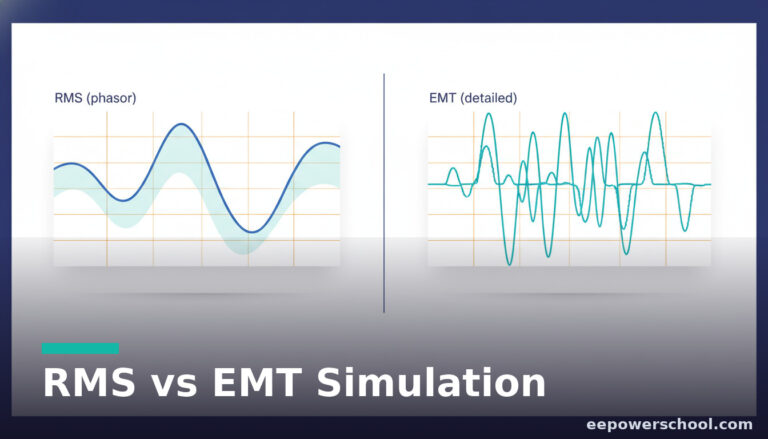
  • RMS vs EMT simulation concept: a smooth phasor representation beside a detailed instantaneous waveform on engineering screens
    Power Systems

    RMS vs EMT Simulation: When Phasor Models Aren’t Enough

    ByMuhammad Sarwar June 22, 2026

    RMS vs EMT simulation explained: phasor vs electromagnetic-transient models, time steps, when RMS fails for inverter-based resources, and how to choose.
    Read More RMS vs EMT Simulation: When Phasor Models Aren’t EnoughContinue

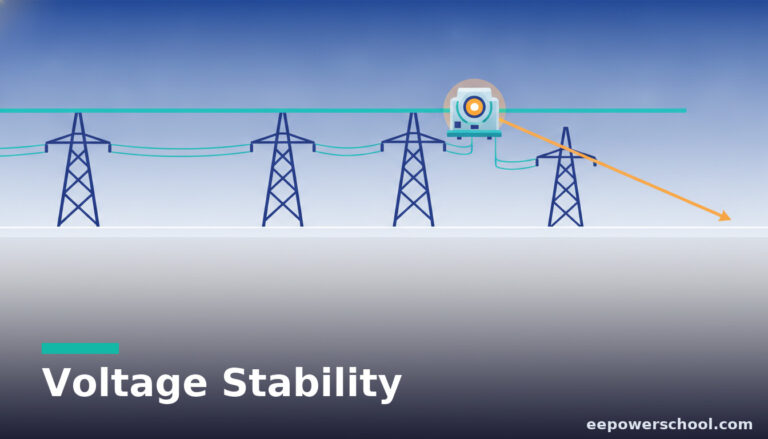
  • Voltage stability concept: a voltage profile across a grid being held steady against a sagging, collapsing one
    Power Systems

    Voltage Stability in Power Systems with High IBR Penetration

    ByMuhammad Sarwar June 22, 2026June 22, 2026

    Voltage stability for high-IBR grids: reactive power, P-V and Q-V curves, voltage collapse, and how dynamic reactive support keeps voltage stable.
    Read More Voltage Stability in Power Systems with High IBR PenetrationContinue

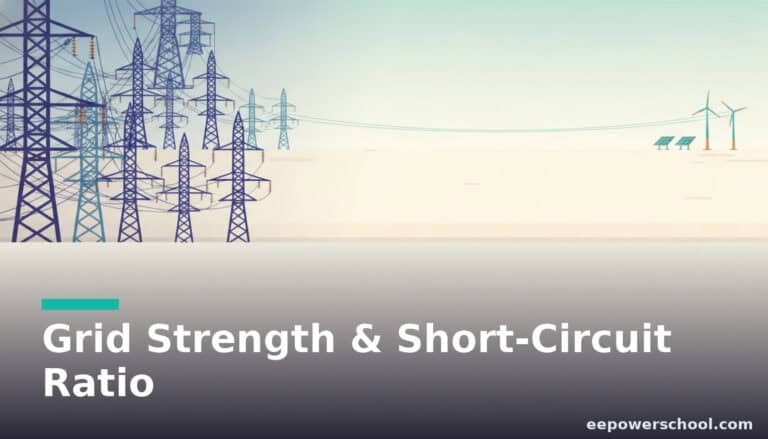
  • Grid strength concept: a strong meshed transmission network beside a weak remote connection feeding a renewable plant
    Power Systems

    What Is Grid Strength? Short-Circuit Ratio and Weak Grids, Explained

    ByMuhammad Sarwar June 22, 2026

    Grid strength, the short-circuit ratio (SCR), and why weak grids destabilise inverters, explained with a worked SCR example for power engineers.
    Read More What Is Grid Strength? Short-Circuit Ratio and Weak Grids, ExplainedContinue

  • Grid-forming vs grid-following inverters on a modern renewable grid with solar, wind and battery storage
    Power Systems

    Grid-Forming vs Grid-Following Inverters: What Every Power Engineer Should Know

    ByMuhammad Sarwar June 21, 2026June 21, 2026

    Grid-forming vs grid-following inverters explained: how each works, why falling grid inertia makes it matter, and what it means for protection.

    Read More Grid-Forming vs Grid-Following Inverters: What Every Power Engineer Should KnowContinue

  • Electrical Engineering Formula Cheat Sheet 2026: Power Systems Quick Reference
    Education

    Electrical Engineering Formula Cheat Sheet 2026: Power Systems Quick Reference

    ByMuhammad Sarwar March 30, 2026June 23, 2026

    Download the 2026 Electrical Engineering Formula Cheat Sheet — covers power equations, transformers, fault analysis, motors & PF correction. Free PDF.

    Read More Electrical Engineering Formula Cheat Sheet 2026: Power Systems Quick ReferenceContinue

Page navigation

Previous PagePrevious 1 … 3 4 5 6 7 … 15 Next PageNext

Search

Search

Categories

  • BSEE (3)
  • Control Systems (3)
  • Education (4)
  • Electric Machines (2)
  • Electrical Engineering Career (2)
  • Energy (9)
  • Future Power Grid (4)
  • FYP (3)
  • General (3)
  • Lighting (1)
  • Power (3)
  • Power Electronics (5)
  • Power Engineering (1)
  • Power Generation (5)
  • Power Systems (15)
  • Protection (5)
  • Simulations (3)
  • Softwares (4)
  • Tutorials (7)
    • MATLAB (2)
  • Uncategorized (1)
  • Wind (9)

Recent Posts

  • The dq (Park) Transformation for Inverter Control July 2, 2026
  • Inside a Grid-Following Inverter: The Control Loops July 1, 2026
  • Inside a Grid-Forming Inverter: Droop, VSM and Power Synchronization July 1, 2026
  • Grid-Forming Inverter Requirements: Specs and Compliance Testing June 30, 2026
  • Stability Screening for IBR-Rich Systems Using SCR, RMS, and EMT June 30, 2026

About EE Power School

EE Power School is an online platform that offers educational resources, tutorials, and training courses for electrical engineering students, professionals, and enthusiasts. The website provides a wide range of content related to power electronics, renewable energy, and control systems, among others, to help learners enhance their knowledge and skills in the field.

Topics

Basics (2) BESS (2) BSEE (2) Cheat Sheet (1) Control Systems (4) Digital Controller Design (2) EMT (1) Energy Resources (4) ETAP (3) Feedback control (2) frequency response (1) FYP (2) Grid-Forming (2) Grid Inertia (1) grid services (1) grid stability (3) Inverter-Based Resources (3) inverter control (5) Inverters (6) List of 10 (2) marine renewable energy (1) matlab (3) Modeling of Power Networks (4) NEC 625 (1) Power Conversion (7) Power Electronics (5) Power Plants (3) Power System (10) Power System Protection (4) power systems (1) Protection Coordination (2) reactive power (1) Reference Guide (1) Renewable Energy (11) renewables (6) Simuilnk (2) Simulation (8) Smart Grid (1) Solar Power (2) Synchronous Generator (1) system strength (2) Tutorial (2) voltage stability (1) Wind Energy (3) Wind Energy Course (7)

© 2026 EE Power School

Facebook X Instagram
Manage Consent
To provide the best experiences, we use technologies like cookies to store and/or access device information. Consenting to these technologies will allow us to process data such as browsing behavior or unique IDs on this site. Not consenting or withdrawing consent, may adversely affect certain features and functions.
Functional Always active
The technical storage or access is strictly necessary for the legitimate purpose of enabling the use of a specific service explicitly requested by the subscriber or user, or for the sole purpose of carrying out the transmission of a communication over an electronic communications network.
Preferences
The technical storage or access is necessary for the legitimate purpose of storing preferences that are not requested by the subscriber or user.
Statistics
The technical storage or access that is used exclusively for statistical purposes. The technical storage or access that is used exclusively for anonymous statistical purposes. Without a subpoena, voluntary compliance on the part of your Internet Service Provider, or additional records from a third party, information stored or retrieved for this purpose alone cannot usually be used to identify you.
Marketing
The technical storage or access is required to create user profiles to send advertising, or to track the user on a website or across several websites for similar marketing purposes.
  • Manage options
  • Manage services
  • Manage {vendor_count} vendors
  • Read more about these purposes
View preferences
  • {title}
  • {title}
  • {title}
  • Home
  • Categories
    • Tutorials
    • Simulations
    • General
    • Energy
    • FYP
    • BSEE
    • Softwares
  • About Us
    • About EEPS
    • Privacy Policy
    • Terms and Conditions
    • Contact
Search