What It Takes to Run a Grid on 100% Inverter-Based Resources
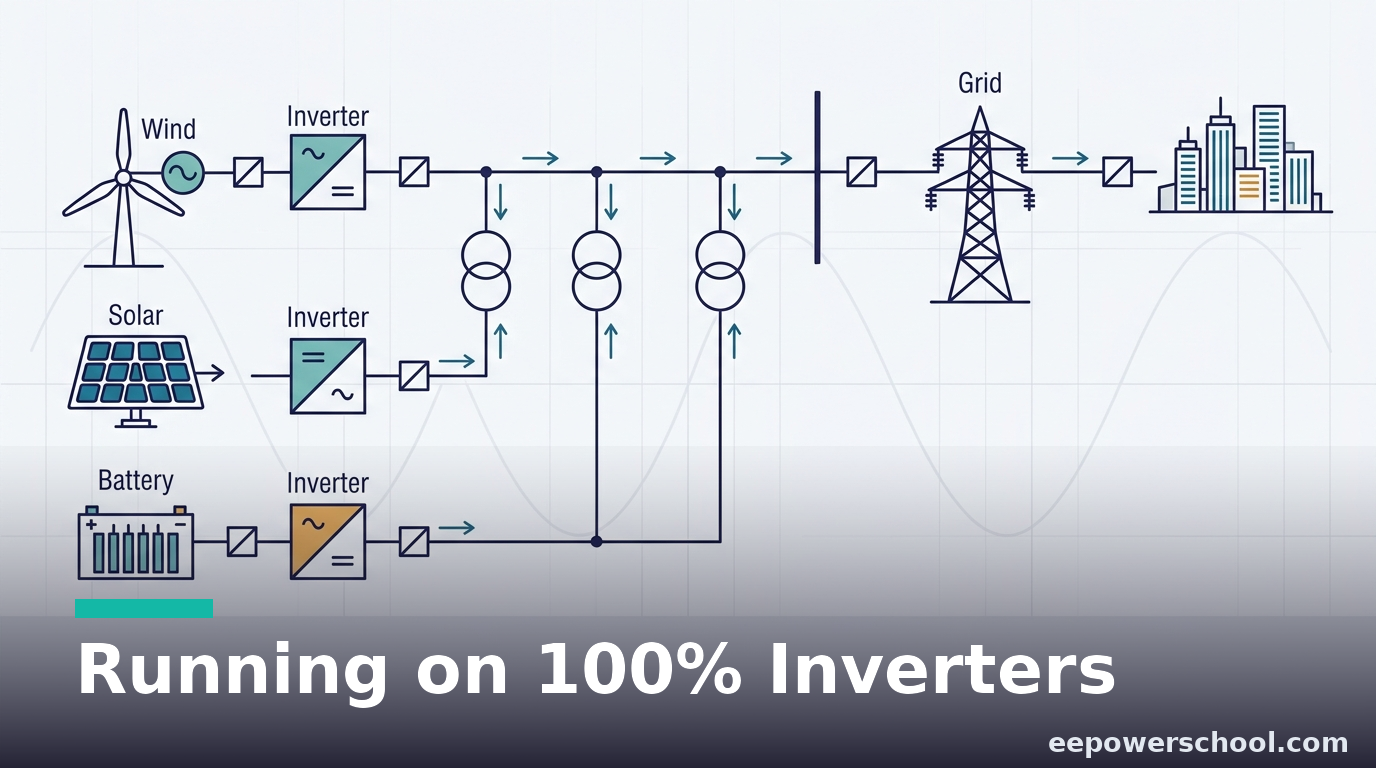
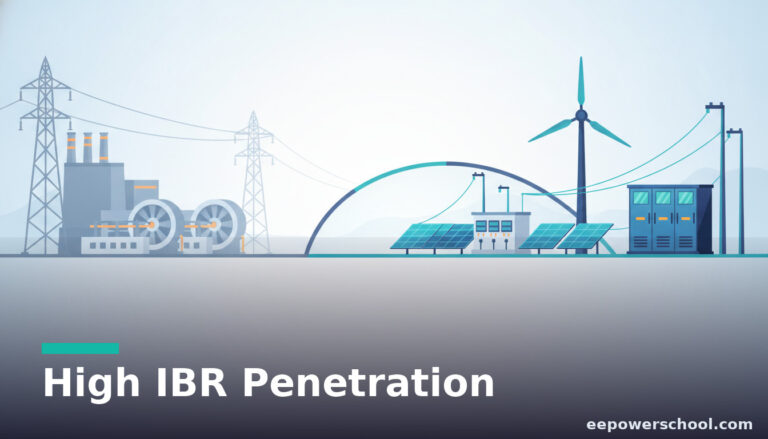
For a few hours on a sunny, windy, low-demand afternoon, some real power systems already meet almost all of their load from wind, solar and batteries. That is a milestone worth pausing on, but it is not the same as proving you can run a grid on 100% inverter-based resources for any condition, at any moment, with the lights staying on through a fault or a sudden plant trip.
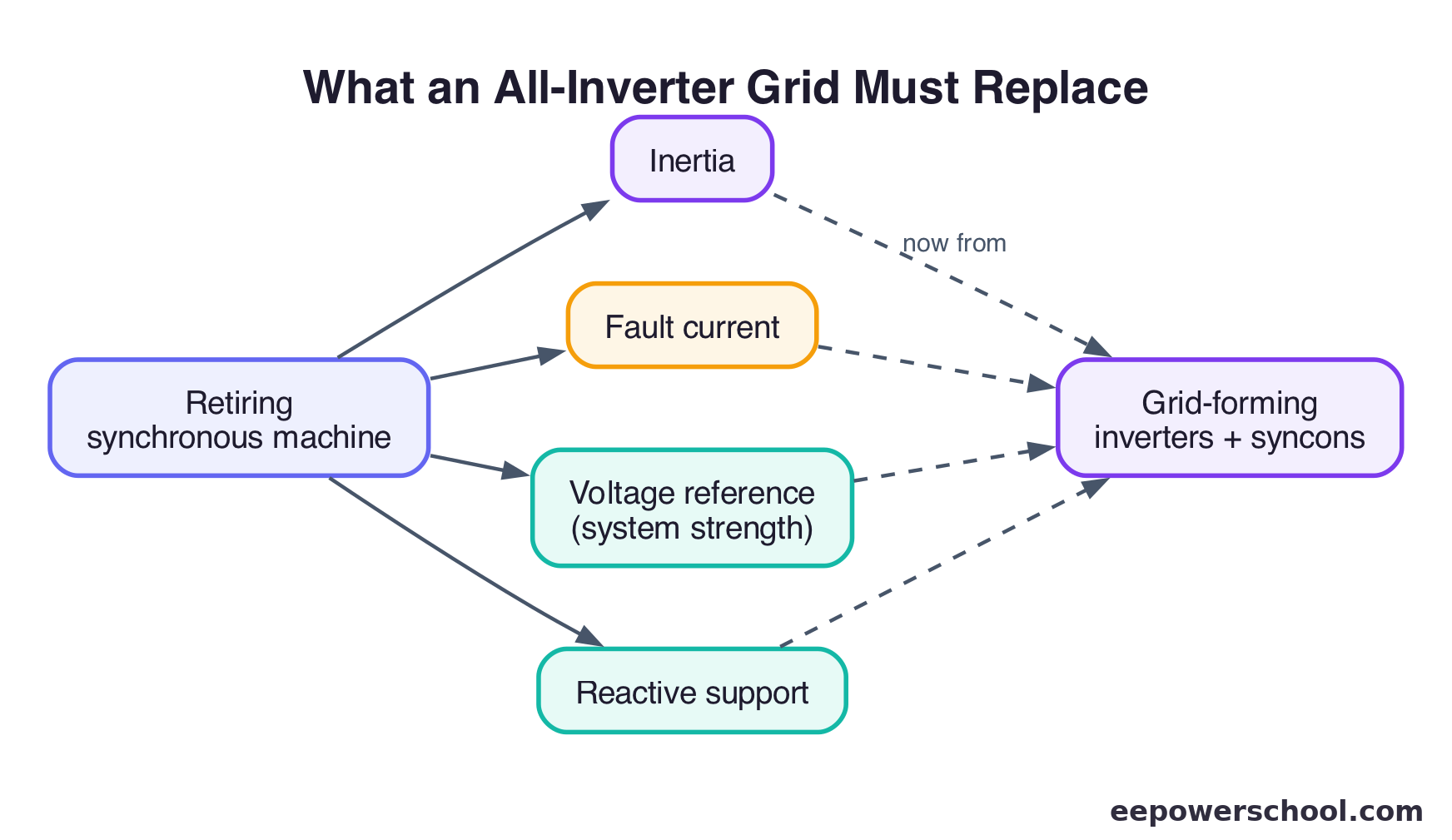
The gap between those two statements is where the real engineering lives. When the last synchronous generator comes offline, a handful of services that machines used to provide for free, inertia, fault current, a stiff voltage reference, reactive support, suddenly have to be designed in on purpose. This post walks through what those services are, why losing them is dangerous, and what operators have actually done to push toward a system that can run on 100% inverter-based resources.
What 100% Inverter-Based Resources Actually Means
The first thing to get straight is what we are counting. There is a big difference between instantaneous share, the fraction of demand met by inverters at a single moment, and energy share, the fraction met over a whole year. A grid can touch 100% instantaneous inverter supply for a few dispatch intervals on a mild day while its annual energy share from those resources is still well under half.
EirGrid and SONI, the operators of the all-island Irish system, track this with a metric called System Non-Synchronous Penetration (SNSP): the real-time ratio of non-synchronous generation plus net HVDC imports to demand plus net HVDC exports. It is a clean way to express how much of the system is, at this instant, electronically interfaced rather than spinning. When people talk loosely about a grid running on 100% inverter-based resources, they almost always mean a high instantaneous or SNSP figure for a limited window, not year-round operation. Both matter, but they pose different problems.
What Synchronous Machines Gave Us for Free
A large synchronous generator does a lot more than push out megawatts. Spinning in step with the grid, it inherently supplies four services that the system quietly relies on. Strip the machines out and each of these becomes an engineering problem you have to solve deliberately.
| Service | From a synchronous machine | From a grid-following inverter |
|---|---|---|
| Inertia | Stored kinetic energy in the rotor resists frequency change instantly | None inherently; must be emulated by control |
| Fault current | Sustained, roughly 5 to 7 times rated current | Limited to about 1.1 to 1.5 times rated by the semiconductors |
| Voltage reference | Sets a stiff voltage magnitude and angle on its own | Follows an existing voltage via a phase-locked loop |
| Reactive support | Continuous, with large short-term overexcitation | Available, but bounded by the inverter rating |
That fault-current row is the one engineers underrate. Protection schemes were designed assuming a fault draws a large, obvious current that relays can see and clear. An inverter that can only push about 1.2 times its rated current makes a fault look far less dramatic, which is one reason a grid built around 100% inverter-based resources forces a rethink of protection, not just generation.
Inertia, RoCoF and a Worked Frequency Example
Inertia is the service people fixate on, and for good reason. The moment a large generator or import trips, the system has a power imbalance, and how fast frequency falls is governed by the swing equation. The initial rate of change of frequency (RoCoF) is:
\[ \mathrm{RoCoF} = \frac{f_0 \, \Delta P}{2 \, H_\mathrm{sys} \, S_\mathrm{base}} \]
where \( f_0 \) is nominal frequency, \( \Delta P \) is the lost infeed, \( H_\mathrm{sys} \) is the system inertia constant in seconds, and \( S_\mathrm{base} \) is the aggregate MVA base of the synchronised plant. Lower inertia means a steeper slope, which leaves less time for any response to arrest the fall before frequency reaches a dangerous nadir.
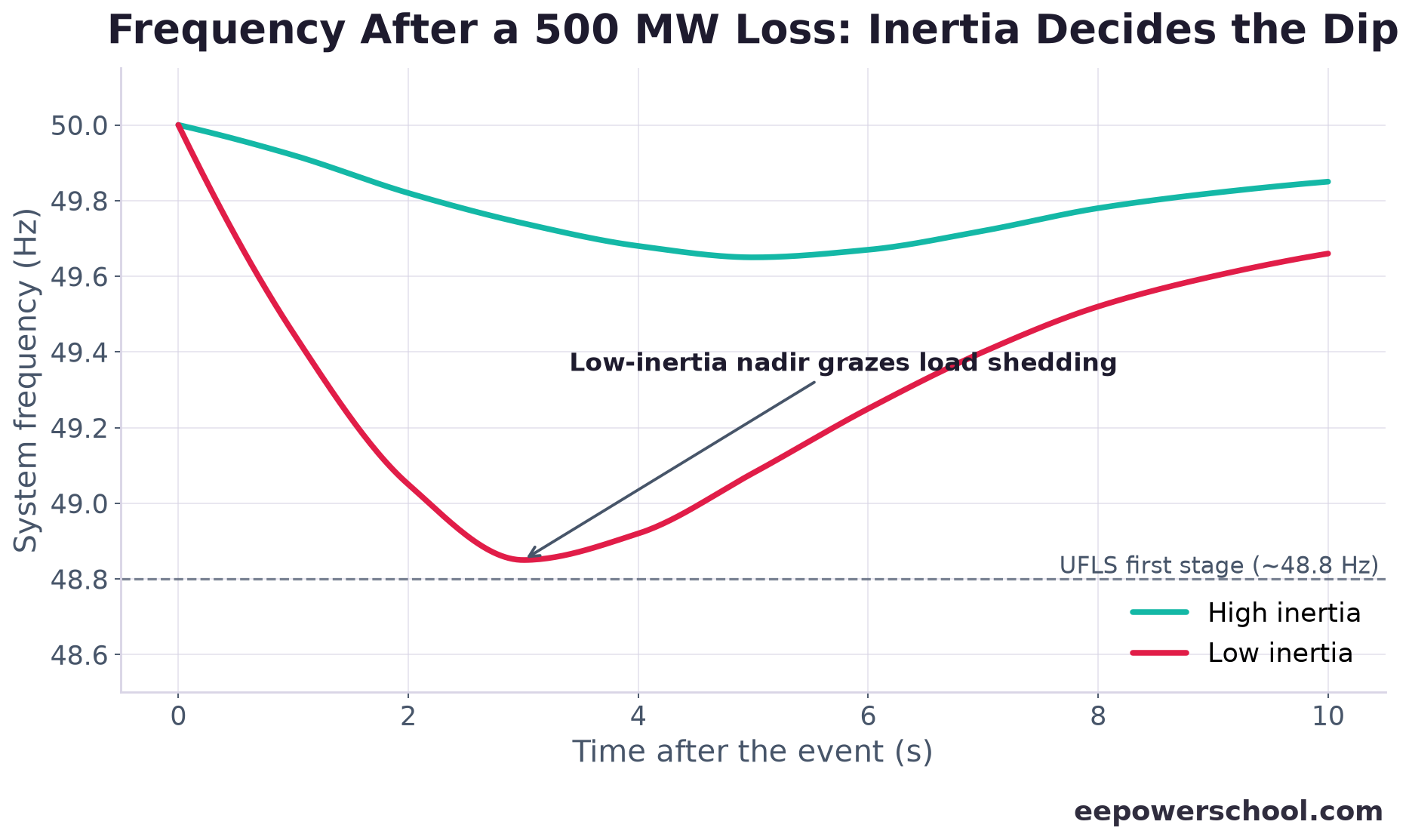
Take a concrete case: a 500 MW infeed loss on a 50 Hz system, the kind of event a system like Ireland’s plans around. Watch what falling inertia does:
| Case | \( S_\mathrm{base} \) (MVA) | \( H_\mathrm{sys} \) (s) | RoCoF (Hz/s) |
|---|---|---|---|
| High inertia | 10,000 | 6 | 0.21 |
| Moderate | 6,000 | 5 | 0.42 |
| Low inertia | 4,000 | 3 | 1.04 |
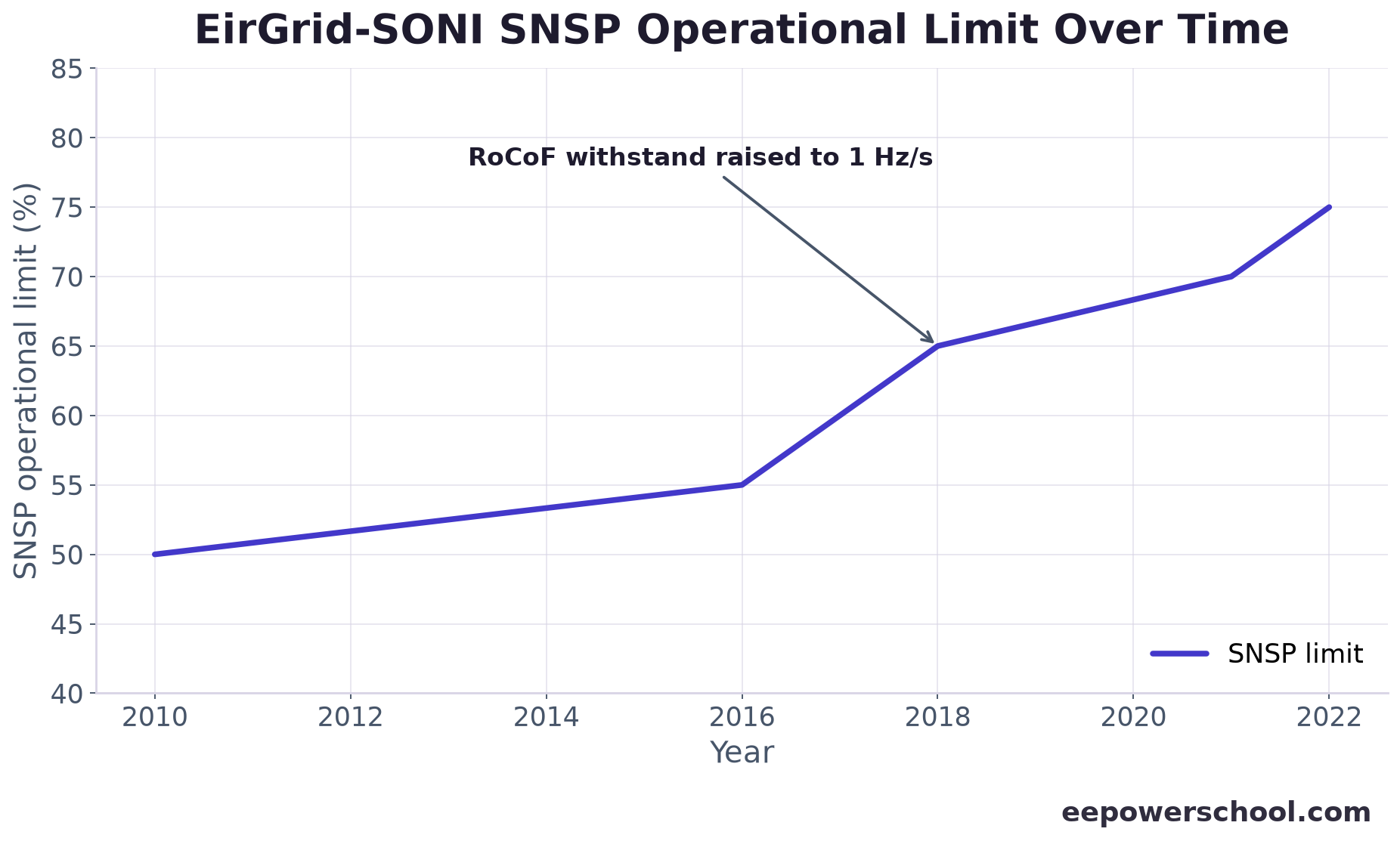
For the low-inertia case: \( \mathrm{RoCoF} = (50 \times 500) / (2 \times 3 \times 4000) = 1.04 \) Hz/s. That number matters because EirGrid had to raise the RoCoF its system was designed to withstand from 0.5 Hz/s to 1.0 Hz/s, over a rolling 500 ms window, before it could safely lift its non-synchronous limits. The chart below shows the same idea as a frequency trace: the low-inertia case plunges toward the first stage of under-frequency load shedding while the high-inertia case barely dips.
System Strength and the Fault-Current Problem
Inertia gets the headlines, but system strength is the quieter constraint that often bites first. System strength is the grid’s ability to hold a stable voltage waveform when something nearby switches or faults, and it is measured through the available fault level, often expressed as a Short Circuit Ratio (SCR) at a connection point.
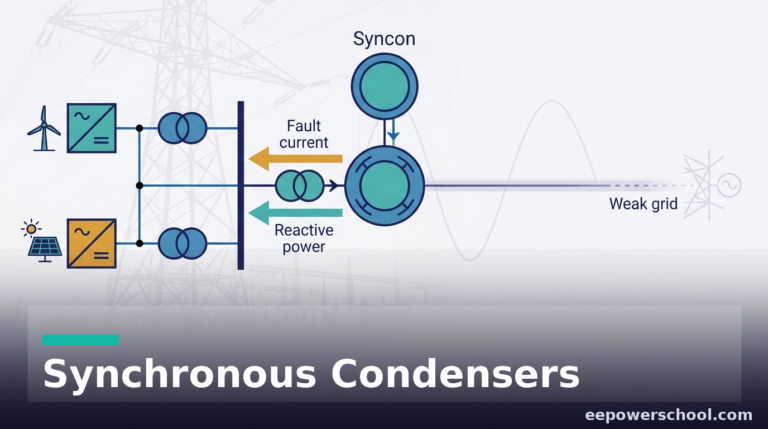
Grid-following inverters depend on a clean, stiff voltage to lock onto. In a weak grid, the inverter’s own current injection moves the local voltage and angle, which feeds back into its phase-locked loop and can drive it unstable. As synchronous machines retire, the fault level falls, SCR drops, and the very resources you are adding make the reference they depend on softer. AEMO, the Australian market operator, typically requires new inverter-based plant to remain stable down to an SCR of about 3, and weak-grid areas have seen real curtailment when that margin disappears. A grid aiming for 100% inverter-based resources has to manufacture system strength, usually with grid-forming inverters or synchronous condensers, rather than assume it.
Grid-Forming Inverters: The Enabler
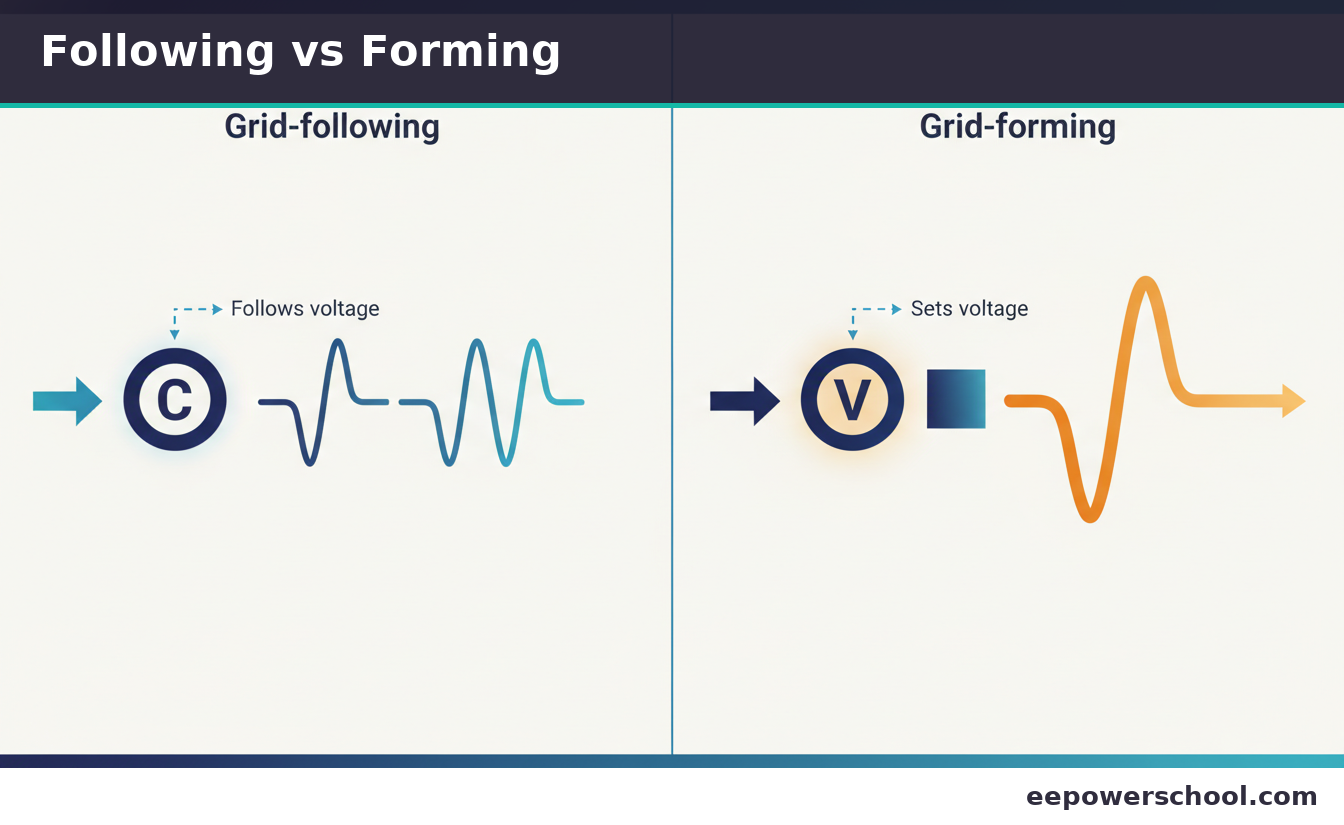
The reason 100% inverter-based resources is even a serious proposition, rather than a thought experiment, is grid-forming control. A grid-following inverter behaves like a controlled current source: it measures the grid voltage and injects current in step with it, so it needs a reference that something else provides. Remove every synchronous machine and a room full of grid-following inverters has nothing to follow.
A grid-forming inverter behaves like a controlled voltage source behind an impedance. It sets its own internal voltage magnitude and angle and holds that phasor through the first cycles of a disturbance, which lets it supply a reference, fast inertial response, fault current and black-start capability, all subject to its current rating. This is the part that changes the answer. With enough grid-forming capacity, the system has something to define voltage and frequency even with zero spinning machines. The Dalrymple battery in South Australia, a 30 MW grid-forming unit, demonstrated exactly this by holding up a stable island with no synchronous generator online at all.
How Far Operators Have Actually Gone
This is not only theory. Several systems have pushed remarkably far:
- EirGrid and SONI stepped their SNSP operational limit up from 50% in the early 2010s to a 75% ceiling under the DS3 programme, raising the RoCoF withstand and adding fast frequency response along the way.
- South Australia met 100% of its demand from solar for an hour in October 2020, and in November 2022 ran islanded from the rest of the National Electricity Market at about 91.5% instantaneous renewables, held secure by four synchronous condensers and the Hornsdale battery.
- The wider National Electricity Market set an instantaneous renewables record of 68.7% in October 2022, and AEMO has openly targeted brief periods of 100% instantaneous renewables.
The pattern is consistent. Every step toward 100% inverter-based resources came paired with a deliberate investment in the missing services: more grid-forming plant, synchronous condensers for strength and inertia, faster frequency response, and tighter operational limits. South Australia has even reduced its minimum number of online synchronous units to one, with a path toward zero.
The Operability Gaps That Remain
So can a grid run on 100% inverter-based resources? For limited windows, with the right mix of grid-forming capacity and synchronous condensers, the demonstrations say yes. Sustained, all-conditions operation is a harder bar, and a few gaps are still being worked:
- Protection. Low fault current undermines schemes that assume a large, fast fault signature. Negative-sequence and other inverter-aware methods help, but coordination across a region built on 100% inverter-based resources is still maturing.
- Restoration. Black start from inverters is real but new. Energising transformers and picking up cold load with current-limited sources, and paralleling multiple grid-forming units, demands careful sequencing.
- System strength at scale. Keeping SCR adequate everywhere, not just on average, often still needs synchronous condensers, which means the cheapest path is usually a high-inverter grid with a few spinning masses left in for strength.
None of these is a brick wall. They are the engineering to-do list standing between a record-setting afternoon and a grid that genuinely runs on inverters whenever it needs to.
Conclusion
The honest answer to whether a grid can run on 100% inverter-based resources is: increasingly, yes, but only because engineers stopped treating inertia, fault current and a voltage reference as free. The moment you account for them as services to be designed, specified and paid for, the problem becomes tractable, and the demonstrations in South Australia and Ireland prove it.
What I find genuinely interesting is that the cheapest, most robust path to a near-100% grid is rarely a purist all-inverter design. It is usually a system dominated by grid-forming inverters with a few synchronous condensers left spinning for strength and inertia. The label says inverters; the engineering says keep a little rotating mass around until protection and restoration fully catch up.
Key takeaways
- Distinguish instantaneous share from annual energy share; most 100% headlines are brief instantaneous windows, not year-round operation.
- Synchronous machines inherently supply inertia, fault current, a voltage reference and reactive support; an all-inverter grid must engineer each one in.
- Lower inertia means higher RoCoF: a 500 MW loss gives about 0.21 Hz/s at high inertia but over 1 Hz/s at low inertia, squeezing the time to arrest a fall.
- System strength and fault current, not just inertia, often constrain weak-grid operation; grid-following inverters destabilise when SCR drops too low.
- Grid-forming inverters are the enabler: they set their own voltage reference, so the system has something to define voltage and frequency with no machines online.
- Real systems (EirGrid at 75% SNSP, South Australia islanded at 91.5%) reached high penetration only by deliberately adding grid-forming plant and synchronous condensers.
Frequently Asked Questions
Can a power grid really run on 100% inverter-based resources?
For limited periods, yes. South Australia has run islanded at about 91.5% instantaneous renewables, and grid-forming batteries have held up stable islands with no synchronous generator. Sustained, all-conditions operation is harder and still depends on adding grid-forming capacity and often synchronous condensers for system strength and inertia.
What is the difference between instantaneous and energy share of inverters?
Instantaneous share is the fraction of demand met by inverters at a single moment; energy share is the fraction over a year. A grid can hit 100% instantaneous for minutes on a mild day while its annual energy share is far lower, so 100% headlines usually refer to brief instantaneous windows.
Why does low inertia matter for an inverter-dominated grid?
Inertia resists frequency change immediately after a generation loss. With less inertia, the rate of change of frequency (RoCoF) is steeper, so frequency falls faster and there is less time for response to arrest it before reaching under-frequency load shedding. Operators raise RoCoF withstand and add fast frequency response to cope.
What makes grid-forming inverters essential at very high penetration?
Grid-following inverters need an existing voltage to synchronise to via a phase-locked loop. With no synchronous machines, there is no reference to follow. Grid-forming inverters act as voltage sources that set their own magnitude and angle, so they can provide the reference, fast inertial response and fault current the system needs.
Related reading
- The future of the electric grid with renewable and green energy
- Power system simulation using PSS/E
- Single line diagram of a power system
- Electrical Engineering Formula Cheat Sheet (power systems quick reference)