EV Charger Load Calculation for a Commercial Building
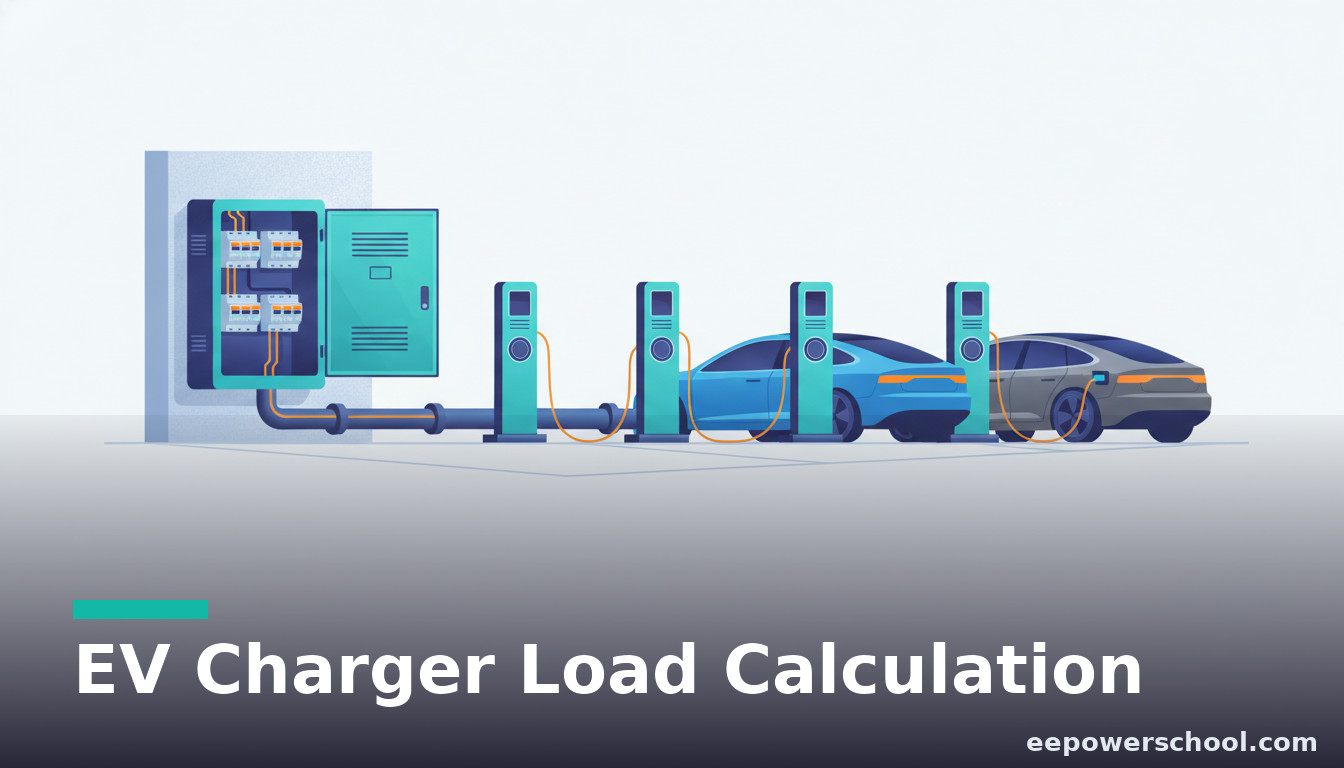
Putting in a few EV chargers sounds simple until you do the EV charger load calculation and discover the naive number wants a service upgrade that costs more than the chargers themselves. The math is not hard, but it hinges on one rule that catches people out, and on a load-management trick that can save a project.
This guide walks through how to size the service and feeders for electric vehicle supply equipment (EVSE) the way the National Electrical Code expects, why EV loads are treated as continuous, and how an energy management system lets you connect far more chargers than the raw arithmetic suggests. We finish with a worked example for six Level-2 chargers.
Why EV Charger Load Calculation Is Different
Most receptacle and lighting loads are intermittent, so the service rarely sees them all at once. EV charging is the opposite: a car plugged in overnight draws its full rated current for hours without pause. That single behavioural fact is what makes an EV charger load calculation different from an ordinary one.
Because the draw is sustained, the Code (NEC Article 625) classifies EVSE as a continuous load, and continuous loads carry a sizing penalty that ripples through the conductors, the overcurrent protection, and ultimately the size of service you need. Get that classification wrong and you will undersize the feeder; apply it blindly and you may over-build the service.
The 125% Continuous-Load Rule
The governing rule is short: because EVSE is a continuous load, the branch circuit, feeder, and overcurrent device must be rated for at least 125% of the EVSE’s rated current. Equivalently, the equipment can only be loaded to 80% of the conductor and breaker rating.
So a charger rated 48 A does not need a 48 A circuit; it needs 48 × 1.25 = 60 A of conductor and overcurrent capacity. Multiply that across several chargers and the 25% adder becomes the difference between fitting inside the existing service and triggering an upgrade. Every EV charger load calculation starts here.
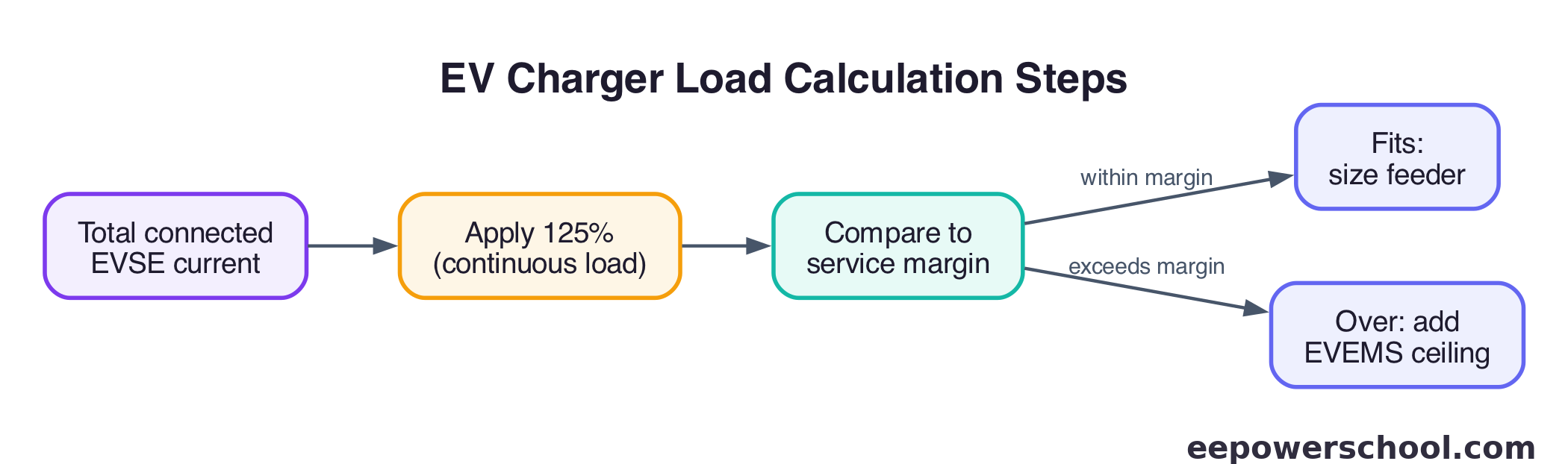
Step 1: Total the Connected EVSE Load
Begin with the nameplate. Add up the rated input current (or power) of every piece of electric vehicle supply equipment you intend to install. Use the EVSE’s rated output, not the car’s onboard charger, and use the continuous rated current the unit can sustain.
For a typical commercial Level-2 unit at 48 A, 240 V, that is about 11.5 kW each. Six of them is a connected load of 288 A, or roughly 69 kW, before any code factor is applied. This raw connected load is the input to everything that follows.
Step 2: Apply the 125% Continuous Factor
Now apply the continuous-load multiplier to size the feeder and service contribution. Taking the six-charger example, 288 A of connected EVSE becomes 288 × 1.25 = 360 A of required capacity, about 86 kW at 240 V.
That is the number that lands on the service load calculation, on top of the building’s existing demand. For many existing buildings, adding 360 A of new continuous load is exactly what pushes the total past the service rating, and that is where most EV projects hit a wall.
The Trap: Naive Sizing Forces a Service Upgrade
The instinctive approach, size for every charger running at full power simultaneously, is the most expensive possible answer. It assumes a worst case that, in a workplace or fleet depot, almost never happens: not every vehicle is plugged in, and not every plugged-in vehicle is drawing full current at the same instant.
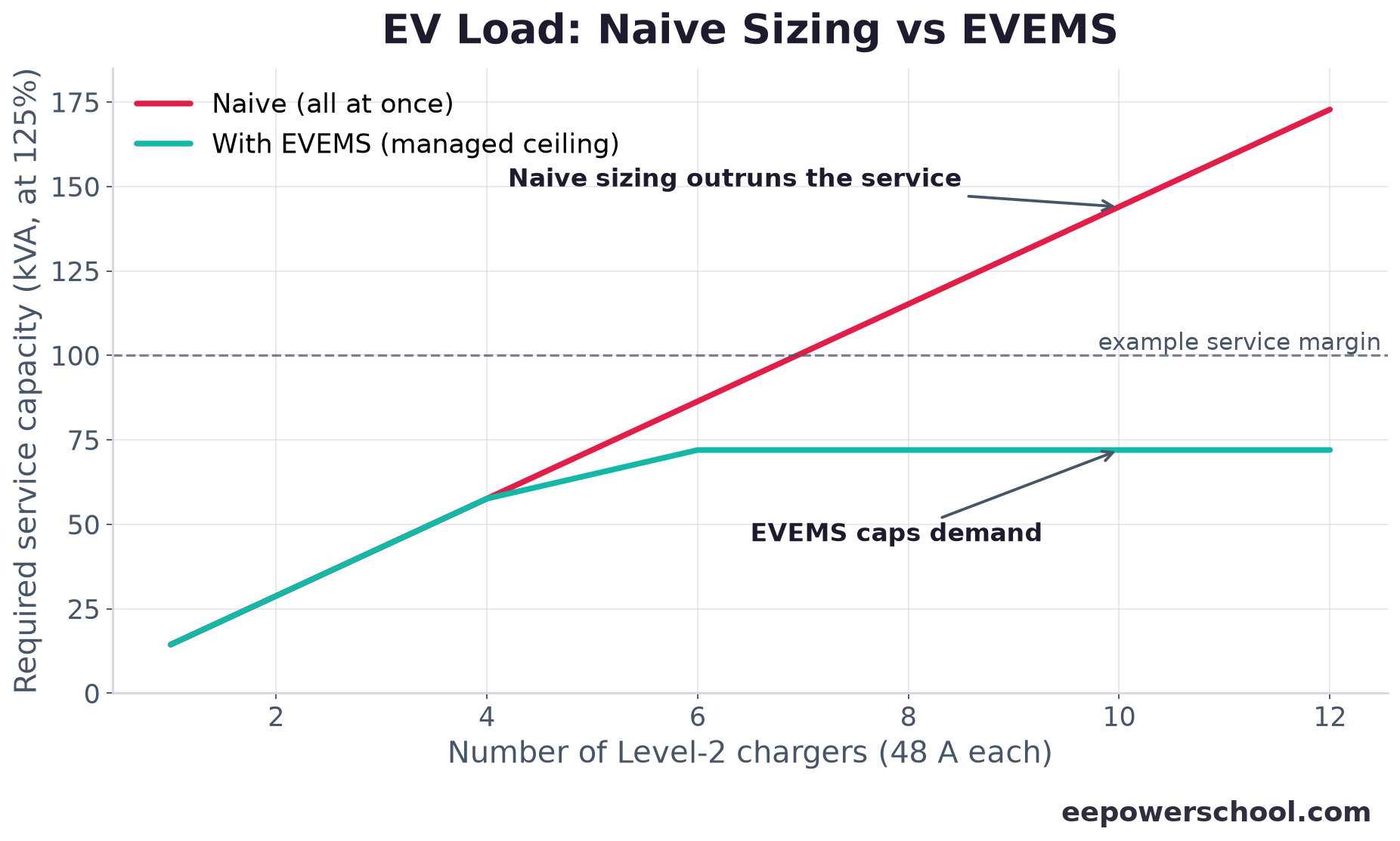
Sizing the service for that improbable peak can mean a new transformer, a new service entrance, and utility work costing far more than the chargers. The chart below shows how quickly naive sizing outruns a typical service as you add chargers. The good news is that the Code now offers a sanctioned way out.
The Fix: EV Energy Management Systems (EVEMS)
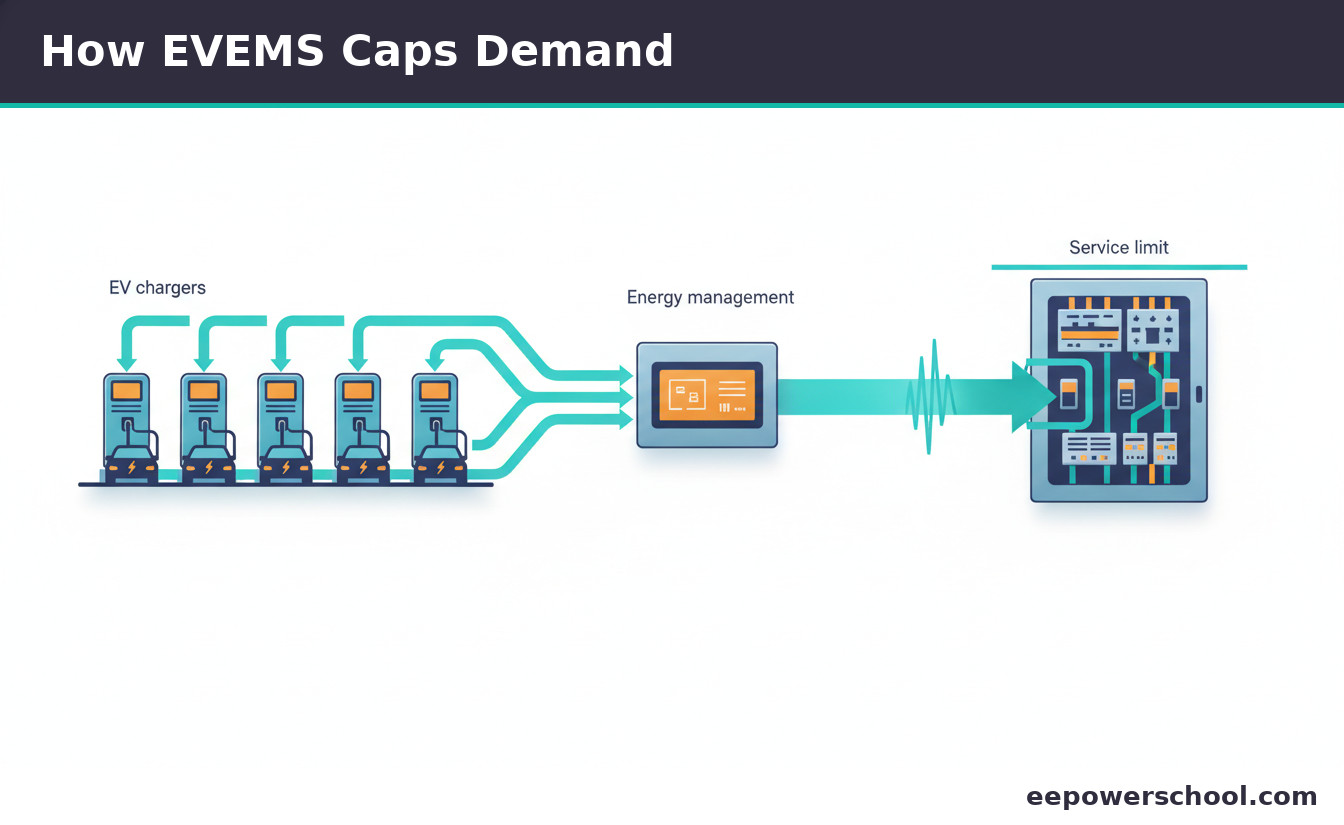
An EV energy management system (EVEMS) actively limits the total power the chargers can draw, throttling or staggering them so their combined load never exceeds a set ceiling. NEC 625.42, together with the energy-management provisions of Article 750, lets you size the feeder and service to that managed maximum rather than the sum of all nameplates.
This changes the economics completely. Instead of sizing for 360 A of simultaneous charging, you size for whatever ceiling the EVEMS enforces, say 80 to 100 A, and let the system share that budget across the fleet. Cars still charge; they simply queue and share capacity during peaks. For most workplace and depot sites this is what makes the project fit the existing service.
Worked Example: Six Level-2 Chargers
Put it together for six 48 A, 240 V Level-2 chargers on a building with a 200 A (about 48 kW) spare margin on its service:
| Approach | Calculation | Required capacity | Fits 48 kW spare? |
|---|---|---|---|
| Naive, all at once | 6 × 48 A × 1.25 | 360 A (~86 kW) | No, needs a service upgrade |
| With EVEMS (80 A ceiling) | 80 A × 1.25 | 100 A (~24 kW) | Yes, comfortably |
The unmanaged calculation demands 86 kW of new capacity and a costly upgrade; the EVEMS-managed design needs about 24 kW and fits inside the existing service, while still charging all six vehicles, just not all at full power simultaneously. The continuous-load math is unchanged; what changes is the load you apply it to. Keep the core formulas handy with our power systems formula cheat sheet.
When a Load Study Is Required
For an existing building, you do not have to guess the base load. NEC 220.87 permits using actual metered demand data, typically the peak measured over the past year with a small margin, as the existing load in the service calculation. That measured figure is often far below the sum of connected loads, freeing up headroom for chargers.
The practical workflow is therefore: pull the metered peak demand, subtract it from the service rating to find the spare margin, then design the EV charger load calculation, with EVEMS if needed, to fit inside that margin. Done this way, far more sites can host EV charging without touching the utility service at all.
Frequently Asked Questions
Why are EV chargers treated as continuous loads?
Because a charging vehicle draws its full rated current for three hours or more without interruption. NEC Article 625 classifies EVSE as a continuous load, which means the circuit, feeder, and overcurrent device must be rated for at least 125% of the charger's rated current.
How do I calculate the load for an EV charger?
Take the EVSE's rated continuous current, multiply by 1.25 for the continuous-load rule, and add it to the building's existing demand in the service calculation. For multiple chargers, total their rated currents first, or use the managed ceiling if an energy management system is installed.
What is an EVEMS and how does it help?
An EV energy management system limits the total power the chargers can draw to a set ceiling, staggering or throttling them. NEC 625.42 lets you size the feeder and service to that managed maximum instead of the sum of all nameplates, often avoiding a service upgrade.
Do I have to size for every charger running at once?
Only without load management. With an EVEMS you size to the enforced ceiling, not the simultaneous nameplate total. The chargers share that budget, so all vehicles still charge, just not all at full power at the same instant during peaks.
Can I use measured demand instead of calculated load?
Yes. For an existing building, NEC 220.87 allows using actual metered peak demand as the existing load, usually the highest reading over the past year plus a margin. This is often well below the connected-load total and frees up capacity for EV charging.
Related reading
- Electrical Engineering Formula Cheat Sheet (power systems quick reference)
- Single line diagram of a power system
- Solar power systems: the basics