BESS Sizing: How to Size a Battery Energy Storage System
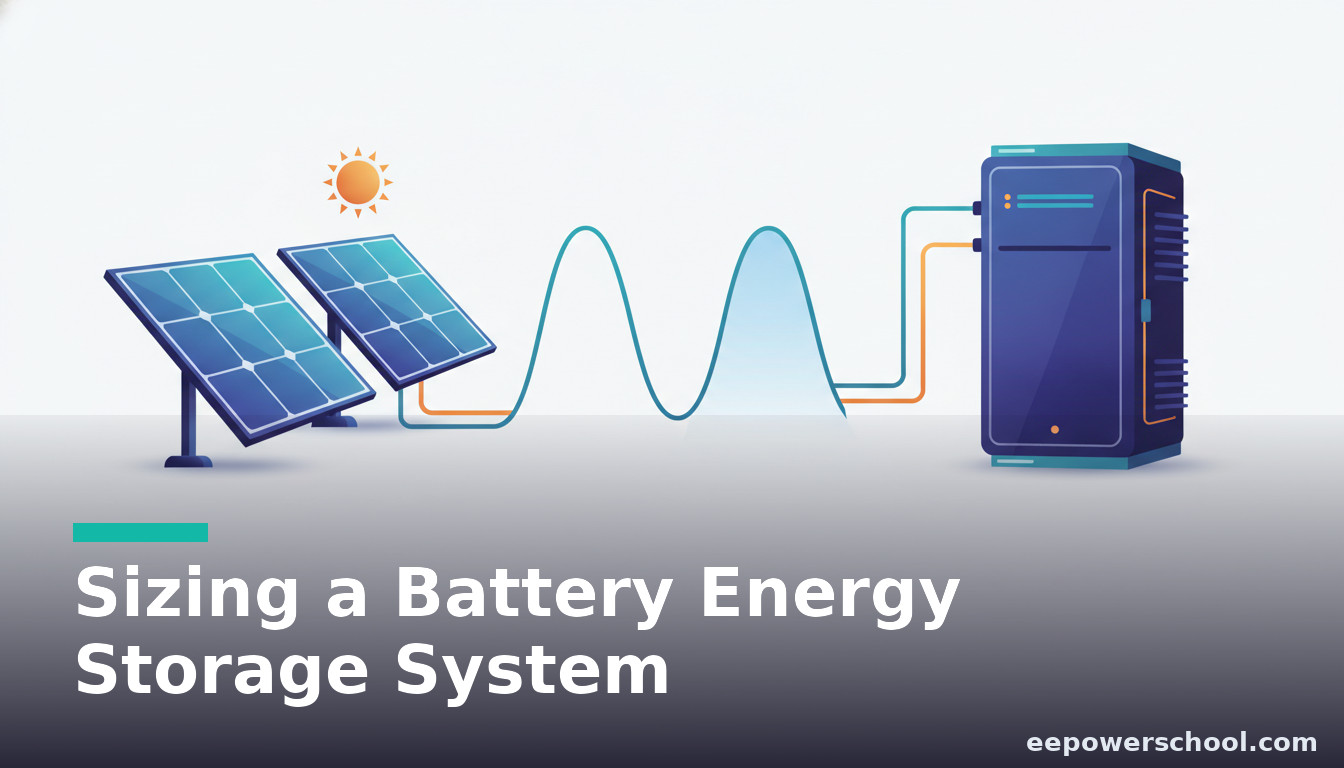
The single most common mistake in BESS sizing is answering the wrong question. People ask “how big a battery do I need?” as if size were one number, when a battery energy storage system is really defined by two: how much power it can deliver, and how much energy it can store. Confuse the two and you end up with a system that is expensive, undersized, or both.
This guide walks through BESS sizing the way it is actually done: separating power from energy, accounting for depth of discharge, efficiency, and C-rate, and then working a real example for combined peak shaving and solar self-consumption. By the end you will be able to turn a use case into a defensible kW and kWh specification.
Power vs Energy: The Two Numbers Behind BESS Sizing
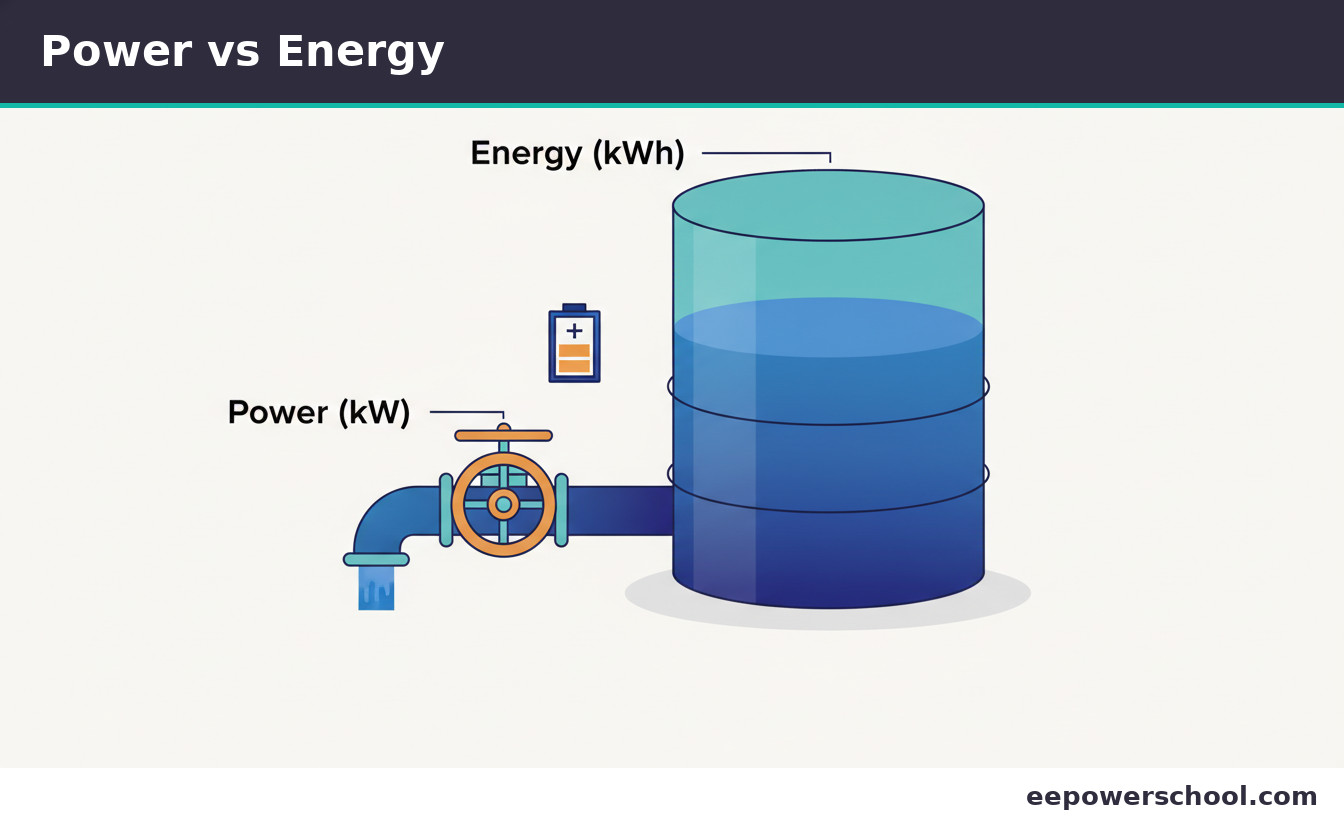
Every battery energy storage system has two independent ratings. Power (kW) is how fast it can charge or discharge, set by the inverter and cell power capability. Energy (kWh) is how much it can store, set by the cells. The water analogy is exact: power is the size of the tap, energy is the size of the tank.
A system can be high power and low energy (a small tank with a big tap, good for short, sharp bursts) or low power and high energy (a big tank with a small tap, good for long, steady delivery). All of BESS sizing flows from deciding which of these the job needs, so the two numbers are the first thing to pin down.
The Parameters That Shape the Numbers
A few factors sit between the nameplate and what you can actually use:
- Depth of discharge (DoD): the fraction of nameplate energy you are allowed to use. Usable energy = nameplate × DoD; modern lithium systems often allow 90% or more.
- Round-trip efficiency: energy out divided by energy in, typically 85 to 95% for lithium-ion. You must put in more than you get out.
- C-rate: the discharge rate relative to capacity. A 100 kWh battery discharging at 100 kW is 1C; at 50 kW it is 0.5C. C-rate links the power and energy ratings.
- Degradation: capacity fades with cycles and age, so you size for end-of-life, not just day one.
Ignore these and your real-world capacity can be 20 to 30% below the headline number.
Step 1: Define the Job
BESS sizing is meaningless without a clearly defined duty. The three most common are very different shapes:
- Backup / autonomy: deliver a known load for a set number of hours during an outage, energy-heavy.
- Peak shaving: cap the site’s grid demand to dodge demand charges, power-defined, with energy set by how long the peak lasts.
- Solar self-consumption / arbitrage: store midday solar for evening use, energy-defined by the daily surplus.
Write down the duty as a power level and a duration; those two numbers drive everything that follows.
Step 2: Size the Energy (kWh)
Energy sizing starts from the duty: the usable energy you need is the delivered power multiplied by how long you must deliver it. A 25 kW shave for 4 hours needs 100 kWh of usable energy.
Then convert usable energy to nameplate by dividing by the depth of discharge, and add a margin so the system still meets the duty at end-of-life (commonly 80% of original capacity). So 100 kWh usable at 90% DoD is about 111 kWh nameplate today, and roughly 140 kWh once you size for end-of-life. That end-of-life margin is the step most amateur BESS sizing skips.
Step 3: Size the Power (kW) and Check the C-rate
Power sizing is set by the largest instantaneous draw the system must cover. For peak shaving that is the gap between the site peak and the target cap; for backup it is the largest simultaneous load. Round up to a standard inverter rating.
Then sanity-check the C-rate: divide the power rating by the energy rating. A 30 kW / 140 kWh system is about 0.21C, a gentle, long-duration duty that is easy on the cells. If your numbers demand a high C-rate (say above 1C continuous), you may need more energy capacity or a higher-power chemistry, because the power and energy ratings are not independent in practice.
Round-Trip Efficiency and Degradation
Two corrections separate a textbook answer from a system that performs. Efficiency means you must charge more than you discharge: to deliver 100 kWh at 90% round-trip efficiency you must store about 111 kWh, which matters for sizing the charging source (often solar) and for running-cost estimates.
Degradation means capacity fades, so a battery sized exactly to the duty on day one will fall short within a few years. Sizing for the end-of-life capacity, or specifying a guaranteed capacity over the warranty period, builds that fade into the BESS sizing from the start.
Worked Example: Peak Shaving Plus Solar Self-Consumption
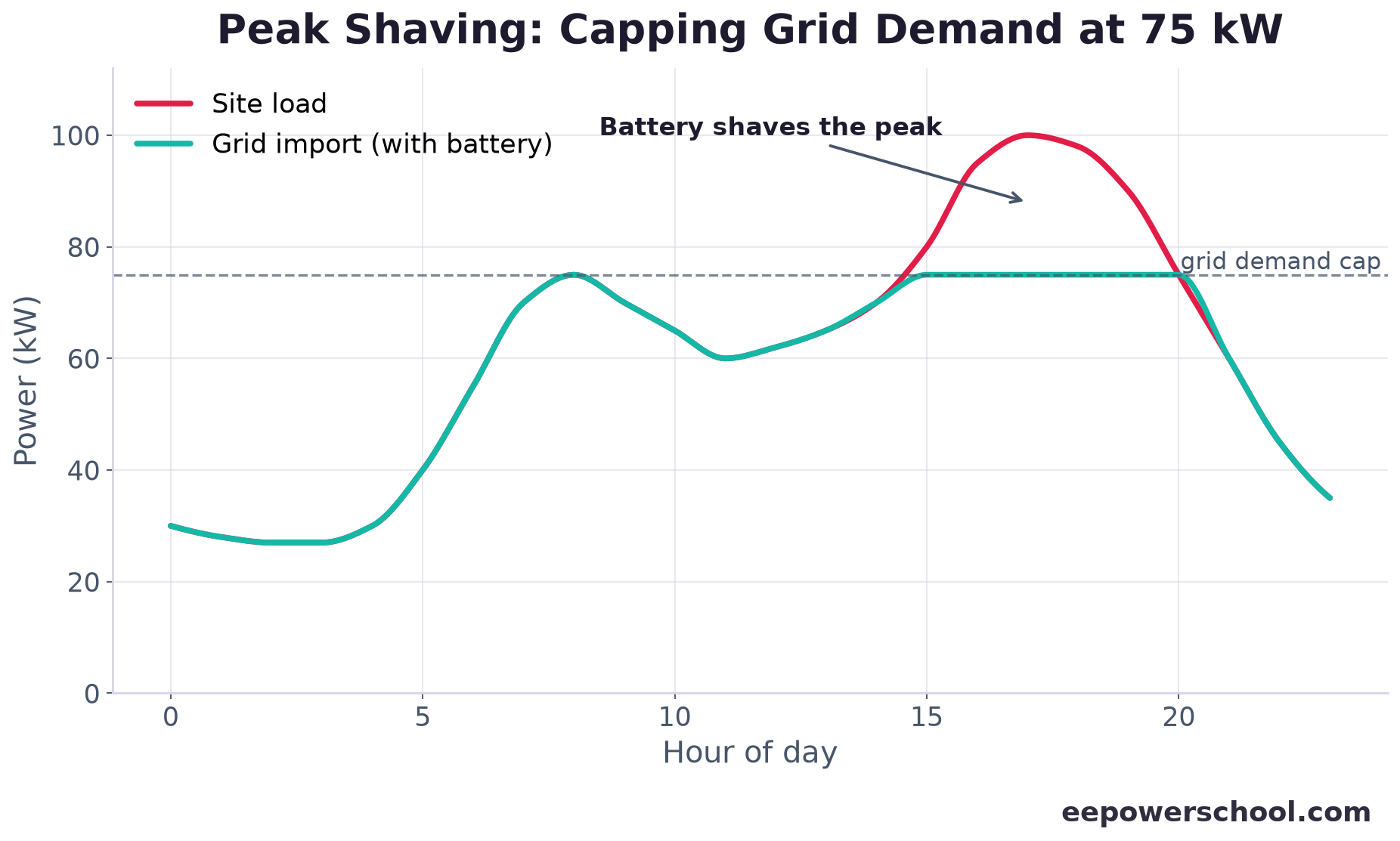
A commercial site peaks at 100 kW each evening and wants to cap grid demand at 75 kW to cut demand charges, with the peak lasting about 4 hours. Work it through:
| Step | Calculation | Result |
|---|---|---|
| Power (kW) | 100 kW peak − 75 kW cap | 25 kW (round up to 30 kW) |
| Usable energy | 25 kW × 4 h | 100 kWh usable |
| Nameplate (90% DoD) | 100 ÷ 0.90 | ~111 kWh |
| End-of-life margin (80%) | 111 ÷ 0.80 | ~140 kWh |
| C-rate check | 30 kW ÷ 140 kWh | ~0.21C (gentle) |
The answer is roughly a 30 kW / 140 kWh system. Midday solar recharges it for the evening shave, so the same battery serves self-consumption and peak shaving. The chart below shows the evening peak being capped at 75 kW. For the underlying power formulas, see our power systems formula cheat sheet.

Common BESS Sizing Mistakes
Most sizing errors come from a short list of habits:
- Quoting one number. A BESS is kW and kWh; a single figure is ambiguous.
- Using nameplate as usable. Always derate by depth of discharge.
- Forgetting efficiency. You charge more than you discharge.
- Ignoring degradation. Size for end-of-life, not day one.
- Mismatching C-rate. A tiny battery cannot deliver huge power for long.
Avoid these and your BESS sizing will hold up from the spreadsheet to the commissioning test, and stay true years into the system’s life.
Frequently Asked Questions
What is the difference between kW and kWh in BESS sizing?
kW is power, how fast the battery can charge or discharge, set by the inverter. kWh is energy, how much it can store, set by the cells. A battery is defined by both: power for the size of the demand, energy for how long it must be sustained.
How do I calculate the energy capacity I need?
Multiply the power you must deliver by the duration to get usable energy, then divide by the depth of discharge for nameplate capacity, and add a margin for end-of-life degradation. For example, 25 kW for 4 hours at 90% DoD sized for end-of-life is roughly 140 kWh.
What is C-rate and why does it matter for sizing?
C-rate is the discharge power divided by the energy capacity: a 100 kWh battery at 100 kW is 1C. It links power and energy. If your duty needs a high continuous C-rate, you often need more energy capacity or a higher-power chemistry, because the two ratings are not fully independent.
Why size a battery for end-of-life instead of day one?
Lithium-ion capacity fades with cycles and age, often to around 80% of original over the warranty period. A battery sized exactly to the duty on day one will fall short within a few years, so you size for the degraded end-of-life capacity or specify a guaranteed capacity.
Does round-trip efficiency affect BESS sizing?
Yes. At 85 to 95% round-trip efficiency you must charge more than you discharge, so to deliver 100 kWh you store about 110 kWh. It mainly affects sizing of the charging source, such as solar, and the operating-cost estimate, rather than the delivered energy rating.
Related reading
- Electrical Engineering Formula Cheat Sheet (power systems quick reference)
- Solar power systems: the basics
- Inverter-based resources: the future of renewable energy