Synchronous Condensers: Restoring System Strength to Weak Grids
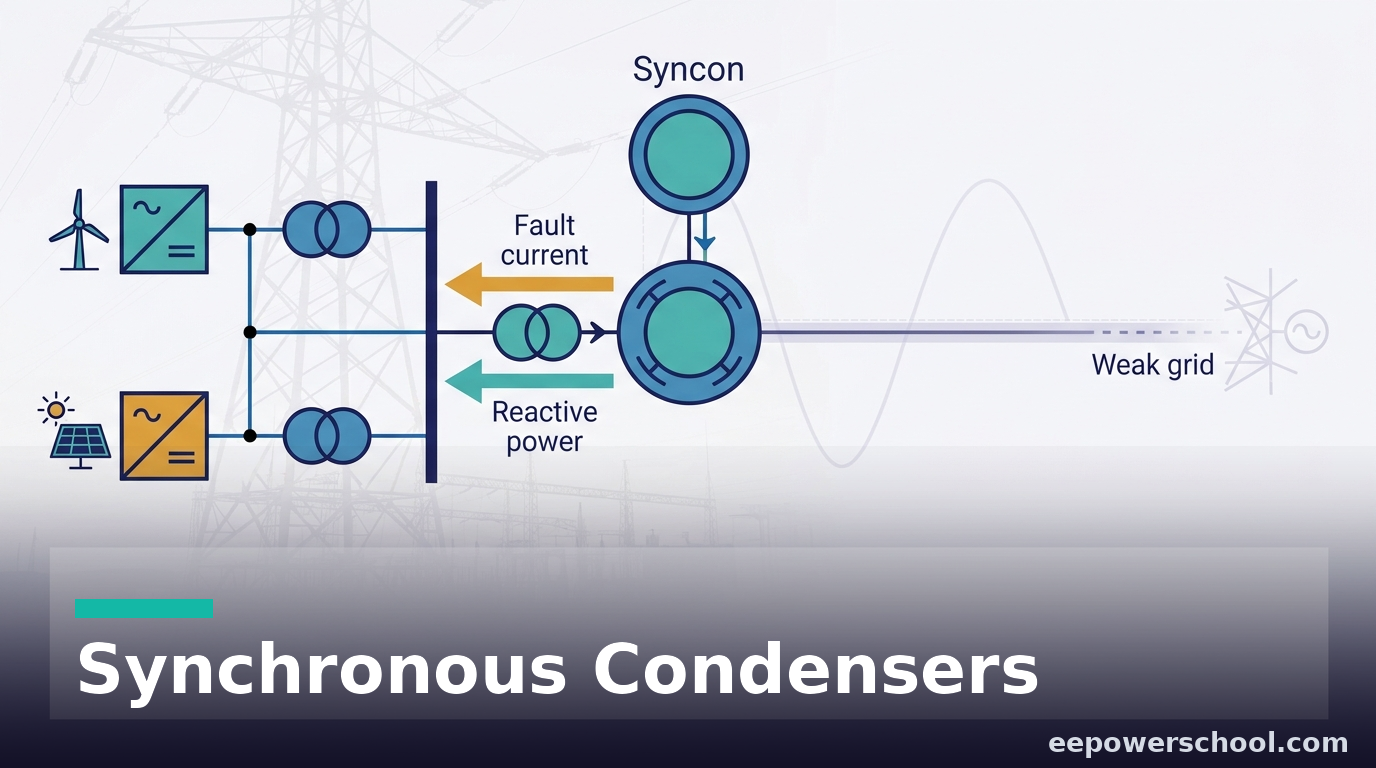
As coal and gas plants retire, they take something with them that nobody used to put a price on: system strength. A synchronous condenser is one of the most direct ways to put it back, a spinning machine that generates no energy at all yet quietly props up the grid that inverters depend on.
It is an old technology having a strong second act. Utilities in South Australia, Great Britain and Texas are spending real money installing new ones, sometimes paired with flywheels, specifically to keep IBR-rich corners of their networks stable. This post explains what a synchronous condenser actually does, works through how much it lifts the short-circuit ratio at a connection point, and looks at where the real installations sit and why.
What System Strength Really Is
System strength is the grid’s ability to hold a steady voltage waveform when something nearby switches, faults, or swings. It has two coupled parts: a high fault level (the available three-phase short-circuit MVA at a point) and a stiff voltage angle that does not lurch around when a device injects or pulls current. Engineers usually express it through the short-circuit ratio (SCR) at a connection point.
Grid-following inverters need that stiffness. They track the grid voltage with a phase-locked loop, so in a soft, low-fault-level grid their own current injection moves the very voltage they are trying to follow, and the control can go unstable. As synchronous machines leave, fault levels drop, SCR falls, and the inverters you keep adding make the reference softer still. That is the gap a synchronous condenser is built to fill.
What a Synchronous Condenser Is
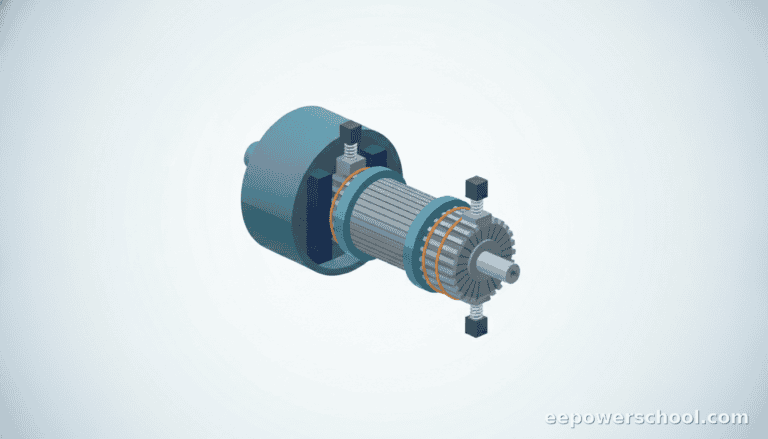
Mechanically, a synchronous condenser is a synchronous machine with the prime mover removed. There is no turbine, no fuel, no net energy production. It free-spins in synchronism with the grid, and the only thing the operator controls is its field excitation. Strip away the generation function and what remains are exactly the grid-support services a machine provides inherently:
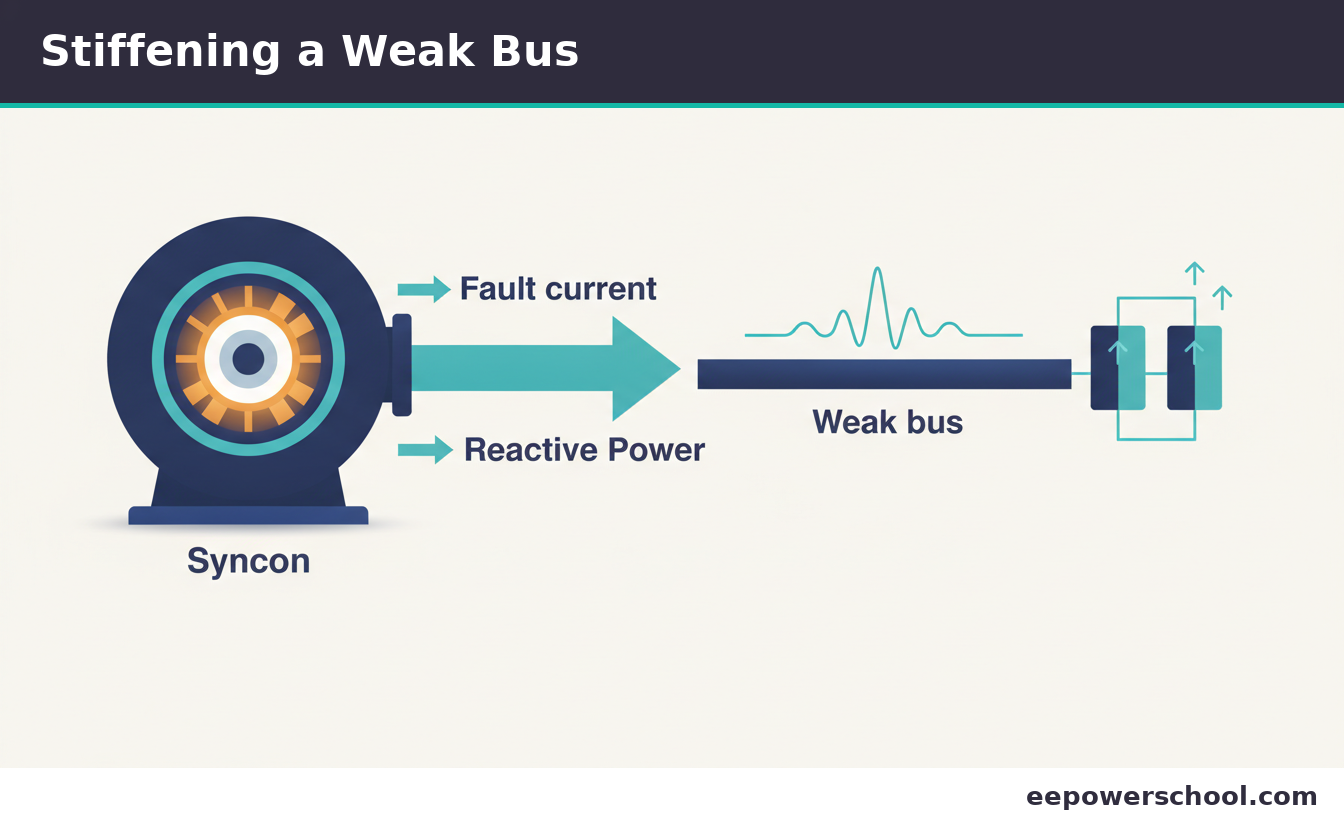
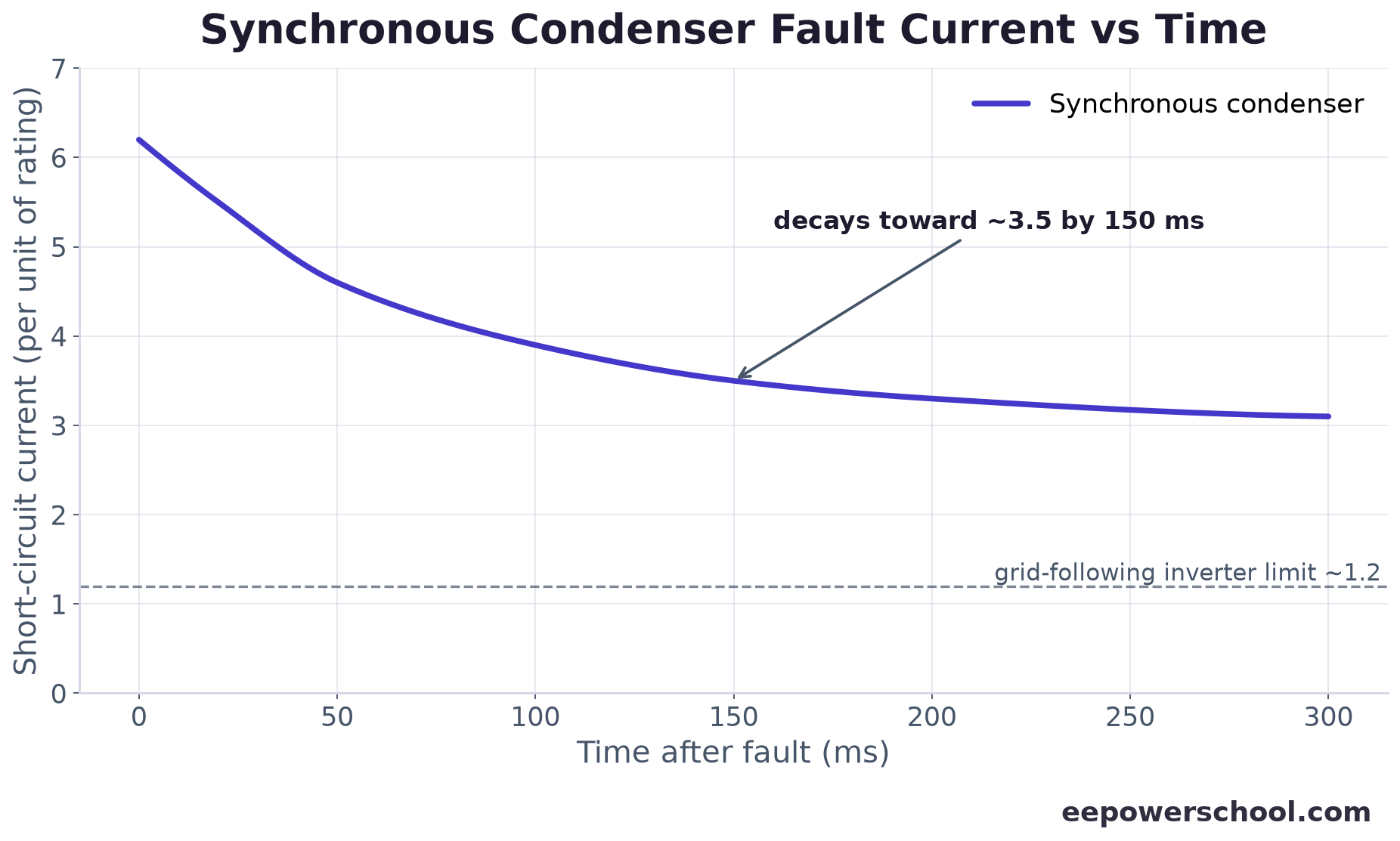
- Fault current. It is a true rotating voltage source behind a low subtransient reactance, so it dumps real short-circuit current into a nearby fault, on the order of 5 to 6 times rated, decaying over the first cycles. That is what raises the fault level.
- Reactive power. By over- or under-exciting the field, it supplies or absorbs VARs continuously to hold voltage, with strong short-term field forcing during disturbances.
- Inertia. Its rotating mass stores kinetic energy that resists frequency change, just like a generator rotor.
So a synchronous condenser delivers fault current, reactive support and inertia, the three services an inverter struggles to fully replicate, in one rotating package.
How Much SCR Does It Buy You? A Worked Example
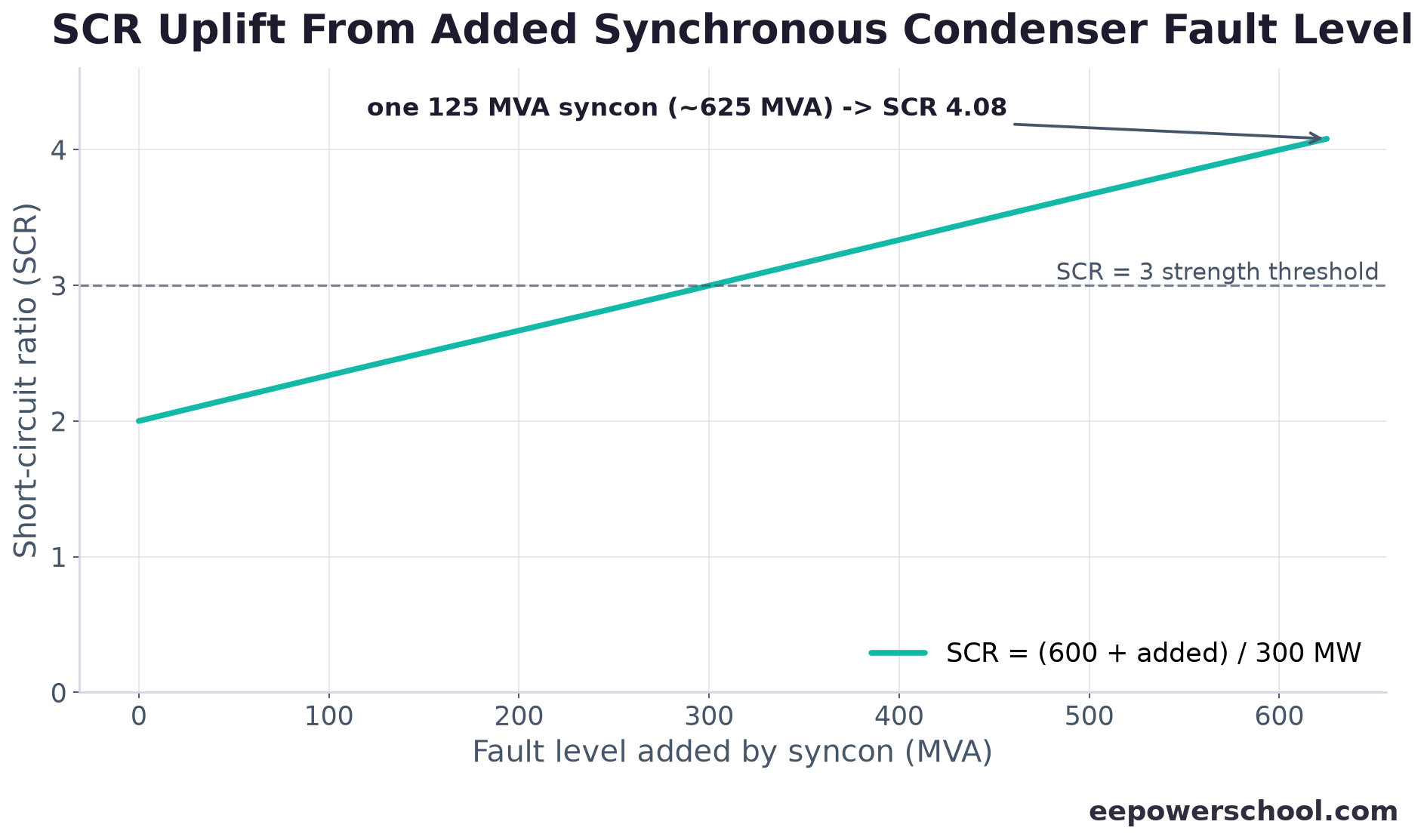
This is the calculation that justifies the capital. Suppose a connection point has a three-phase fault level of \( S_\mathrm{sc} = 600 \) MVA and hosts an IBR plant of \( P_\mathrm{IBR} = 300 \) MW. The short-circuit ratio is:
\[ \mathrm{SCR} = \frac{S_\mathrm{sc}}{P_\mathrm{IBR}} = \frac{600}{300} = 2.0 \]
That is a weak grid, below the SCR of 3 that operators like AEMO commonly require for stable grid-following operation. Now add a single synchronous condenser rated 125 MVA, the same size as the units installed in South Australia. A synchronous machine contributes short-circuit power of roughly 5 times its rating in the subtransient window, so the added fault level is:
\[ \Delta S_\mathrm{sc} = 5 \times 125 = 625 \ \mathrm{MVA} \]
The new fault level becomes \( 600 + 625 = 1225 \) MVA, and the SCR rises to:
\[ \mathrm{SCR}_\mathrm{new} = \frac{1225}{300} = 4.08 \]
One machine took the connection from a problematic 2.0 to a comfortable 4.08, clearing the strength threshold with margin. The chart shows the SCR climbing as the added fault level grows. The contribution factor depends on the machine’s subtransient reactance, so treat 5 times as a sound design assumption, with the early peak nearer 6 times and decaying toward 3.5 times within about 150 ms, as the fault-decay chart illustrates.
Adding Inertia With a Flywheel
A bare synchronous condenser already has some inertia from its rotor, but operators who need a lot of inertia couple it to a flywheel. The flywheel multiplies the stored kinetic energy without changing the electrical machine, which is an elegant way to buy both system strength and inertia in one unit.
South Australia’s Robertstown machines are the textbook case: Siemens supplied synchronous condensers with flywheels that roughly triple the machine’s inertia, the first flywheel-coupled units the vendor had built. The economics are attractive because the same capital simultaneously raises fault level (for system strength), supplies reactive power (for voltage), and provides inertia (for frequency), three problems, one spinning mass. For a grid losing thermal plant on all three fronts at once, that bundling is exactly what makes the business case work.
Where They Are Actually Being Installed
This is happening at scale right now:
| Project | What was installed | Purpose |
|---|---|---|
| ElectraNet, South Australia | Four units (2×129 MVA Davenport, 2×125 MVA Robertstown with flywheels) | Close the state’s system-strength and inertia gap, including a 4,400 MWs minimum |
| National Grid ESO Stability Pathfinder (GB) | Multiple phases; Phase 3 awarded all 29 contracts to synchronous condensers | Procure inertia and short-circuit level as standalone services |
| ERCOT, West Texas | Six 345 kV sites recommended, about 2,100 MVA total | Strengthen an IBR-saturated region after Odessa-type IBR trips |
The common thread: each grid hit a wall where adding more inverters into a weak area was no longer safe, and a synchronous condenser, often the least-cost option found in the studies, was how they bought back the headroom. National Grid even ran competitive tenders treating stability as a market product, which is a notable shift in how the service is valued.
The Remediation Menu
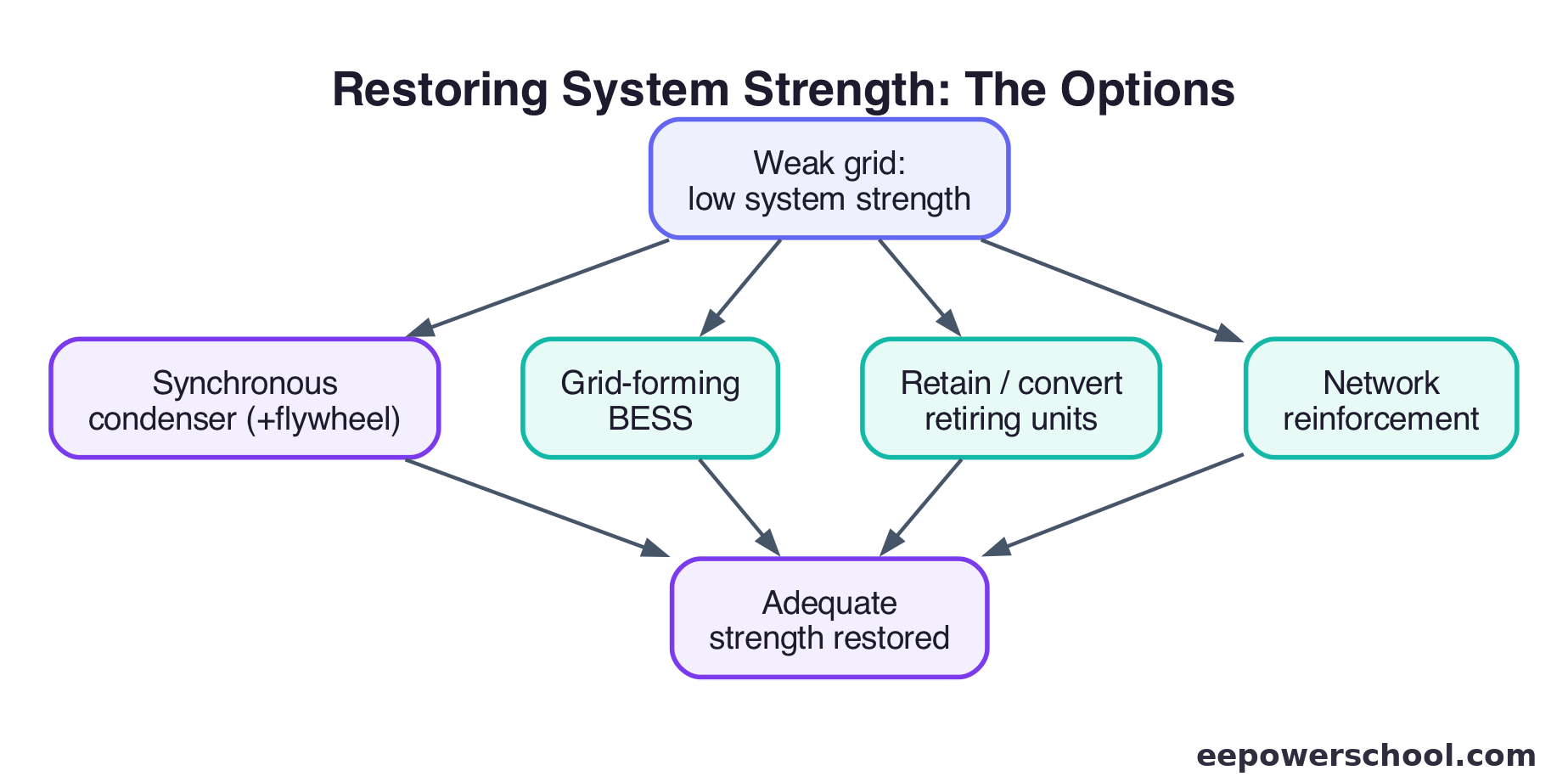
A synchronous condenser is the most direct fix, but it is not the only one, and the right choice is study-specific. The realistic options for restoring system strength are:
- Synchronous condensers, optionally flywheel-augmented, for fault level, reactive power and inertia in one device.
- Grid-forming BESS, which provide a voltage-source reference and synthetic strength, and were chosen for half of National Grid’s Pathfinder Phase 2.
- Retaining or synchronously converting retiring thermal units, running an old generator as a condenser to keep its strength online.
- Network reinforcement, adding lines or transformers to raise the fault level at the node directly.
In practice, a near-100% renewable grid often lands on a blend: mostly inverters, with a few synchronous condensers spinning to anchor strength and inertia. The condenser is not a step backward to fossil plant, it is a deliberate, fuel-free way to keep the rotating-machine services the grid still needs.
Conclusion
There is something satisfying about the synchronous condenser comeback. The cheapest, most robust way to integrate enormous amounts of inverter-based generation often turns out to involve a few large spinning machines that produce no power at all, just strength, voltage and inertia. It is a reminder that the grid does not care about ideology, it cares about fault current and a stiff voltage angle.
If you are sizing remediation for a weak connection, run the SCR numbers before reaching for the most exotic solution. A single well-placed synchronous condenser can move a connection point from unworkable to comfortable, and when the same unit also carries a flywheel, you solve the inertia problem in the same purchase. Old technology, new and very current job.
Key takeaways
- System strength is fault level plus a stiff voltage angle; grid-following inverters destabilise when it drops too low.
- A synchronous condenser is a synchronous machine with no prime mover, providing fault current, reactive power and inertia without burning fuel.
- Worked example: adding one 125 MVA synchronous condenser (about 625 MVA of fault level) lifts SCR at a connection point from 2.0 to 4.08.
- Its subtransient fault current peaks near 6 times rated and decays toward 3.5 times within about 150 ms; 5 times is a sound design figure.
- A flywheel triples the inertia of a synchronous condenser, bundling system strength, voltage support and inertia into one machine.
- Real fleets exist: four units in South Australia, multiple Stability Pathfinder phases in Great Britain, and about 2,100 MVA recommended in West Texas.
Frequently Asked Questions
What does a synchronous condenser do?
A synchronous condenser is a synchronous machine with no prime mover. It produces no net energy but provides fault current, continuously variable reactive power for voltage support, and inertia from its rotating mass. Those are exactly the grid-strength and stability services that inverters struggle to fully replicate as conventional plants retire.
How much does a synchronous condenser raise the short-circuit ratio?
It adds short-circuit power of roughly 5 times its rating. For a connection point at 600 MVA fault level hosting a 300 MW IBR plant (SCR 2.0), one 125 MVA condenser adds about 625 MVA, raising the fault level to 1225 MVA and the SCR to about 4.08, clearing the typical strength threshold of 3.
Why add a flywheel to a synchronous condenser?
The flywheel multiplies the stored kinetic energy, and so the inertia, without changing the electrical machine. South Australia's Robertstown units use flywheels that roughly triple inertia. It lets one machine deliver system strength, reactive support and a large inertia contribution together, which is efficient for a grid losing all three as thermal plant retires.
Is a synchronous condenser better than a grid-forming battery?
It depends on the study. Synchronous condensers give real fault current and inertia directly. Grid-forming batteries provide a voltage-source reference and can also deliver energy services. Operators use both: National Grid's Stability Pathfinder Phase 2 split contracts between grid-forming batteries and synchronous condensers, choosing by site need and cost.
Related reading
- The future of the electric grid with renewable and green energy
- Single line diagram of a power system
- Power system simulation using PSS/E
- Electrical Engineering Formula Cheat Sheet (power systems quick reference)